Place value (AQA GCSE Maths): Revision Notes
📚Revision Notes
Place value
What is place value?
Place value refers to the worth of each digit in a number based on its position. The further left a digit is positioned, the greater its value becomes. Understanding place value helps you read, write, compare and order numbers correctly.
You can use a place value chart to help you understand and work with numbers more effectively.
Note
Place value is fundamental to understanding how our number system works. Each position in a number has a specific value, and this determines what the digit is actually worth in the overall number.
Understanding place value columns
Place value charts organise digits into columns, each representing a different value:
| Ten thousands | Thousands | Hundreds | Tens | Units |
|---|---|---|---|---|
| 10,000s | 1,000s | 100s | 10s | 1s |
Each column represents a specific value, and understanding this relationship is crucial for working with numbers effectively.
Important
Each column is worth ten times more than the column to its right. For example, the hundreds column is worth ten times more than the tens column.
Comparing numbers using place value
To compare numbers effectively, you need to work systematically through the place value columns:
- Start from the left - compare the highest place value first
- Work systematically - move right column by column
- Stop when you find a difference - the larger digit indicates the larger number
Example
Worked Example: Comparing Numbers
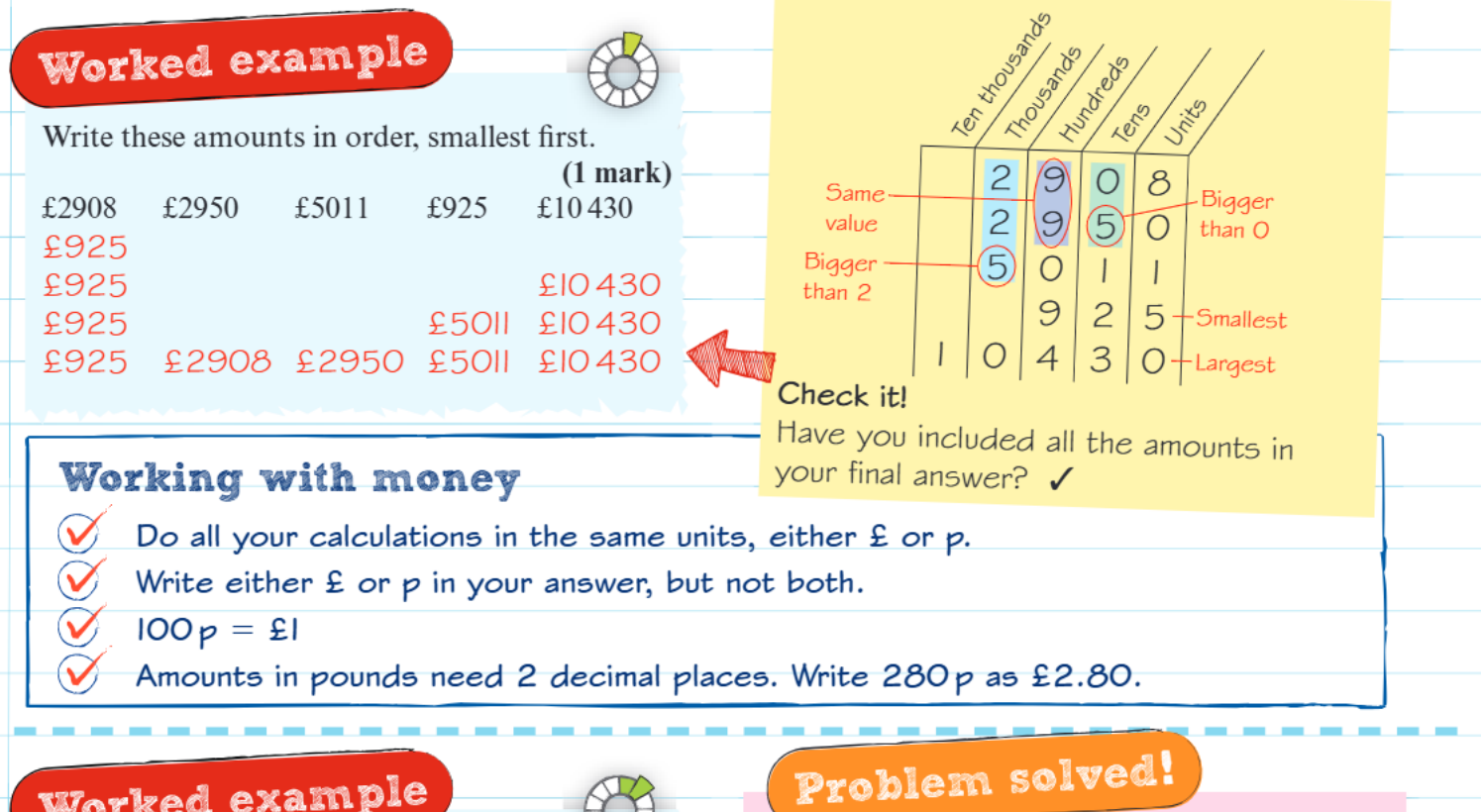
When comparing 2908 and 2950:
- Both have 2 in the thousands column (same value)
- Both have 9 in the hundreds column (same value)
- 2908 has 0 in the tens column, while 2950 has 5 in the tens column
- Since 5 > 0, we know 2950 > 2908
Ordering numbers from smallest to largest
When ordering multiple numbers, you apply the same systematic approach used for comparing, but you need to consider all numbers simultaneously:
- Compare systematically using place value columns
- Group numbers that start with the same digits
- Work through each column until you can determine the order
- Check your answer by ensuring all numbers are included
Example
Worked Example: Ordering Money Amounts
Order these amounts: £2908, £2950, £5011, £925, £10430
Step 1: Compare the highest place value digits
- £925 starts with 9 (hundreds)
- £2908, £2950 start with 2 (thousands)
- £5011 starts with 5 (thousands)
- £10430 starts with 1 (ten thousands)
Step 2: Order by place value The correct order is: £925, £2908, £2950, £5011, £10430
Working with money and place value
When working with monetary amounts, place value principles still apply, but there are additional rules you must follow to avoid common errors.
Important
Money Calculation Rules:
- Use consistent units - work in either pounds (£) or pence (p) throughout your calculations
- Don't mix currency symbols - write either £ or p in your answer, but never both
- Remember the conversion - 100p = £1
- Use correct decimal places - amounts in pounds need exactly 2 decimal places (e.g. write 280p as £2.80)
These rules help prevent errors and ensure your answers are clearly formatted.
Exam tips for place value questions
Success in place value questions requires both understanding the concepts and applying good exam technique.
Note
Essential Exam Techniques:
- Show your working clearly when ordering numbers
- Use place value charts if they help you organise your thinking
- Double-check that you've included all numbers in your final answer
- Be careful with money units - stick to one type throughout
- Read questions carefully to check if they want smallest first or largest first
Summary
Key Points to Remember:
- Place value depends on a digit's position - left digits are worth more
- Use place value charts to organise and compare numbers systematically
- When ordering numbers, start comparing from the leftmost column
- Keep money calculations in consistent units (£ or p, not both)
- Always double-check your final answers include all the original numbers