Problem-solving practice 1 (AQA GCSE Maths): Revision Notes
📚Revision Notes
Problem-solving practice 1
What is problem-solving in maths?
About half of the questions in your Foundation GCSE exam will require you to problem-solve, reason, interpret or communicate mathematically. When you encounter a tricky or unfamiliar question in your exam, having a toolkit of strategies will help you tackle it successfully.

These types of questions test your ability to apply mathematical knowledge to real-world situations and work through multi-step problems systematically.
Note
Problem-solving questions are designed to test deeper understanding rather than just memorised procedures. They often combine multiple mathematical concepts and require you to think creatively about how to approach unfamiliar scenarios.
Key problem-solving strategies
When you come across a challenging question, try these five essential strategies:
Important
Five Essential Problem-Solving Strategies:
- Sketch a diagram to see what is happening in the problem
- Try the problem with smaller or easier numbers first
- Plan your strategy before you start calculating
- Write down any formulae you might be able to use
- Use x or n to represent an unknown value
These strategies help you break down complex problems into manageable steps and avoid getting overwhelmed by difficult numbers or complicated scenarios. The key is to approach problems systematically rather than jumping straight into calculations.
Worked example 1: Money and place value
Example
Worked Example: Money and Place Value
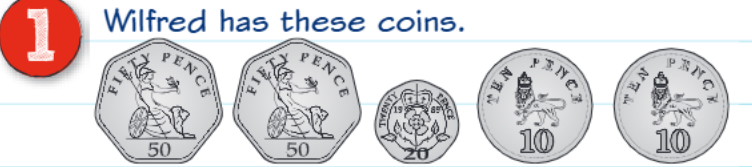
Problem: Wilfred has these coins shown above.

Nisha has these coins shown above.
Wilfred gives Nisha one coin. Wilfred now has twice as much money as Nisha. What value is the coin Wilfred gives to Nisha? (2 marks)
Understanding money problems
In money questions, you should decide whether you are going to work in pounds or pence. Don't mix up your units - this is a common mistake that can cost you marks.
Important
Key Point About Money Transfers: Remember that when Wilfred gives a coin to Nisha:
- His amount is reduced by that coin's value
- Nisha's amount is increased by that same value
Problem-solving approach
This type of problem requires you to set up equations and work backwards from the given condition.
Note
Top tip: With a question like this, it's easy to check your answer. Write down the amounts of money Wilfred and Nisha have after the exchange, and verify that Wilfred's total is exactly twice Nisha's total.
Worked example 2: Trip planning and costs
Example
Worked Example: Trip Planning and Costs

Problem: Liam is planning a trip for a group of 20 children and 5 adults. They can go to either the theatre or the zoo.
- If they go to the theatre, they will travel by train
- If they go to the zoo, they will travel by coach
Cost information
Theatre option:
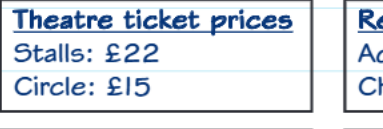
- Stalls: £22
- Circle: £15

- Adults: £11.50
- Child: £5.75
Zoo option:
- Adult: £18
- Child: £12
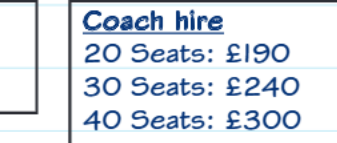
- 20 seats: £190
- 30 seats: £240
- 40 seats: £300
Question: What is the lowest possible total cost of the trip? You must show all your working. (5 marks)
Calculating total costs
Work out the total cost of each trip option. Remember to choose the cheapest ticket price for the theatre tickets, and write down all your working clearly.
Structuring your answer
For complex multi-step problems like this, organisation is key to earning full marks.
Note
Top tip: Plan how you will lay out your answer. You need to show what you are working out at each stage, so write short headings to go with your workings. You could use these headings:
- Cost of theatre trip
- Cost of zoo trip
- Conclusion
This helps the examiner follow your working and ensures you don't miss any important steps in your calculation.
Summary
Key Points to Remember:
- Use the five key problem-solving strategies when you encounter unfamiliar questions
- In money problems, stick to one unit (pounds or pence) throughout your working
- Always check your answers make sense in the context of the problem
- Show all your working clearly with helpful headings to guide the reader
- Plan your approach before diving into calculations