LCM and HCF (AQA GCSE Maths): Revision Notes
📚Revision Notes
LCM and HCF
What are LCM and HCF?
Understanding LCM and HCF is essential for working with numbers effectively. These concepts help us find relationships between different numbers and solve various mathematical problems.
LCM (Least Common Multiple) refers to the smallest number that can be divided by all the given numbers without leaving a remainder. Think of it as finding the smallest number that appears in the times tables of all your given numbers.
HCF (Highest Common Factor) is the largest number that can divide into all the given numbers exactly. It represents the biggest number that is a factor of all your given numbers.
Note
The key difference to remember: LCM finds the smallest common multiple, while HCF finds the largest common factor. They are essentially opposite operations!
Finding the LCM (Least Common Multiple)
Method 1: Listing multiples
When you need to find the LCM of two numbers, you can start by writing out the multiples of each number until you find the smallest one that appears in both lists.
Example
Worked Example: Finding LCM of 12 and 15
Step 1: List the multiples of each number
- Multiples of 12: 12, 24, 36, 48, 60, 72...
- Multiples of 15: 15, 30, 45, 60, 75...
Step 2: Identify the smallest common multiple The smallest number that appears in both lists is 60.
Therefore, LCM(12, 15) = 60
Method 2: Using prime factors
This method is particularly useful when dealing with larger numbers or when you already know the prime factorisation of the numbers.
Note
Steps for finding LCM using prime factors:
- Write down all the prime factors that appear in either of the numbers
- If a prime factor appears multiple times in one number, include it that many times
- Multiply all these factors together to get the LCM
Example
Worked Example: Finding LCM of 18 and 30
Step 1: Find prime factorisation
Step 2: Include all prime factors from either number Prime factors that appear in either number: 2, 3, 3, 5 (we take because it appears twice in 18)
Step 3: Calculate the LCM LCM =
Finding the HCF (Highest Common Factor)
Method 1: Listing factors
You can find the HCF by listing all the factors of each number and identifying the largest one that appears in both lists.
Example
Worked Example: Finding HCF of 36 and 54
Step 1: List all factors of each number
- Factors of 36: 1, 2, 3, 4, 6, 9, 12, 18, 36
- Factors of 54: 1, 2, 3, 6, 9, 18, 27, 54
Step 2: Identify the largest common factor The largest number that appears in both lists is 18.
Therefore, HCF(36, 54) = 18
Method 2: Using prime factors
This method involves identifying the prime factors that are common to both numbers.
Note
Steps for finding HCF using prime factors:
- Identify all prime factors that appear in both numbers
- Multiply these common prime factors together to find the HCF
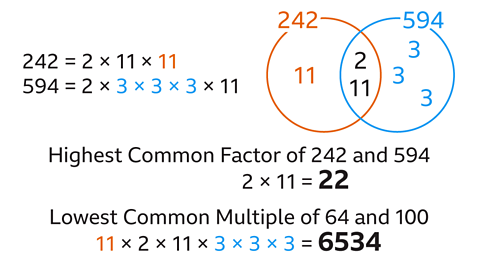 Choosing the right method
Both methods work effectively, but the listing method tends to be simpler for smaller numbers, while the prime factorisation method becomes more practical for larger numbers. It's important to be comfortable with both approaches, as exam questions may specify which method to use or the numbers involved may make one method more suitable than the other.
Important
When using the prime factorisation method, remember the key difference:
- For LCM: take ALL prime factors from EITHER number
- For HCF: take only prime factors that appear in BOTH numbers
Summary
Key Points to Remember:
- LCM is the smallest number that all given numbers divide into exactly
- HCF is the largest number that divides into all given numbers exactly
- For LCM using prime factors: include all factors from either number
- For HCF using prime factors: include only factors common to both numbers
- Both methods (listing and prime factorisation) will give you the same answer