3D Pythagoras (AQA GCSE Maths): Revision Notes
📚Revision Notes
3D Pythagoras
Introduction to 3D Pythagoras
The 3D Pythagoras theorem extends the familiar 2D version that you already know. Instead of working with flat shapes, you can now find distances through three-dimensional objects like boxes and pyramids. You only need to remember one key formula, and once you master it, you'll be able to tackle any 3D distance problem.
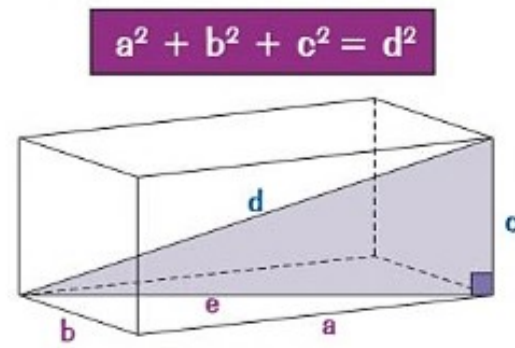
The main formula for finding the space diagonal in a cuboid (a 3D rectangular box) is:
Note
Understanding the Variables:
- , , and are the three dimensions of the cuboid
- is the space diagonal (the longest possible distance inside the shape)
How the formula works
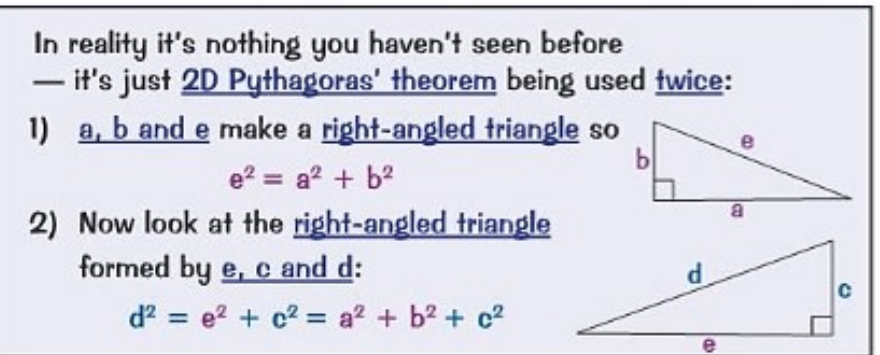
This concept builds on what you already know about right-angled triangles. The 3D formula is actually just the 2D Pythagoras theorem being applied twice in succession.
Example
Step-by-Step Breakdown:
Step 1: First, you create a right-angled triangle using two sides of the base ( and ) to find the diagonal across the base ():
Step 2: Then you form another right-angled triangle using this base diagonal () and the height () to find the space diagonal ():
When you substitute the first equation into the second, you get:
Working with cubes
Let's look at how to find the space diagonal of a cube. Since all sides of a cube are equal, this makes the calculation straightforward.
Example
Worked Example: Finding the Space Diagonal
Find the exact length of diagonal BH in a cube with 4cm sides.
Step 1: Write down the formula:
Step 2: Substitute the values:
Step 3: Calculate:
Step 4: Take the square root: cm
Using the formula with other 3D shapes
The cuboid formula can be adapted for other three-dimensional shapes, not just rectangular boxes. The key is to visualise the problem as if you're working with a cuboid.
Example
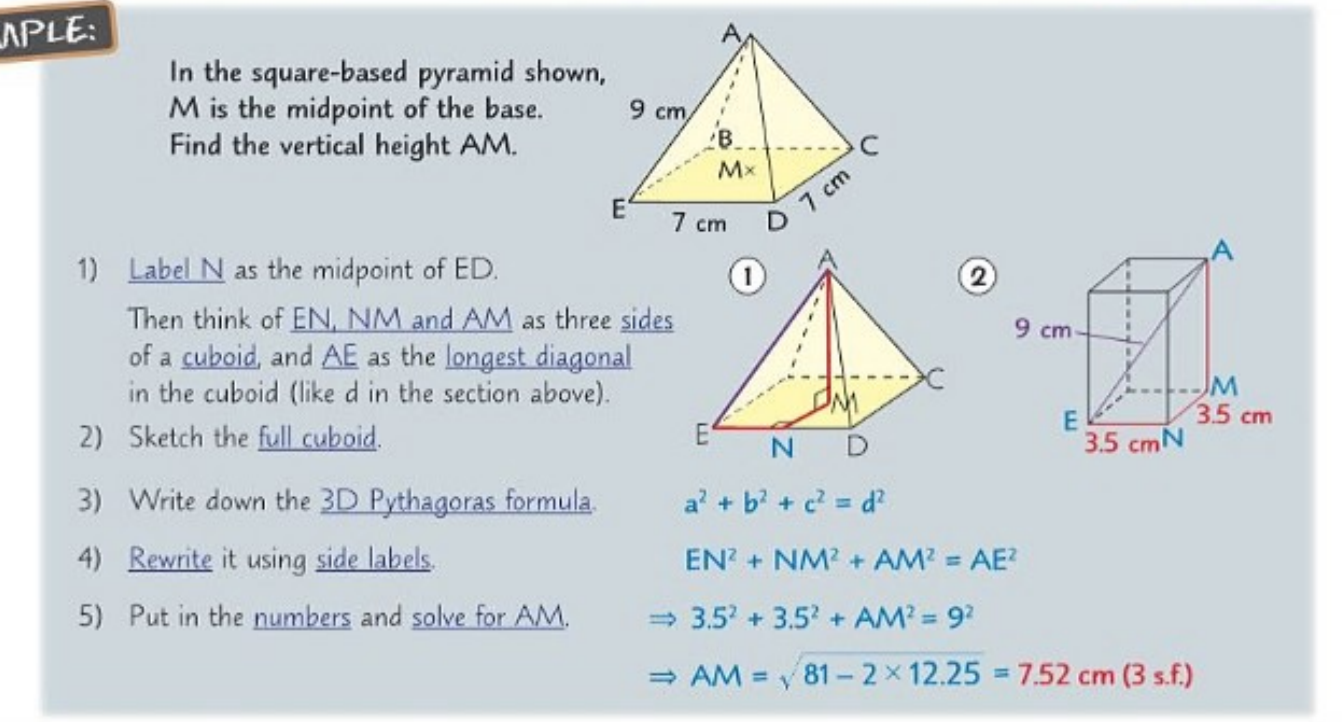
Worked Example: Finding the Vertical Height of a Square-Based Pyramid
For a square-based pyramid where M is the midpoint of the base:
Step 1: Label the key point as the midpoint of the base edge
Step 2: Think of the problem as three sides of a cuboid, where the pyramid's slant edge becomes the space diagonal
Step 3: Sketch the full cuboid to visualise the problem clearly
Step 4: Apply the 3D Pythagoras formula:
Step 5: Substitute using appropriate labels and solve for the unknown height
In this case:
- cm
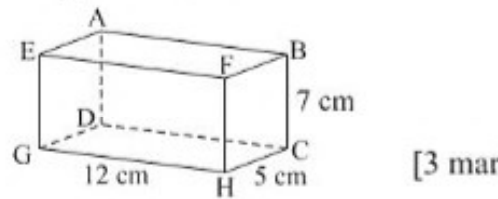
Practice problems
Note
Exam Strategy Tips:
When tackling exam questions, remember to:
- Identify which measurements you have and which you need to find
- Set up the formula correctly with the given dimensions
- Show all your working clearly
- Give your answer to the required number of significant figures
The 3D Pythagoras theorem is a powerful tool that works for any situation where you need to find distances through three-dimensional space, whether it's the diagonal of a box, the height of a pyramid, or the distance between two points in 3D coordinates.
Important
Critical Understanding: The 3D Pythagoras theorem isn't just limited to perfect cuboids - it can be applied to any 3D problem by thinking of it as a cuboid situation. This flexibility makes it one of the most useful tools in 3D geometry.
Summary
Key Points to Remember:
- The 3D Pythagoras formula is where is the space diagonal
- It's just the 2D Pythagoras theorem applied twice - nothing completely new!
- You can use this formula for any 3D shape by thinking of it as a cuboid problem
- Always identify your three dimensions clearly before substituting into the formula
- The space diagonal is always the longest possible distance inside a 3D shape