Trigonometry — Common Values (AQA GCSE Maths): Revision Notes
📚Revision Notes
Trigonometry — Common values
Why learn common trigonometric values?
Understanding common trigonometric values is essential for GCSE mathematics success. These special angles appear frequently in exam questions, and knowing their exact values will make calculations much quicker and more accurate. Most importantly, you'll need these values for non-calculator exam sections, so memorising them is crucial.
Note
Learning these exact values by heart will give you a significant advantage in your GCSE mathematics exam, especially in the non-calculator paper where these values frequently appear.
The two reference triangles
To help you remember the trigonometric values, you can use two special right-angled triangles. These triangles contain the angles 30°, 60°, and 45°, and their side lengths follow predictable patterns.
The 30-60-90 triangle
This triangle has angles of 30°, 60°, and 90°. If the shortest side (opposite the 30° angle) has length 1, then the side opposite the 60° angle has length , and the hypotenuse has length 2.
The 45-45-90 triangle
This triangle has two equal angles of 45° and one right angle. If each of the two equal sides has length 1, then the hypotenuse has length .
By drawing these triangles and labelling their sides, you can work out all the trigonometric ratios using SOH CAH TOA.
Important
Master these two reference triangles! The 30-60-90 triangle and the 45-45-90 triangle are the foundation for remembering all common trigonometric values. Practice drawing them from memory until it becomes automatic.
Using SOH CAH TOA with common values
Remember that SOH CAH TOA tells us:
Using these ratios with our reference triangles, we can calculate all the common trigonometric values.
Important
SOH CAH TOA is your key tool This mnemonic is essential for selecting the correct trigonometric ratio. Always identify which sides you know and which you need to find before choosing your ratio.
Common trigonometric values table
Here are the exact values you need to memorise:
Note
Common Trigonometric Values to Memorise
For 30°, 45°, and 60°:
For 0° and 90°:
- ,
- ,
Note that you cannot work out using triangles - this value is undefined.
Worked example
Let's look at how to apply these common values in practice.
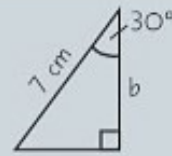
Example
Worked Example 1: Finding an exact length
Without using a calculator, find the exact length of side in the right-angled triangle with a 30° angle and hypotenuse of 7 cm.
Solution:
-
This is a right-angled triangle, so we use SOH CAH TOA to choose the correct trigonometric ratio.
-
We know the hypotenuse and want to find the adjacent side to the 30° angle, so we use cosine:
-
We know that , so we substitute this value:
-
Solving for :
Example
Worked Example 2: Proving an identity
Without using a calculator, show that
Solution:
-
Substitute the known values:
-
To add these fractions, we need a common denominator. We can rationalise :
-
Now we have:
-
Using common denominator 6:
-
Therefore:
Practice makes perfect
Try sketching the reference triangles whenever you're unsure about a trigonometric value in an exam. This method provides a quick way to check your work and ensures you're using the correct values.
Note
Exam Strategy Tip Drawing the reference triangles in your exam can help you verify your trigonometric values and catch any errors before making calculations. This technique is especially valuable in non-calculator questions.
Summary
Key Points to Remember:
- Master the two reference triangles (30-60-90 and 45-45-90) to remember all common values
- , and
- , which makes sense since the opposite and adjacent sides are equal
- For 0° and 90°, remember that and , while and
- Always rationalise denominators when working with surds in your final answers
- Use SOH CAH TOA to select the correct trigonometric ratio for each problem