Trigonometry — Examples (AQA GCSE Maths): Revision Notes
📚Revision Notes
Trigonometry examples
Learning to solve trigonometry problems becomes much easier when you follow a consistent step-by-step approach. This revision note will guide you through three different types of trigonometry problems using the SOH CAH TOA method.
The key to mastering trigonometry is understanding that every problem follows the same logical process - identify what you know, determine what you need to find, and choose the appropriate trigonometric ratio.
Understanding SOH CAH TOA
Before diving into examples, you need to have the fundamental trigonometric ratios firmly in your memory. These ratios are the foundation of all trigonometry problems.
Note
SOH CAH TOA is your essential memory tool for trigonometry:
- SOH:
- CAH:
- TOA:
The key to success is identifying which sides and angles you know, and which trigonometric ratio will help you find what you're looking for.
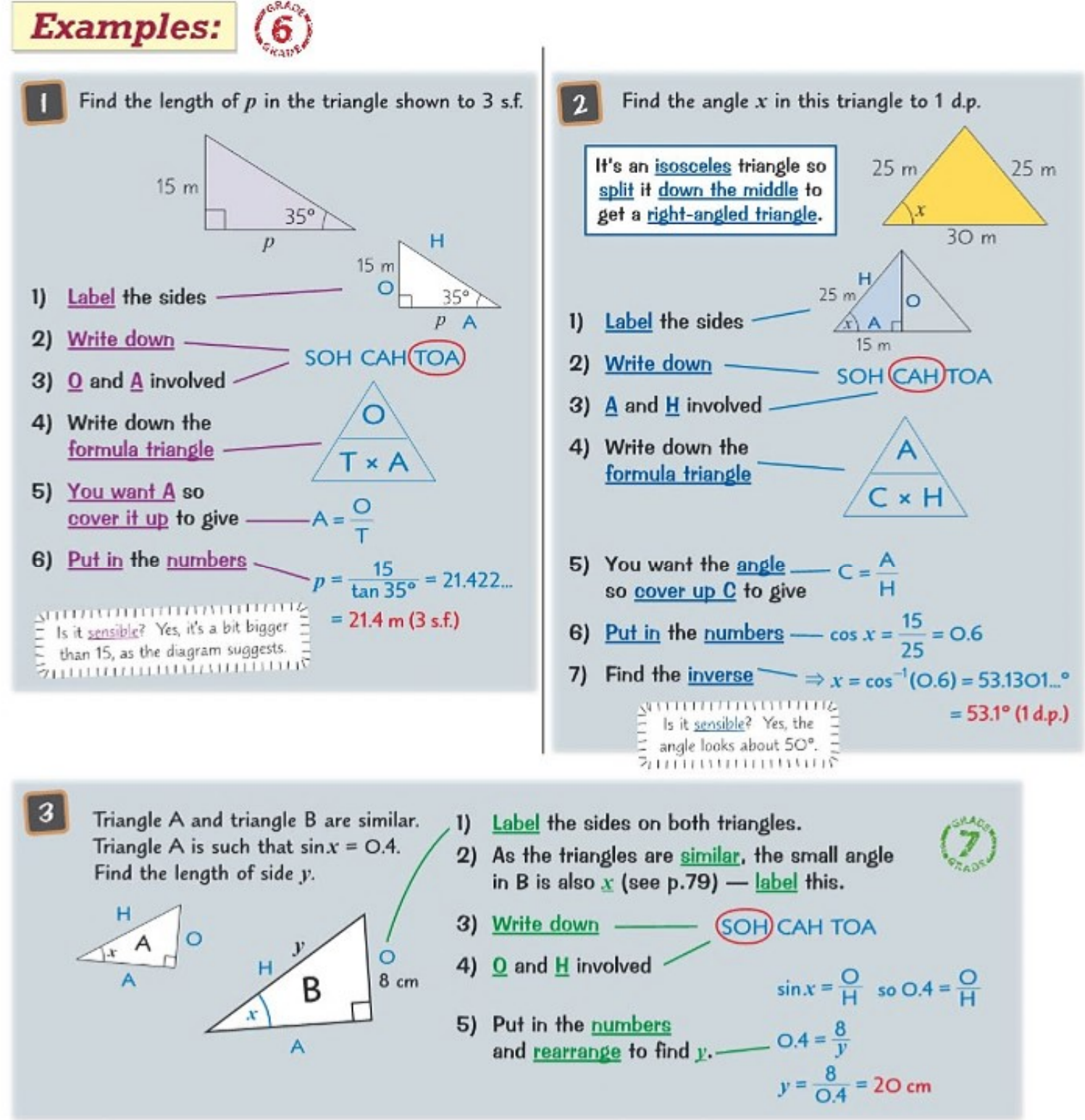
Example 1: Finding a missing side using tangent
When you need to find a missing side and you know an angle plus another side, trigonometry is your best friend. Let's work through finding the length of side p in a right triangle.
Given information:
- Right triangle with a angle
- Adjacent side = metres
- Need to find: opposite side (p)
Example
Worked Example: Finding a missing side using tangent
Step 1: Label the sides Identify which sides are opposite, adjacent, and hypotenuse relative to the given angle.
Step 2: Choose the right ratio Since we have the adjacent side and want the opposite side, we use TOA (tangent).
Step 3: Write the formula
Step 4: Rearrange to find p
Step 5: Calculate
Step 6: Round appropriately
Example 2: Finding a missing angle using cosine
Sometimes you'll encounter an isosceles triangle where you need to find an angle. The essential trick is to split it into a right triangle first, as trigonometry only works directly with right triangles.
Given information:
- Isosceles triangle with two sides of metres each
- Base = metres
- Need to find: angle x
Example
Worked Example: Finding a missing angle using cosine
Step 1: Split the triangle Draw a line from the apex to the base, creating two identical right triangles.
Step 2: Label the sides In the right triangle: adjacent = m, hypotenuse = m
Step 3: Choose the right ratio Since we have adjacent and hypotenuse, we use CAH (cosine).
Step 4: Write the formula
Step 5: Find the angle
Step 6: Round appropriately
Important
When finding angles, always remember to use the inverse trigonometric functions (, , ) to work backwards from the ratio to the angle.
Example 3: Similar triangles and trigonometry
When working with similar triangles, the trigonometric ratios remain the same. This property helps us solve problems involving proportional relationships.
Given information:
- Triangle A and Triangle B are similar
- In Triangle A:
- In Triangle B: one side = cm
- Need to find: length of side y
Example
Worked Example: Similar triangles and trigonometry
Step 1: Use the similarity property Since the triangles are similar, the same angle x appears in both triangles.
Step 2: Apply the sine ratio In Triangle B:
Step 3: Use the known value Since , we have:
Step 4: Solve for y
Working with alternative methods
If you find the formula triangle method challenging, you can always work directly with the original trigonometric formulas. Both approaches will give you the same answer - choose the one that makes more sense to you.
Note
Some students prefer to memorise the basic ratios and substitute values directly, while others find the triangle method more visual and easier to follow. The most important thing is to use the method that helps you understand the problem clearly and avoid calculation errors.
Summary
Key Points to Remember:
- Always start by labelling the sides of your triangle relative to the angle you're working with
- SOH CAH TOA helps you choose the correct trigonometric ratio for your problem
- When finding angles, use the inverse functions (, , )
- In isosceles triangles, splitting them into right triangles makes trigonometry problems much easier
- Similar triangles have the same trigonometric ratios, which is incredibly useful for solving proportional problems
- Show all your working steps and round your final answer appropriately