Trigonometry — Sin, Cos, Tan (AQA GCSE Maths): Revision Notes
📚Revision Notes
Trigonometry — Sin, Cos, Tan
Introduction to trigonometry
Trigonometry might sound intimidating, but it's actually a very useful mathematical tool that helps us work with right-angled triangles. The word itself comes from Greek, meaning "triangle measurement". While it's an important topic that appears frequently in exams, it's definitely not something to be afraid of - it just takes a bit of practice to master!
The three fundamental trigonometry formulas
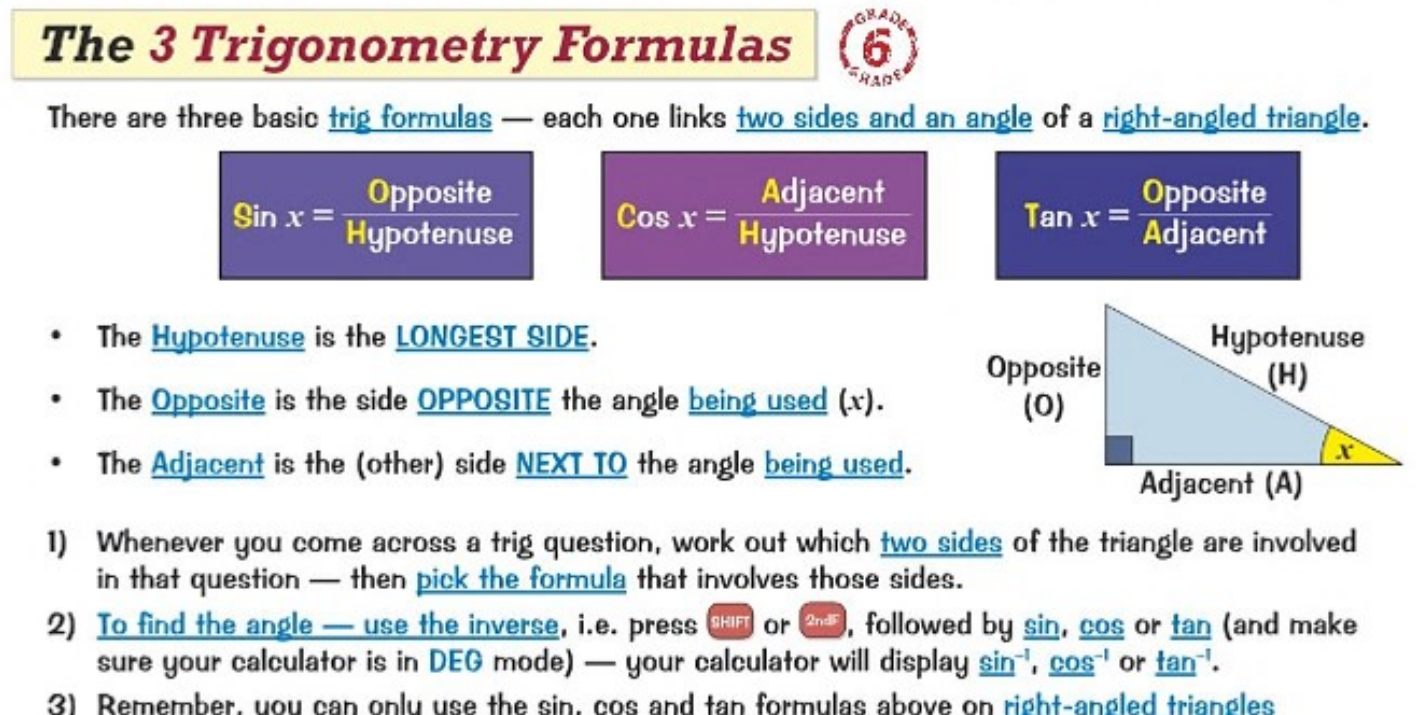 There are three essential trigonometry formulas that form the foundation of all trigonometric calculations. Each formula connects two sides of a right-angled triangle with an angle:
Important
The Three Fundamental Trigonometry Formulas:
Sine (sin) - This ratio compares the opposite side to the hypotenuse
Cosine (cos) - This ratio compares the adjacent side to the hypotenuse
Tangent (tan) - This ratio compares the opposite side to the adjacent side
These formulas only work with right-angled triangles, so you may need to add construction lines to create a right angle if one isn't already present in your diagram.
Understanding the sides of a right-angled triangle
Before you can use trigonometry effectively, you need to identify the three sides of any right-angled triangle:
Note
The hypotenuse is always the longest side of the triangle. It's the side that sits opposite the right angle (90°), and it never changes regardless of which angle you're focusing on.
Note
The opposite side is the side that sits directly across from the angle you're working with. This side changes depending on which angle you're considering in your problem.
Note
The adjacent side is the side that sits next to the angle you're working with (but it's not the hypotenuse). Like the opposite side, this changes depending on which angle you're focusing on.
Step-by-step approach to solving trigonometry problems
When you encounter a trigonometry question, follow these systematic steps:
Note
Systematic Problem-Solving Steps:
-
Identify the sides involved - Work out which two sides of the triangle are mentioned in the question, then select the appropriate formula that connects those sides.
-
Finding an angle - If you need to find an angle, use the inverse function on your calculator. Press the inverse button followed by sin, cos, or tan. Make sure your calculator is set to DEG (degrees) mode, and your calculator will show sin⁻¹, cos⁻¹, or tan⁻¹.
-
Check your triangle - Remember that these formulas only work on right-angled triangles. If your triangle doesn't have a right angle, you may need to add construction lines to create one.
The formula triangle method (SOH CAH TOA)
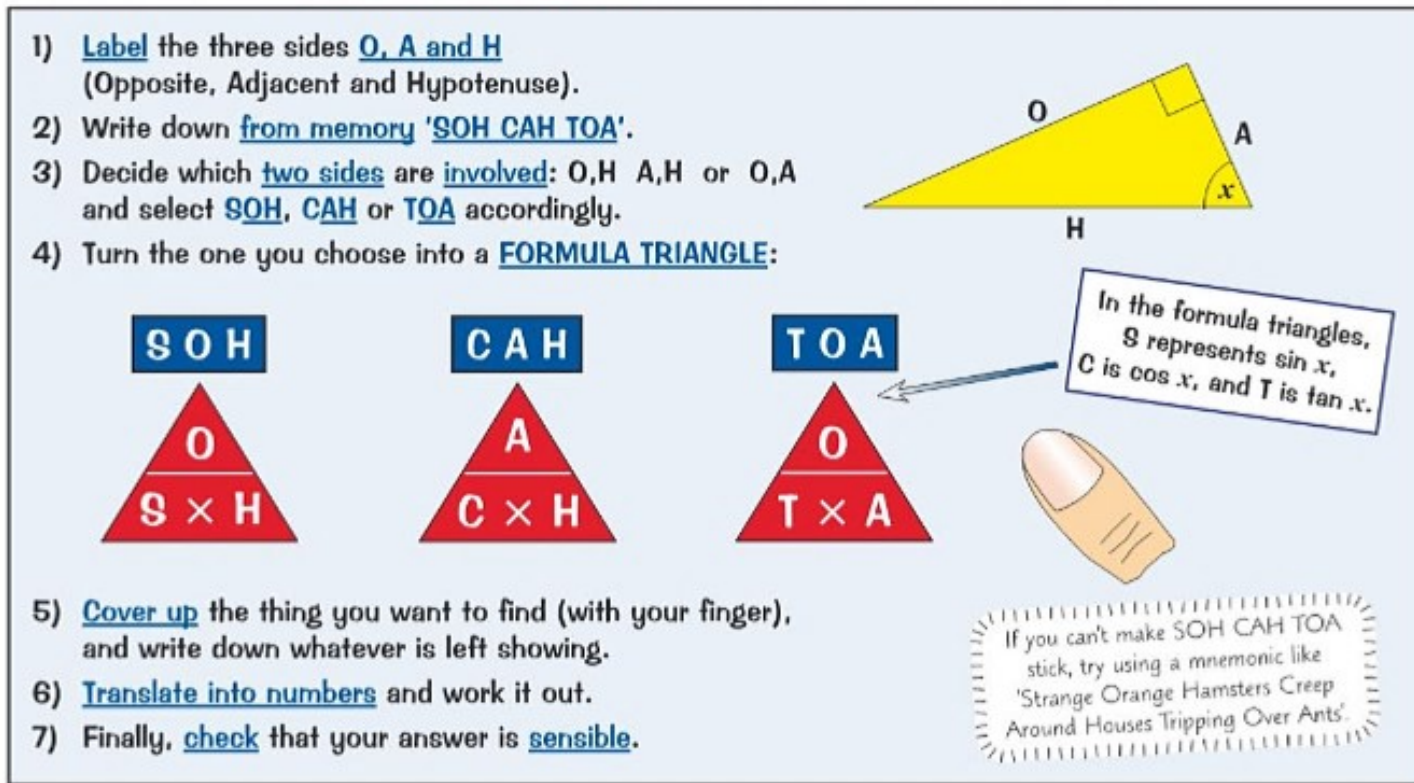 A particularly helpful technique for tackling trigonometry problems is the formula triangle method, which uses the famous mnemonic SOH CAH TOA:
Important
Sin = Opposite ÷ Hypotenuse
Cos = Adjacent ÷ Hypotenuse
Tan = Opposite ÷ Adjacent
Here's how to use this method effectively:
- Label your triangle - Mark the three sides as O (opposite), A (adjacent), and H (hypotenuse) based on the angle you're working with.
- Recall SOH CAH TOA - Write this mnemonic down from memory to help you remember the formulas.
- Identify the sides - Determine which two sides are involved in your problem (for example, O and H, or A and H, or O and A).
- Create your formula triangle - Choose the appropriate triangle (SOH, CAH, or TOA) and draw it out.
- Cover the unknown - Use your finger to cover the value you want to find in the triangle, and the remaining visible parts show you the calculation needed.
- Calculate - Substitute the known values and work out your answer.
- Check your answer - Always verify that your final answer makes sense in the context of the problem.
Using inverse functions for finding angles
When you need to find an angle rather than a side length, you'll use the inverse trigonometric functions. These are the same formulas, but rearranged to solve for the angle instead of the side. On your calculator, these appear as sin⁻¹, cos⁻¹, and tan⁻¹. Always ensure your calculator is in DEG mode when working with these functions.
Memory aids for SOH CAH TOA
While SOH CAH TOA is the most common way to remember these formulas, there are several creative phrases that can help you memorise it:
Note
Creative Memory Phrases for SOH CAH TOA:
- "Some Old Hippie Caught Another Hippie Tripping On Acid"
- "Strange Orange Hamsters Create Amazing Healthy Tonic Over Ants"
Choose whichever phrase works best for you, or create your own memorable version!
Remember!
Summary
Key Points to Remember:
- SOH CAH TOA is your best friend - memorise this mnemonic and the three formulas it represents
- The hypotenuse is always the longest side and sits opposite the right angle
- Opposite and adjacent sides change depending on which angle you're focusing on
- Use inverse functions (sin⁻¹, cos⁻¹, tan⁻¹) when you need to find an angle
- Formula triangles make calculations easier - cover what you want to find and calculate what remains visible