Percentage change 2 (AQA GCSE Maths): Revision Notes
📚Revision Notes
Percentage change 2
What is percentage change without a calculator?
Percentage change involves calculating increases or decreases without using a calculator. You need to be able to work out percentages mentally using your knowledge of multiples and division.
The key skill is understanding whether to add to or subtract from the original amount depending on whether it's an increase or decrease.
Mental calculation methods
Using multiples of 1% and 10%
You can break down any percentage using multiples of 1% and 10% to make calculations easier.
Note
Key steps for mental calculation:
- Work out 10% by dividing by 10
- Work out 1% by dividing by 100
- Work out 0.5% by dividing 1% by 2
- Add these components together
Example
Worked Example: Finding 12.5% of £600
Step 1: Calculate the components
- 10% of £600 = £60 (600 ÷ 10)
- 1% of £600 = £6 (600 ÷ 100)
- 0.5% of £600 = £3 (£6 ÷ 2)
Step 2: Add components together 12.5% = 10% + 1% + 1% + 0.5% = £60 + £6 + £6 + £3 = £75
Step-by-step process
Important
For percentage increases:
- Work out the percentage of the original amount
- Add this to the original amount
For percentage decreases:
- Work out the percentage of the original amount
- Subtract this from the original amount
Worked example: Television comparison
Example
Worked Example: Television Price Comparison
Problem: Which television is cheaper?
- Television A: £440 + 20% VAT
- Television B: £550 with 15% off
Television A calculation:
- 10% of £440 = £44
- 20% of £440 = £88 (2 × £44)
- Final price: £440 + £88 = £528
Television B calculation:
- 10% of £550 = £55
- 5% of £550 = £27.50 (half of 10%)
- 15% of £550 = £82.50 (10% + 5%)
- Final price: £550 - £82.50 = £467.50
Answer: Television B is cheaper at £467.50
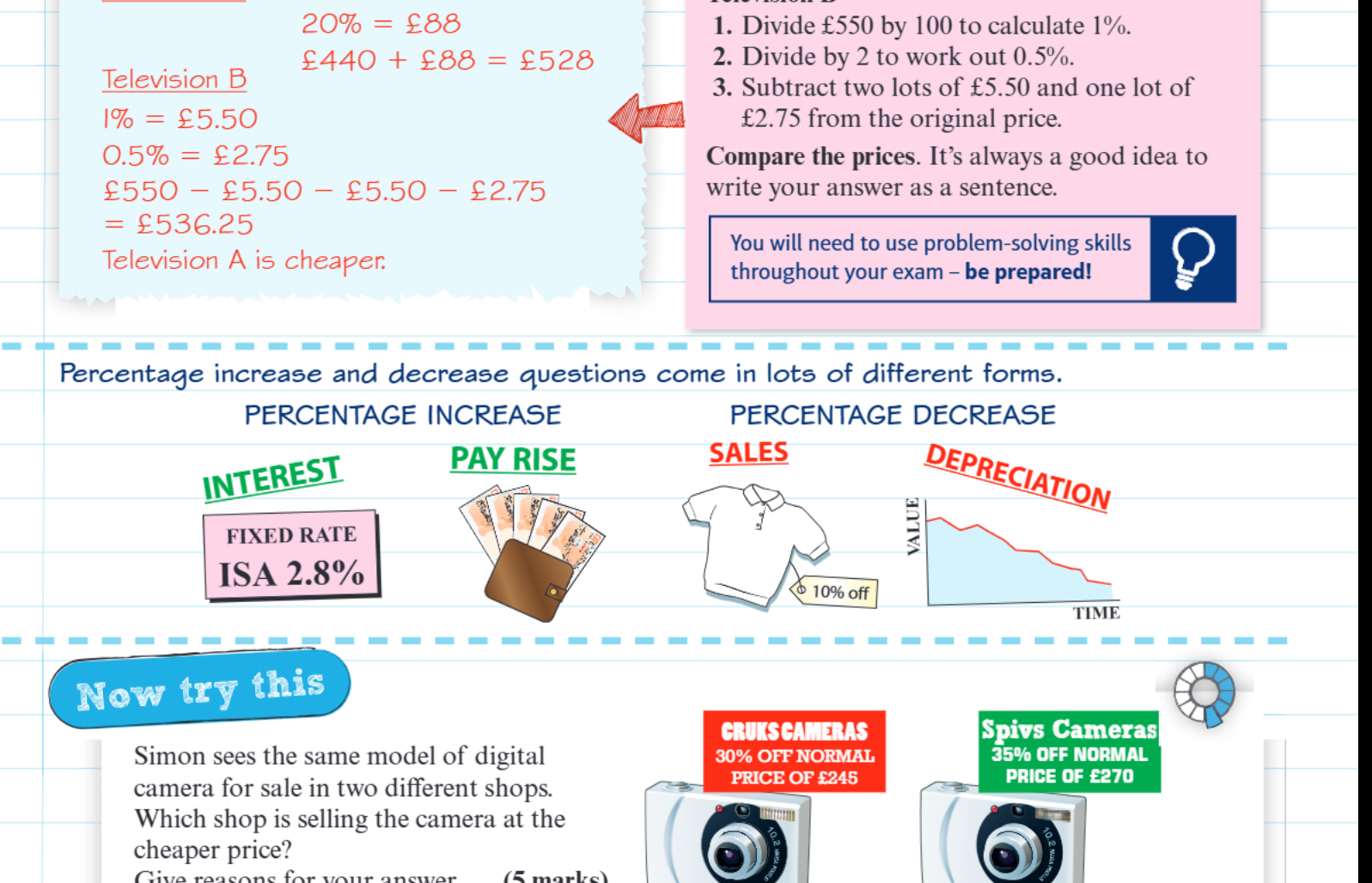
Types of percentage problems
Understanding the context helps you determine whether to add or subtract the percentage.
Percentage increases:
- Interest on savings accounts
- Pay rises for employees
- VAT added to prices
Percentage decreases:
- Sales discounts on items
- Depreciation of value over time
- Reductions in prices
Note
Remember that increases make amounts larger, while decreases make amounts smaller. This can help you check if your calculation method is correct.
Exam tips
Important
Essential exam strategies:
Show your working: Always display all calculation steps clearly to gain full marks.
Use correct units: Make sure your final answer includes the appropriate currency or units.
Write a conclusion: State your final answer in a complete sentence for comparison questions.
Problem-solving skills: These questions test your ability to apply percentage knowledge to real situations.
Remember!
Summary
Key Points to Remember:
- Break down percentages using multiples of 1% and 10% for easier mental calculation
- Add the percentage to the original amount for increases, subtract for decreases
- Show all working clearly in exam questions to gain maximum marks
- Check your answer makes sense - increases should give larger amounts, decreases should give smaller amounts
- Practice different contexts like interest, discounts, and VAT to prepare for various question types