Problem-solving practice 1 (AQA GCSE Maths): Revision Notes
📚Revision Notes
Problem-solving practice 1
Problem-solving strategies for your exam
About half of the questions in your Foundation GCSE exam will require you to problem-solve, reason, interpret or communicate mathematically. When you encounter a tricky or unfamiliar question, you can use these proven strategies to help you tackle it successfully.
Five key problem-solving strategies
These approaches will help you break down complex problems and find your way to the solution:
- Sketch a diagram to visualise what is happening in the problem
- Try the problem with smaller or easier numbers to understand the process
- Plan your strategy before you begin calculating
- Write down any formulae you might be able to use
- Use x or n to represent unknown values
Important
These five strategies are your toolkit for tackling unfamiliar problems. Don't skip the planning stage - it's often the difference between success and confusion in your exam.
Worked examples

Example
Worked Example 1: Counter Problem
Problem: A bag contains green, red and blue counters. 20% of the counters are green. There are three times as many red counters as blue counters. There are 9 blue counters in the bag. How many counters are there in the bag in total?
Solution approach: This problem involves percentages and ratios. We need to work systematically through the given information.
Step 1: Find the number of red counters
- Blue counters = 9
- Red counters = counters
Step 2: Find the total of red and blue counters
- Red and blue together = counters
Step 3: Use the percentage information Since green counters make up 20% of the total, red and blue counters represent 80% of the total.
Step 4: Calculate the total number of counters
- If 36 counters = 80% of the total
- Then the total = counters
Answer: There are 45 counters in the bag in total.

Note
Top tip: You can sometimes solve percentage problems by working out what 1% represents and then multiplying by 100.

Example
Worked Example 2: Trainer Shopping Comparison
Problem: Suresh wants to buy a new pair of trainers. There are three shops that sell the trainers he wants. Which shop is selling the trainers the cheapest? You must show working to justify your answer.
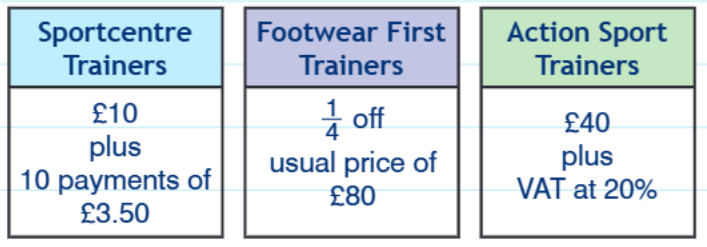
The three options are:
- Sportcentre Trainers: £10 plus 10 payments of £3.50
- Footwear First Trainers: ¼ off usual price of £80
- Action Sport Trainers: £40 plus VAT at 20%
Solution approach:
Sportcentre Trainers calculation:
- Initial payment: £10
- Instalment payments:
- Total cost:
Footwear First Trainers calculation:
- Discount:
- Final price:
Action Sport Trainers calculation:
- VAT amount:
- Final price:
Answer: Sportcentre Trainers is the cheapest at £45.
Note
Top tip: Divide your answer space into three columns when comparing multiple options. This helps the examiner see which shop each calculation relates to and makes your working clearer.
Key exam guidance
When tackling fractions, decimals and percentages problems, remember there are often multiple valid approaches. The key is to:
- Show all your working clearly
- Keep track of each step in your calculation
- Calculate the final price for each option when comparing
- State which option is cheapest and justify your answer
Important
Problem-solving questions often have lots of steps, so organisation is crucial. Take your time to plan your approach and work through each part systematically.
Summary
Key Points to Remember:
- Use the five problem-solving strategies when you encounter unfamiliar questions
- Always sketch diagrams to help visualise percentage and ratio problems
- Show clear working when comparing multiple options - divide your space into columns
- Check that red and blue counters represent 80% when green counters are 20%
- Calculate VAT by finding 20% of the original price and adding it on