Reverse percentages (AQA GCSE Maths): Revision Notes
📚Revision Notes
Reverse percentages
What are reverse percentages?
Reverse percentages allow you to find the original amount when you know the final amount after a percentage change. This is the opposite of normal percentage calculations where you start with an original value and find the result after a change.
When you're given a final amount and need to work backwards to find what you started with, you use the reverse percentage method. This technique is particularly useful in real-world situations like sales, price changes, and growth calculations.
Note
The key insight with reverse percentages is that you're essentially "undoing" a percentage calculation. If someone applied a percentage change to get from the original to the final amount, you can reverse that process to find where they started.
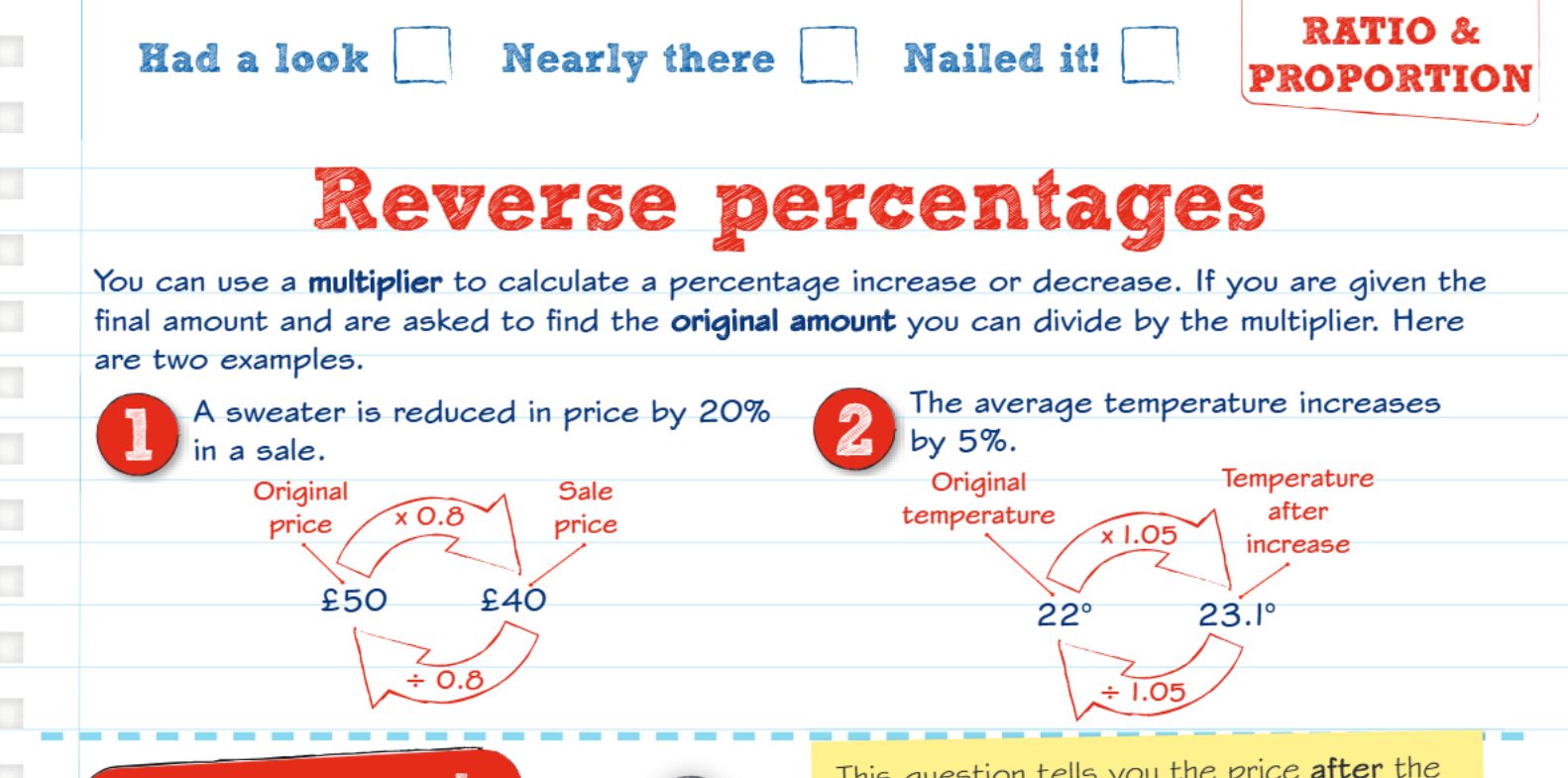
Understanding multipliers
Multipliers are decimal numbers that represent percentage changes. Instead of calculating percentages step by step, multipliers allow you to complete the calculation in one operation.
Important
Creating Multipliers:
- For percentage decreases: Subtract the percentage from 100%, then convert to a decimal
- For percentage increases: Add the percentage to 100%, then convert to a decimal
This is essential for reverse percentage calculations - you must get the multiplier right to find the correct original amount.
For example:
- A 20% decrease: 100% - 20% = 80% = 0.8
- A 5% increase: 100% + 5% = 105% = 1.05
The reverse percentage method
When working backwards from a final amount to find the original amount, follow this key principle:
This works because if you multiply the original amount by the multiplier to get the final amount, you can reverse the process by dividing the final amount by the same multiplier.
Step-by-step process
- Identify the percentage change from the problem
- Calculate the multiplier using the method above
- Divide the final amount by the multiplier to find the original amount
- Check your answer by working forwards
Worked examples
The following examples demonstrate how to apply the reverse percentage method in different situations:
Example
Worked Example 1: Price reduction
A jumper is reduced by 20% in a sale and now costs £40. What was the original price?
Step 1: Identify the percentage change
- Percentage decrease = 20%
Step 2: Calculate the multiplier
- Multiplier = 100% - 20% = 80% = 0.8
Step 3: Apply the reverse percentage formula
Step 4: Check the answer
- £50 × 0.8 = £40 ✓
Example
Worked Example 2: Temperature increase
The temperature increased by 5% and is now 23.1°C. What was the original temperature?
Step 1: Identify the percentage change
- Percentage increase = 5%
Step 2: Calculate the multiplier
- Multiplier = 100% + 5% = 105% = 1.05
Step 3: Apply the reverse percentage formula
Step 4: Check the answer
- 22 × 1.05 = 23.1 ✓
Problem-solving with comparison questions
Some reverse percentage problems require you to compare two people or situations. You'll need to calculate each original amount separately before making your comparison.
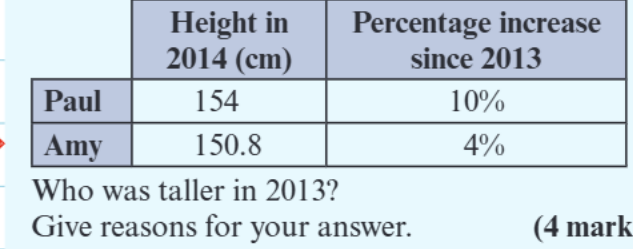
When solving comparison problems:
- Plan your approach before starting calculations
- Work out each original amount separately
- Compare the results and write a clear conclusion
- Show all your working for full marks
Note
Strategy for complex problems:
- Read the question carefully to identify what you're being asked to find
- Set up separate calculations for each person or situation
- Use the reverse percentage method for each calculation
- Make sure your final answer directly addresses the question asked
Taking time to plan your approach will help you avoid mistakes and ensure you answer the actual question being asked.
Exam tips
Important
Essential Exam Tips:
- Always check your answers by working forwards with your calculated original amount
- Show clear working including the multiplier you've used
- Write your final answer clearly with appropriate units
- Read questions carefully to identify whether you need to find one original amount or compare multiple amounts
Remember that reverse percentage questions often appear as word problems, so take time to identify the key information before starting your calculations.
Summary
Key Points to Remember:
- Reverse percentages work backwards from final amounts to find original amounts
- The key formula is:
- For decreases: Multiplier = (100% - percentage) ÷ 100
- For increases: Multiplier = (100% + percentage) ÷ 100
- Always check your answer by working forwards to verify your result