Direct and Inverse Proportion (AQA GCSE Maths): Revision Notes
📚Revision Notes
Direct and inverse proportion
Understanding proportional relationships is a fundamental skill in mathematics. While proportion questions can sometimes seem complicated with lots of information, the methods for solving them remain consistent and straightforward.
What is proportion?
Proportion describes the relationship between two quantities and how they change relative to each other. There are two main types of proportional relationships you need to understand.
Note
The key to understanding proportion is recognising how quantities change in relation to each other. This concept appears frequently in real-world scenarios like cooking, shopping, and construction.
Direct proportion
When two quantities are in direct proportion, they increase or decrease together at the same rate. This means if one quantity doubles, the other quantity also doubles. If one quantity is halved, the other is also halved.
For example, if you're buying cheese and the price increases directly with the amount you buy, then the cost and weight are in direct proportion.
The golden rule for direct proportion
Important
DIVIDE for ONE, then TIMES for ALL
This means you first work out the value for one unit, then multiply by the total number of units needed.
Example
Worked Example: Cheese Cost Calculation
Hannah pays £3.60 for 400g of cheese. She uses 220g of cheese to make 4 cheese pasties. How much would the cheese cost if she wanted to make 50 cheese pasties?
Step 1: Find how much cheese is needed for one pasty
- 220g ÷ 4 = 55g of cheese per pasty
Step 2: Calculate total cheese needed for 50 pasties
- 55g × 50 = 2750g of cheese
Step 3: Find the cost per gramme
- £3.60 ÷ 400g = £0.009 per gramme
Step 4: Calculate total cost
- £0.009 × 2750g = £24.75
Inverse proportion
When two quantities are in inverse proportion, as one quantity increases, the other decreases proportionally. This means if one quantity doubles, the other quantity halves.
For example, if you have a fixed amount of work to complete, the more people working on it, the less time it takes each person.
The rule for inverse proportion
Important
TIMES for ONE, then DIVIDE for ALL
This means you first work out the total amount of work or effort required, then divide by the new number of units.
Example
Worked Example: Bakers and Cake Decoration
4 bakers can decorate 100 cakes in 5 hours. How long would it take 10 bakers to decorate the same number of cakes?
Step 1: Find the total work required
- 100 cakes will take 1 baker: 5 × 4 = 20 hours
Step 2: Divide by the new number of bakers
- So 100 cakes will take 10 bakers: 20 ÷ 10 = 2 hours
Types of proportion in algebra
When working with algebraic proportion, you'll encounter proportionality statements that need to be converted into equations. The proportionality symbol () means "is proportional to".
Simple proportions
The most basic proportional relationships are:
- Direct proportion: , which becomes
- Inverse proportion: , which becomes
Note
In both cases, represents a constant value that you need to find using the given information.
More complex proportions
You might also encounter trickier proportional relationships:
- Square proportion: , which becomes
- Square root proportion: , which becomes
- Inverse cubic proportion: , which becomes
Graphical representations
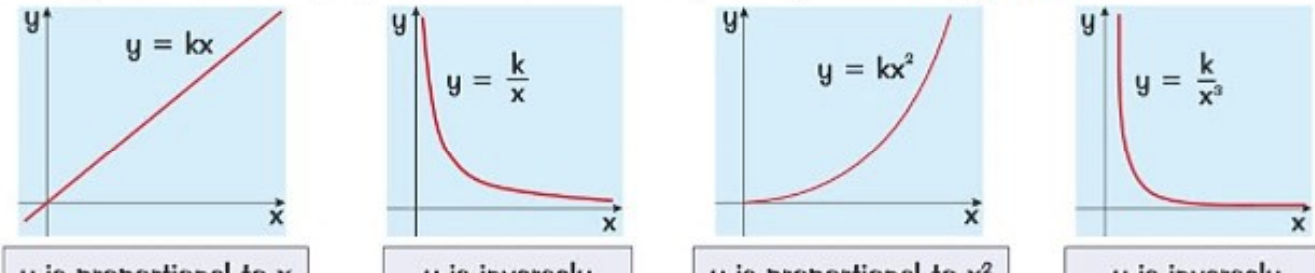
Different types of proportional relationships produce characteristic graph shapes. Understanding these patterns helps you recognise the type of proportion you're dealing with.
Note
Graph recognition is a powerful tool for identifying proportional relationships. Each type of proportion creates a distinctive curve that can help you determine the correct approach to solving problems.
Handling algebra questions on proportion
When tackling algebraic proportion problems, follow these systematic steps:
Important
Essential Steps for Proportion Problems:
- Write the proportionality statement and replace the symbol with
- Find the value of k by substituting the given values
- Put the value of k back into the equation to create your working formula
- Use your equation to find the required value
Example
Worked Example: Inverse Square Root Proportion
is inversely proportional to the square root of . When , . Find the value of when .
Step 1: Convert to proportionality
- , so
Step 2: Find using the given values
- , so
Step 3: Put back into the equation
Step 4: Find when
Summary
Key Points to Remember:
- Direct proportion: When one quantity increases, the other increases proportionally. Use "DIVIDE for ONE, then TIMES for ALL"
- Inverse proportion: When one quantity increases, the other decreases proportionally. Use "TIMES for ONE, then DIVIDE for ALL"
- Proportionality symbol: means "is proportional to" and can be replaced with to form an equation
- Constant k: This value stays the same for a given proportional relationship and must be calculated from given information
- Graph recognition: Different types of proportion create distinctive curve shapes that help identify the relationship type