Transverse & Longitudinal Waves (AQA GCSE Physics Combined Science): Revision Notes
📚Revision Notes
6.1.1 Transverse & Longitudinal Waves
Transverse and Longitudinal Waves
- All waves transfer energy from one place to another.
- Waves move in oscillations.
Transverse Waves
Example
Example: Ripples on the surface of water.
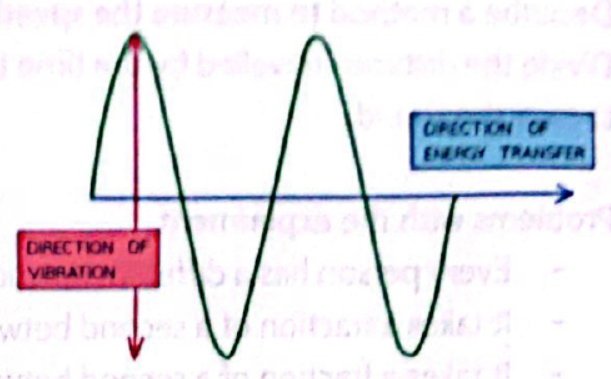
- In transverse waves, the oscillations are perpendicular to the direction of energy transfer.
- The oscillations are up and down, but the direction of energy transfer is sideways.
Longitudinal Waves
Example
Example: Sound waves travelling through air.
- Sound waves travel as particles in the air move from side to side.
- Compressions: Regions where the air particles are very close together.
- Rarefactions: Regions between compressions where the air particles are more spread out.
- In longitudinal waves, the oscillations are parallel to the direction of energy transfer.
- All longitudinal waves require a medium to travel in (air, liquid, solid).

Note
Note
- It is the wave that travels and not the medium.
Types of Waves
Transverse Waves
Example
Examples: Light, or any electromagnetic wave
- Have peaks and troughs
- Vibrations are at right angles to the direction of travel
Longitudinal Waves
Example
Examples: Sound waves
- Have compressions and rarefactions
- Vibrations are in the same direction as the direction of travel
- For both types, the wave moves and not whatever it passes through
Example
Examples: A water wave has a moving wave, but the water doesn't keep moving with it