Electric Fields (AQA GCSE Physics): Revision Notes
📚Revision Notes
2.4.3 Electric Fields
What are Electric Fields?
Note
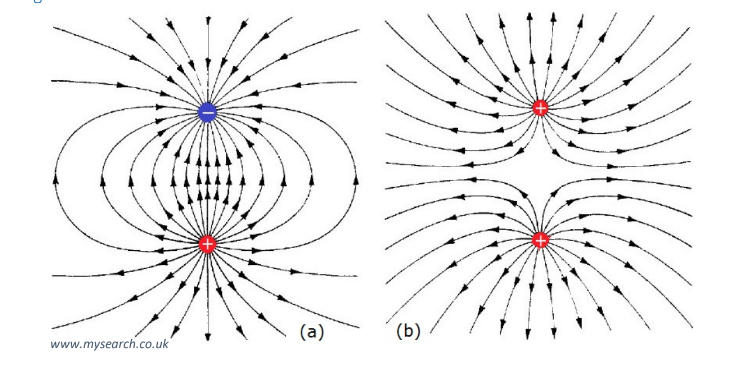
Charged objects create electric fields around them, similar to how magnets create magnetic fields. However, instead of a magnet at the centre, an electric field is centred around a charged particle.
Direction of Electric Field Lines:
- Electric field lines show the direction a positive test charge would move: they point away from positive charges and towards negative charges.
- These field lines are always perpendicular (at right angles) to the surface of a charged object.
Strength of Electric Fields:
The strength of an electric field depends on two factors:
- Distance from the Charge: The closer you are to the charged object, the stronger the electric field. As you move further away, the field strength decreases.
- Amount of Charge: A larger charge produces a stronger electric field, indicated by more field lines.
Forces in Electric Fields:
- When a charged object is placed within another object's electric field, it experiences a force. This force can be either attractive (opposite charges) or repulsive (like charges).
- The strength of this force varies with distance: the closer the objects are, the stronger the force; the further apart they are, the weaker the force.
- Types of Electric Fields:
- Uniform Electric Fields: These occur between two parallel plates with opposite charges, where the field lines are parallel and evenly spaced, indicating a constant field strength.
- Radial Electric Fields: Found around a single point charge, where the field lines radiate outwards (for positive charges) or inwards (for negative charges) from the charge.
Diagrams