Energy Transfer & Work Done (AQA GCSE Physics): Revision Notes
📚Revision Notes
1.1.2 Energy Transfer & Work Done
- Energy can be transferred between energy stores in one of the following ways: Mechanical Work – when a force moves an object at a distance.
Heating – when energy is transferred to a colder object from a hotter object.
Electrical Work – when energy is transferred by a moving charge due to a potential difference.
Radiation – when energy is transferred as an electromagnetic wave e.g. gamma-rays or UV radiation
Examples:
Note
A ball rolling and hitting a wall The system is moving the ball
- When it hits the wall, (some of) the kinetic energy is transferred as sound
Note
Vehicle slowing down
- System is vehicle moving
- When it slows down, kinetic transfers to thermal due to friction between wheels and brakes
Energy Transfers
Pendulum - The Law of Conservation of Energy
Note
Energy cannot be created or destroyed; it can only be transferred, stored, or dissipated.
System Definition
-
System: An object or a group of objects.
- Example: Pendulum
- Components:
- Fixed point
- String
- Mass
- Air particles
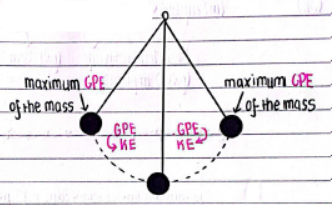
-
Closed System: No energy can enter or leave.
Energy Transfer in a Pendulum
- Pendulum Motion:
- At the highest points: Maximum Gravitational Potential Energy (GPE)
- At the lowest point: Maximum Kinetic Energy (KE)
Friction in the Pendulum
-
Sources of Friction:
-
Friction in the fixed point
-
Friction as the pendulum passes through air particles
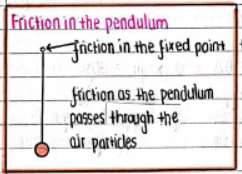
-
Effect of Friction:
- Energy transferred to thermal energy
- Fixed point and air around the pendulum become warmer
- Thermal energy is less useful
- Energy dissipation causes the pendulum to swing with less energy and eventually stop
Reducing Unwanted Energy Transfers
Note
Method:
- Reduce friction by using a lubricant (e.g., oil on the fixed point)
- Remove air particles from around the pendulum
Bungee Jumper
Energy Transfers During a Bungee Jump
- At the start of the jump:
- All energy in the system is the store of gravitational potential energy (GPE).
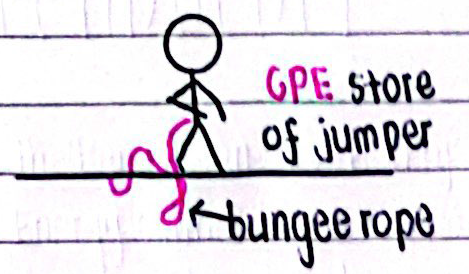
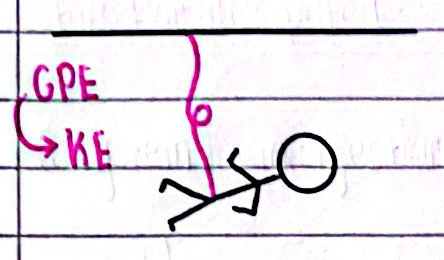
-
As the jumper falls:
-
Energy is transferred from the GPE store to the kinetic energy (KE) store.
-
When the bungee rope just starts to tighten:
-
The kinetic energy store is now at its maximum.
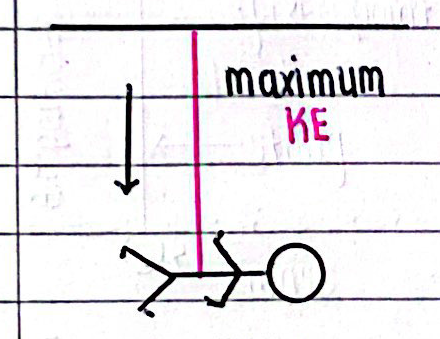
Maximum Kinetic Energy
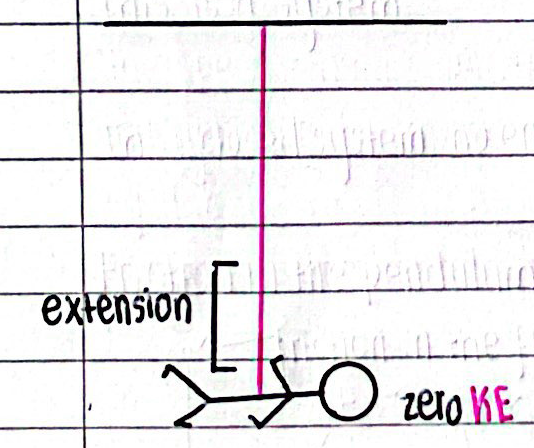
- When the rope is fully extended:
- The KE store is zero.
- The jumper is not moving.
- All energy has been transferred to the elastic potential energy (EPE) store.
Elastic Potential Energy
- As the rope recoils:
- Energy is transferred from the EPE store back to the KE store.
- During the ascent:
- Energy transfers from the KE store back to the GPE store.
- At the top of the ascent:
- All of the energy is now in the GPE store.
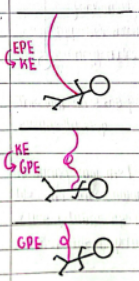
Bungee Jump
Energy Dissipation
- Observation: The jumper never returns back to its original position.
Reasons for Energy Dissipation
- Energy is dissipated as thermal energy due to:
- Friction with air particles
- Stretching effects in the bungee rope, which is not fully elastic
Work Done by a Force
Note
Definition
- Work is done whenever energy is transferred from one store to another.
- Mechanical work involves using a force to move an object.
Formula
Example
Example
Example
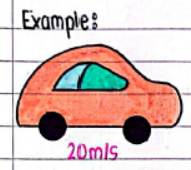
- Scenario: The driver applies the brakes, and the car comes to a stop.
- Moving car → Kinetic energy store
- Speed: 20 m/s
Note
Process:
- When the driver presses the brakes, the brake presses against the wheel.
- This creates friction between the brake and the wheel.
- The kinetic energy stored in the car is transferred to the thermal energy stored in the brakes.
- The temperature of the brakes increases, and the car slows down and stops.
Note
Calculation Example
- Question: During braking, a force of 2000 N is applied to the brakes of a car. The car takes 20 m to come to a stop. Calculate the work done.