Extraneous variables (AQA GCSE Statistics): Revision Notes
📚Revision Notes
Extraneous variables
What are extraneous variables?
Extraneous variables are factors in an experiment that you're not actually studying, but which might still influence your results. Think of them as unwanted "noise" that can make it harder to see the real relationship between the variables you're interested in.
Note
Definition: Extraneous variables are unwanted factors that can affect experimental results even though they're not the focus of your study. They act like "background noise" that can interfere with your ability to see clear relationships between your chosen variables.
For instance, imagine you're investigating whether background music helps factory workers be more productive. The health or how tired the employees feel on a particular day could affect productivity - but these aren't what you're trying to study. These would be extraneous variables that could interfere with your results.
Why controlling extraneous variables matters
When conducting scientific investigations, you want your results to show only the relationship between your chosen variables. If extraneous variables aren't controlled, they can create false patterns in your data or hide real relationships that exist.
Important
Critical Point: Without proper control of extraneous variables, you cannot be confident that your results are due to the factor you're investigating. This undermines the validity and reliability of your entire experiment.
By identifying and controlling these unwanted variables, you ensure that any changes in your results are genuinely due to the factor you're investigating, not something else entirely. This makes your experiment much more reliable and trustworthy.
Worked example: Memory test experiment
Let's examine a practical example to understand how extraneous variables work in real research:
Example
Worked Example: Memory Test with Construction Noise
The setup: Students took a memory test to see how many words from a list they could remember. On Day 1, they took the test in the main school hall. On Day 2, they repeated the test in the same hall, but there was building work happening outside.
Breaking down the variables:
- Explanatory variable: The list of words (what the researchers are testing)
- Response variable: The number of words the students remembered (what they're measuring)
- Extraneous variable: The noise from the building work (an unwanted factor that could affect results)
How to control it: The students could wear noise-cancelling headphones during both tests to eliminate the distraction from construction noise.
Common extraneous variables and their controls
Different types of experiments face different challenges. Here are the most frequently encountered extraneous variables and proven methods to control them:
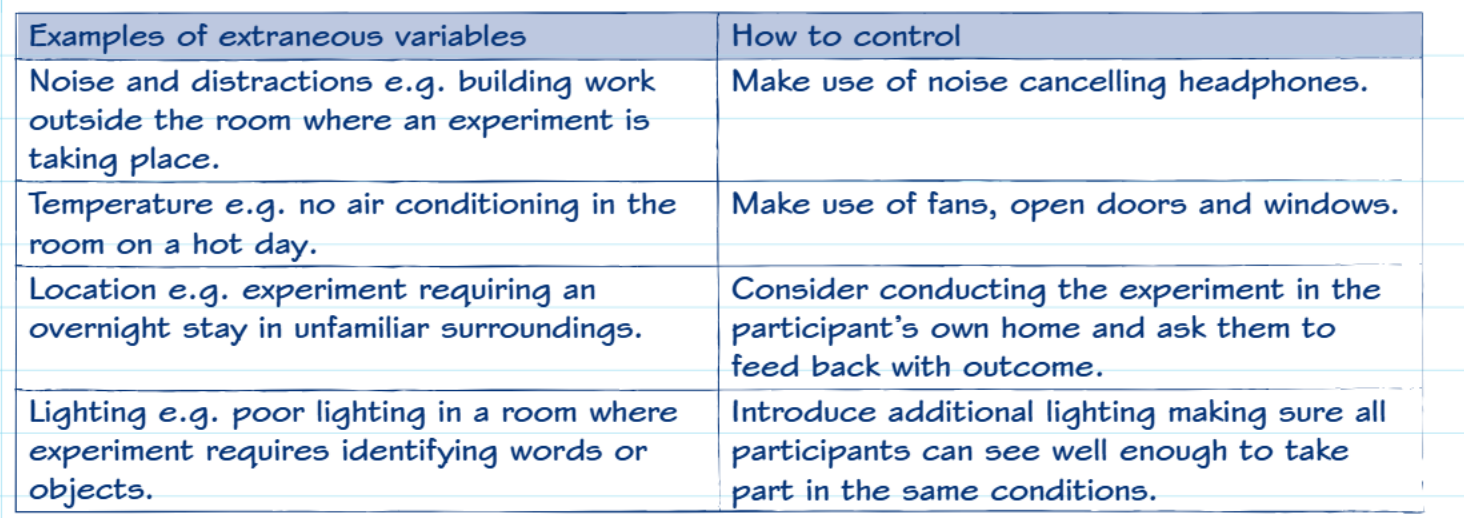
Noise and distractions can seriously impact concentration-based tasks. When participants can't focus properly due to external sounds like building work, their performance drops regardless of what you're actually testing. Using noise-cancelling headphones creates a consistent, quiet environment for all participants.
Temperature variations affect both comfort and cognitive performance. On particularly hot days without air conditioning, participants might feel sluggish or distracted. Installing fans, opening windows and doors, or ensuring proper ventilation helps maintain comfortable conditions throughout the study.
Location factors can create anxiety or unfamiliarity that affects results. If an experiment requires overnight stays in unfamiliar places, participants might feel stressed or sleep poorly. Conducting research in participants' own homes, or at least allowing them to provide feedback about their comfort, helps control this variable.
Lighting issues are crucial when experiments involve visual tasks like identifying words or objects. Poor lighting means some participants might struggle to see clearly whilst others have adequate vision. Adding proper lighting equipment ensures all participants can see equally well and perform under the same visual conditions.
Note
Control Strategy: The key principle is to create standardised conditions where all participants experience exactly the same environment, except for the variable you're deliberately manipulating.
Practice opportunity: Sleep study example
Here's a scenario to test your understanding of identifying and controlling extraneous variables:
Example
Practice Example: Sleep Medication Study
A researcher investigates whether a new medication helps people sleep better. Patients stay overnight in hospital whilst their heart rates are monitored throughout the night.
Think about:
- What is the explanatory variable? (The new medication)
- What is the response variable? (Sleep quality, measured through heart rate patterns)
- What extraneous variables might affect this study? (Hospital environment, unfamiliar beds, medical equipment noise, staff interruptions, room temperature, etc.)
- How could the researcher control these factors? (Standardising room conditions, minimising interruptions, ensuring consistent temperatures, using quiet monitoring equipment)
Remember!
Summary
Key Points to Remember:
- Extraneous variables are unwanted factors that can affect your experimental results even though they're not what you're studying
- Always identify potential extraneous variables before starting your experiment - think about environmental, social, and physical factors that could interfere
- Control methods vary depending on the type of variable: use equipment (headphones, fans), change locations (participant's home), or standardise conditions (lighting, temperature)
- The goal is consistency - all participants should experience the same conditions except for the variable you're deliberately changing
- Better control leads to more reliable results - your conclusions will be much stronger when extraneous variables are properly managed