Populations (AQA GCSE Statistics): Revision Notes
📚Revision Notes
Populations
What is a population in statistics?
In statistics and data collection, understanding what we mean by a "population" is absolutely crucial. A population refers to the entire group of people, objects, or items that we want to investigate or learn about. This could be all students in a school, every person who uses a local gym, or all the cars manufactured by a particular company in a given year.
When we want to gather information about a population, we have two main approaches: conducting a census or taking a sample.
Note
The choice between a census and a sample often depends on practical considerations like time, cost, and the size of your population. Understanding when to use each approach is fundamental to good statistical practice.
Census vs sample
Census
A census involves collecting data from every single member of the population. This means gathering information from everyone - no exceptions. For example, if you wanted to know the favourite subject of students in your school, a census would involve asking every single student in the entire school.
The advantages of a census include:
- Complete accuracy since everyone is included
- No sampling errors
- Comprehensive data coverage
However, censuses can be extremely time-consuming, expensive, and sometimes impossible to carry out, especially with large populations.
Sample
A sample involves collecting data from only some members of the population. Using the same example, you might ask only 50 students from your school about their favourite subject, rather than all 1,000 students.
The key benefit of sampling is that it's much quicker and cheaper than a census, but the trade-off is that your results might not be as accurate or complete.
Key terminology you need to know
Sampling units: These are the individual people or items that you actually collect data from. In our school example, each student you survey would be a sampling unit.
Sampling frame: This is your complete list of all the members in the population from which you'll select your sample. Think of it as your "phone book" of everyone who could potentially be chosen.
Representative sample: This is a sample that accurately reflects the characteristics and diversity of the entire population. A good representative sample should contain the same proportions of different groups as exist in the population.
Pilot survey: A small-scale trial run of your data collection before conducting the main study. This helps identify any problems with your methods.
Pre-test: A specific type of pilot survey where you test out questionnaire questions to make sure they're clear and useful.
Note
Getting familiar with this terminology is essential - these terms appear frequently in statistics problems and understanding their precise meanings will help you tackle questions more effectively.
What makes a good sample vs a poor sample?
Understanding the difference between good and poor samples is essential for collecting reliable data.
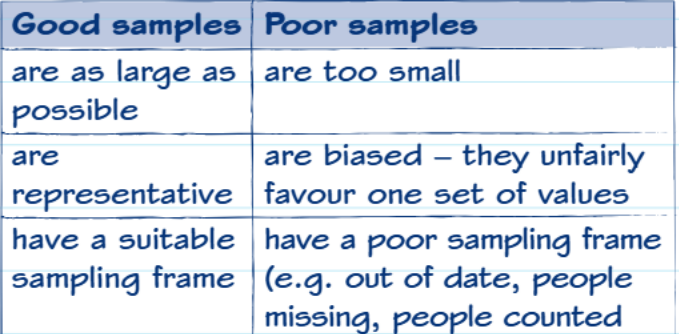
Good samples have three key characteristics:
As large as possible: Generally, the bigger your sample size, the more reliable your results will be. A larger sample reduces the impact of unusual or extreme responses.
Representative of the population: Your sample should mirror the population's characteristics. If 60% of your population is female, roughly 60% of your sample should be female too.
Suitable sampling frame: You need an up-to-date, complete list of the population that doesn't miss anyone important or count people twice.
Poor samples typically suffer from:
Being too small: Small samples can be heavily influenced by a few unusual responses, making results unreliable.
Bias: This means unfairly favouring certain groups or characteristics. For example, only surveying people who visit a gym in the morning would bias your results towards morning exercisers.
Poor sampling frame: This includes problems like outdated information, missing people, or counting the same person multiple times.
Important
Avoiding bias is crucial! Always ask yourself: "Could my sampling method favour certain groups over others?" This is one of the most common reasons why statistical studies produce misleading results.
Worked example: leisure centre study
Example
Worked Example: Leisure Centre Survey Design
Scenario: A manager of a new leisure centre wants to find out what people in the local area think about the quality of facilities.
(a) What population should the manager use?
The population should be all people in the local area who use the leisure centre. Notice that it's not everybody in the local area - only those who actually use or might use the leisure centre are relevant to this investigation.
(b) Describe a sampling unit.
A sampling unit would be one person who lives in the local area and uses the leisure centre.
(c) The manager asks 20 people who come to the leisure centre on Monday morning. Give two reasons why this sample is likely to be biassed.
This sample is problematic because:
- It's not representative of all people who use the leisure centre at different times - it only includes people who come on Monday mornings
- It's too small - with only 20 people, the results might not reflect the views of the much larger population of users
Better approach: The manager could take a systematic sample throughout different days of the week and times of day to get a more representative view of all users.
Common exam traps to avoid
Important
Watch out for these common mistakes:
- Don't confuse population with sample: Remember, population = everyone, sample = some people
- Watch out for bias: Always consider whether a sampling method might favour certain groups
- Size matters: Be ready to explain why sample size affects reliability
- Representative doesn't mean identical: A representative sample should reflect proportions, not be exactly the same as the population
Exam-style problem solving tips
When tackling questions about populations and sampling:
- Identify the population first: Ask yourself "who or what exactly are we trying to learn about?"
- Look for bias: Consider if the sampling method might exclude certain groups or favour others
- Evaluate sample size: Think about whether the sample is large enough to be reliable
- Check the sampling frame: Is the list of potential participants complete and up-to-date?
Note
These step-by-step approaches work well under exam pressure. Practice applying them to different scenarios until they become second nature.
Summary
Summary
Key Points to Remember:
- A population includes everyone or everything you want to investigate, while a sample includes only some members
- A census collects data from everyone in the population, but a sample only collects from some people
- Good samples are large, representative, and use a suitable sampling frame
- Poor samples are too small, biassed, or use flawed sampling frames
- Always watch out for bias in sampling methods - this is a common source of unreliable results