RPI and CPI (AQA GCSE Statistics): Revision Notes
📚Revision Notes
RPI and CPI
What are index numbers?
Index numbers are statistical tools used to measure changes in variables over time. They help us compare prices, costs, or other economic factors between different time periods. The most common index numbers you'll encounter are the Retail Price Index (RPI) and Consumer Price Index (CPI), both of which measure changes in the cost of living.
Note
Index numbers provide a standardised way to track changes over time by setting a base year as the reference point. This makes it easier to compare data across different periods and understand trends.

Retail Price Index (RPI)
What does RPI measure?
The Retail Price Index tracks changes in the cost of living by measuring price changes for everyday items that households purchase. It includes a comprehensive range of expenses such as:
- Rental payments and housing costs
- Food and beverages
- Heating and utilities
- Travel costs
- Other household expenses
RPI base year and calculation
The RPI uses 1987 as its base year, with an index value of 100. This means that all other years are compared to 1987 prices. When the RPI is above 100, it indicates that prices have increased since 1987. When it's below 100, prices have decreased.
Important
Critical Concept: The base year index of 100 is the foundation for all comparisons. Any index value above 100 represents an increase from the base year, while values below 100 represent a decrease.

How the government uses RPI
The government primarily uses RPI to set interest rates for student loans. This ensures that loan costs adjust with inflation, maintaining their real value over time.
Consumer Price Index (CPI)
What does CPI measure?
The Consumer Price Index also measures changes in the cost of living, but with some important differences from RPI. The CPI focuses on general consumer goods and services but specifically excludes mortgage payments. This makes it a different measure of inflation compared to RPI.
CPI base year and calculation
The CPI uses 2015 as its base year, with an index value of 100. This more recent base year means the CPI reflects modern spending patterns better than RPI.

How the government uses CPI
The government uses CPI to index benefits, tax credits, and pensions in the UK. This ensures these payments maintain their purchasing power as general prices change over time.
Key differences between RPI and CPI
Understanding the differences between these indices is crucial for economic analysis and policy understanding:
Important
Key Differences You Must Know:
- Base years: RPI uses 1987 (index = 100), while CPI uses 2015 (index = 100)
- Housing costs: RPI includes rental payments, CPI excludes mortgage payments
- Government applications: RPI for student loans, CPI for benefits and pensions
- Coverage: Both measure cost of living but include different items
Calculating with index numbers
Understanding how to work with index numbers is essential for data analysis and economic calculations.
Basic percentage increase formula
To calculate percentage changes using index numbers:
Working with index values
When you have index values and need to find actual costs:
Note
These formulas are fundamental tools for converting between index values and actual monetary amounts. Practice using them with different scenarios to build confidence.
Worked example walkthrough
Let's examine how to compare price changes with CPI data:
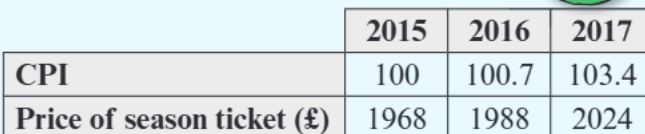
Example
Worked Example: Comparing Season Ticket Prices with CPI (2015-2017)
Step 1: Calculate price change as percentage of 2015 price
- 2016 price vs 2015:
- 2017 price vs 2016:
Step 2: Compare with CPI changes
- CPI 2016 vs 2015: 100.7 vs 100 (above CPI increase)
- CPI 2017 vs 2016: 103.4 vs 100.7 (below CPI increase)
Step 3: Calculate historical prices using index values If CPI in 2012 was 96.1, and we know the 2015 price was £1968:
Index formula:
Rearranging:
Common exam techniques
Mastering these calculation techniques will help you tackle exam questions confidently:
Percentage calculations
Always show your working clearly:
- Identify the old and new values
- Apply the percentage formula
- Round appropriately (usually 1 or 2 decimal places)
Index comparisons
When comparing different items with indices:
- Convert both to the same base year if needed
- Calculate percentage changes for both
- Compare the rates of change
- Draw conclusions about relative price movements
Note
Exam Tip: When making comparisons, always state clearly whether price increases are above, below, or in line with the relevant index. This shows you understand the economic significance of the data.
Reverse calculations
To find historical values from current ones:
- Identify the index values for both periods
- Set up the proportion:
- Solve for the unknown value
- Check your answer makes logical sense
Summary
Key Points to Remember:
- RPI measures cost of living including housing costs - it uses 1987 as base year (index = 100) and helps set student loan interest rates
- CPI measures cost of living excluding mortgage payments - it uses 2015 as base year (index = 100) and determines benefit increases
- Index values above 100 mean prices have increased since the base year, while values below 100 mean prices have decreased
- Always show clear working in calculations - identify your formula, substitute values, and round appropriately for the context
- Both indices track inflation but serve different purposes - understanding when to use each one is key for exam success