The shape of a distribution (AQA GCSE Statistics): Revision Notes
📚Revision Notes
The shape of a distribution
Understanding the shape of data distributions is essential for analysing and interpreting statistical information. When you collect data and display it graphically, the overall pattern it creates tells you important information about how the values are spread out.
Note
The shape of a distribution is one of the most fundamental concepts in statistics. It helps you make predictions, identify patterns, and choose appropriate statistical methods for your analysis.
What is the shape of a distribution?
The shape of a distribution refers to the overall pattern formed when data is displayed visually. This shape can be seen in various types of graphs including:
- Stem and leaf diagrams
- Frequency polygons
- Histograms
- Bar charts
The shape helps us understand where most of the data values lie and how they spread out from the centre.
Types of distribution shapes
There are three main types of distribution shapes you need to recognise:
Positive skew
In a positively skewed distribution, most of the data values cluster at the lower end of the range. The distribution has a longer tail stretching towards the positive (higher) values on the right side.
Key characteristics:
- Most data points are at the lower end
- The distribution stretches out in the positive direction
- The longer tail points towards higher values
Important
Remember the direction: Positive skew means the tail points to the right (towards positive/higher values). Think "positive = right direction".
Symmetrical distribution
A symmetrical distribution has data values evenly spread around the middle point. The shape looks balanced, like a mountain, with equal amounts of data on both sides of the centre.
Key characteristics:
- The distribution is balanced about the middle
- No skew present
- Equal spread of data on both sides of the centre
Negative skew
In a negatively skewed distribution, most data values are clustered at the upper (higher) end. The longer tail stretches towards the negative (lower) values on the left side.
Key characteristics:
- Most data points are at the upper end
- The distribution stretches out in the negative direction
- The longer tail points towards lower values
Important
Common mistake to avoid: Don't confuse the direction of the skew with where most data lies. In negative skew, most data is at the higher end, but the skew is called "negative" because the tail points left (towards negative/lower values).

Understanding tails in distributions
Note
Every distribution has two tails - these are the parts of the distribution that extend furthest away from the mean (average). The positive tail extends to the right towards higher values, whilst the negative tail extends to the left towards lower values. The length and direction of these tails determines the type of skew.
Worked example: analysing pulse rate data
Let's examine a practical example using pulse rate measurements taken before and after exercise.
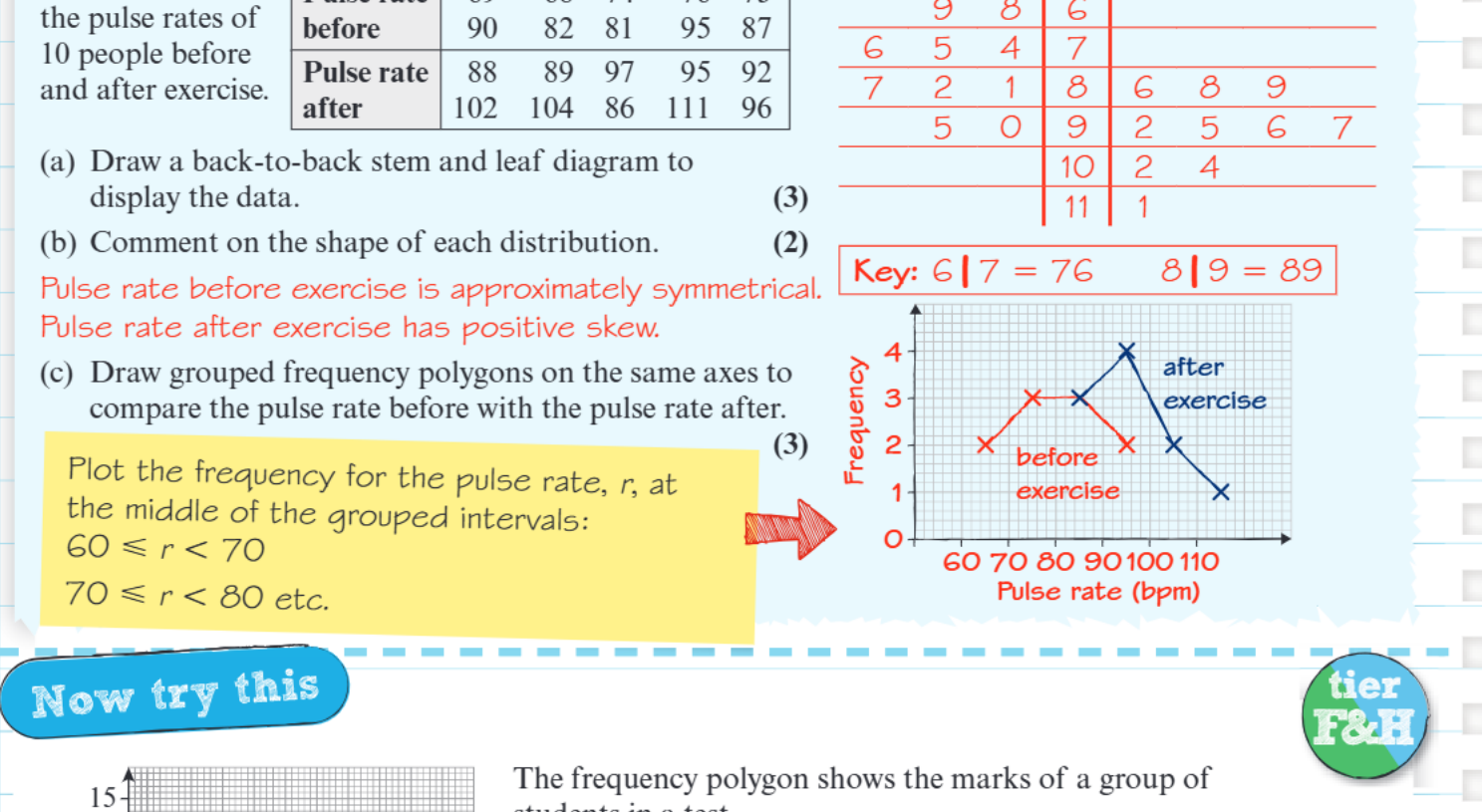
Example
Worked Example: Creating and Analysing Back-to-Back Stem and Leaf Diagrams
The data shows pulse rates for 10 people measured both before and after exercise. When creating a back-to-back stem and leaf diagram:
Step 1: Set up the stems - Use the tens digits as stems in the centre column
Step 2: Add leaves on both sides - Place the units digits as leaves extending left (before exercise) and right (after exercise)
Step 3: Include a key - For example: 6|7 = 76 beats per minute
Analysis of Results:
- Before exercise: The distribution appears approximately symmetrical, with pulse rates fairly evenly distributed around the middle values
- After exercise: The distribution shows positive skew, with most values clustered at the lower end but some much higher values creating a tail towards the right
Drawing frequency polygons
When comparing two distributions using frequency polygons:
- Group the data into suitable intervals (e.g., 60 ≤ r < 70, 70 ≤ r < 80)
- Plot frequencies at the midpoint of each grouped interval
- Connect the points with straight lines
- Use different markers or colours to distinguish between the two datasets
This allows you to visually compare the shapes of both distributions on the same axes.
Important
Critical Point: When plotting frequency polygons, always plot at the midpoint of grouped intervals, not at the interval boundaries. This ensures accurate representation of the data distribution.
Common exam tips
- Remember the direction: Positive skew has the tail pointing right (towards positive/higher values), negative skew has the tail pointing left (towards negative/lower values)
- Look at where most data clusters: In positive skew, most data is at the lower end; in negative skew, most data is at the higher end
- Symmetrical means balanced: Equal amounts of data on both sides of the centre
- When plotting frequency polygons: Always plot at the midpoint of grouped intervals, not at the interval boundaries
Summary
Key Points to Remember:
- The shape of a distribution describes the overall pattern formed by data when displayed graphically
- Positive skew has most data at lower values with a tail extending towards higher values (right)
- Negative skew has most data at higher values with a tail extending towards lower values (left)
- Symmetrical distributions are balanced around the centre with no skew
- Tails are the parts of distributions furthest from the mean - positive tail on right, negative tail on left
- Frequency polygons help compare distribution shapes by plotting frequencies at interval midpoints