Deciduous woodlands features (Edexcel GCSE Geography A): Revision Notes
📚Revision Notes
Deciduous woodlands features
Introduction to deciduous woodlands
Deciduous woodland ecosystems are primarily located across Europe, south-eastern USA, China and Japan. These temperate forest environments share similar characteristics to tropical rainforests in that they contain both abiotic (non-living) and biotic (living) components, but they have their own distinct features that make them unique ecosystems.
Note
While deciduous woodlands share some similarities with tropical rainforests in their basic ecosystem structure, their temperate location and seasonal nature create fundamentally different environmental conditions and ecological processes.
Components of deciduous woodlands
Abiotic components
The non-living elements of deciduous woodlands are significantly influenced by human activity. People actively shape these woodland environments through various recreational activities including walking, cycling, horse-riding and having picnics. These human interactions create pathways, clearings and disturbed areas that become part of the woodland's physical structure.
Note
Human Impact on Woodland Structure
Human activities don't just use woodland spaces - they actively modify the physical environment. The paths, clearings, and disturbed areas created by recreational use become permanent features that influence water flow, soil development, and plant growth patterns throughout the woodland.
Biotic components
The living components of deciduous woodlands create a complex ecosystem with several important characteristics:
Soil development: Each autumn, deciduous trees shed their leaves, creating a thick layer of leaf litter that accumulates on the forest floor. This organic matter decomposes over time, forming deep and highly fertile soil that supports the woodland ecosystem.
Nutrient retention: Unlike tropical rainforests, deciduous woodlands experience slower leaching rates. This means nutrients move more gradually through the soil system, allowing plants better access to essential minerals and compounds needed for growth.
Seasonal growth patterns: The herb layer (ground-level plants) in deciduous woodlands has adapted to the seasonal nature of the canopy above. These smaller plants typically flower and complete much of their growth during spring, before the larger trees fully develop their leaves and block out sunlight.
Wildlife habitats: Bogs and ponds within deciduous woodland areas provide crucial habitats that support a diverse range of both plant and animal species, contributing to the overall biodiversity of the ecosystem.
Important
Key Adaptation: Seasonal Timing
The timing of growth in deciduous woodlands is critical. Herb layer plants must complete their major growth and flowering before the tree canopy fully develops, as this blocks most sunlight from reaching the forest floor. This creates a narrow window of opportunity each spring.
Example
Worked Example: Spring Wildflower Strategy
Step 1: Early spring (March-April) - Tree buds begin to swell but leaves haven't fully emerged
- Sunlight reaches forest floor at nearly 100%
- Soil temperature begins to warm
Step 2: Wildflowers respond rapidly
- Plants like bluebells and wood anemones flower quickly
- They photosynthesize intensively while light is available
Step 3: Late spring (May) - Tree canopy closes
- Light levels drop to 2-5% of open conditions
- Wildflowers have already stored energy for the rest of the year
Four-layer structure
Deciduous woodland ecosystems are organised into four distinct vertical layers, each with its own characteristics and species:
- Canopy layer: The uppermost level formed by the crowns of mature deciduous trees
- Sub-canopy layer: A secondary tree layer beneath the main canopy
- Herb layer: Ground-level vegetation including wildflowers, ferns and small shrubs
- Ground layer: The forest floor containing leaf litter, mosses and decomposing organic matter
This layered structure creates different microclimates and niches that support various species throughout the woodland ecosystem.
Important
Microclimate Creation
Each layer of the woodland creates its own microclimate with distinct temperature, humidity, and light conditions. This vertical zonation allows many more species to coexist in the same area than would be possible in a single-layer habitat, significantly increasing biodiversity.
Climate characteristics
Deciduous woodlands experience distinctly different climatic conditions compared to tropical rainforests. Research comparing these ecosystems reveals important differences:
Temperature patterns: Tropical rainforest ecosystems maintain consistently high temperatures throughout the year, averaging around 27-29°C. In contrast, deciduous woodland ecosystems show much greater seasonal temperature variation, with maximum average temperatures reaching only 17°C during summer months.
Precipitation patterns: Tropical rainforests receive significantly more rainfall overall, with most precipitation occurring between December and May. Deciduous woodlands receive less annual rainfall, but their precipitation is more evenly distributed throughout the year, with peak rainfall typically occurring from October to February.
These climatic differences explain why deciduous trees have evolved to shed their leaves seasonally, adapting to cooler temperatures and varying moisture availability throughout the year.
Note
Climate Adaptation Strategy
The seasonal leaf-shedding strategy of deciduous trees is a direct response to their temperate climate. By dropping leaves before winter, trees avoid the energy cost of maintaining foliage during cold periods when photosynthesis would be inefficient, and they reduce water loss when soil water may be frozen and unavailable.
Nutrient cycling in deciduous woodlands
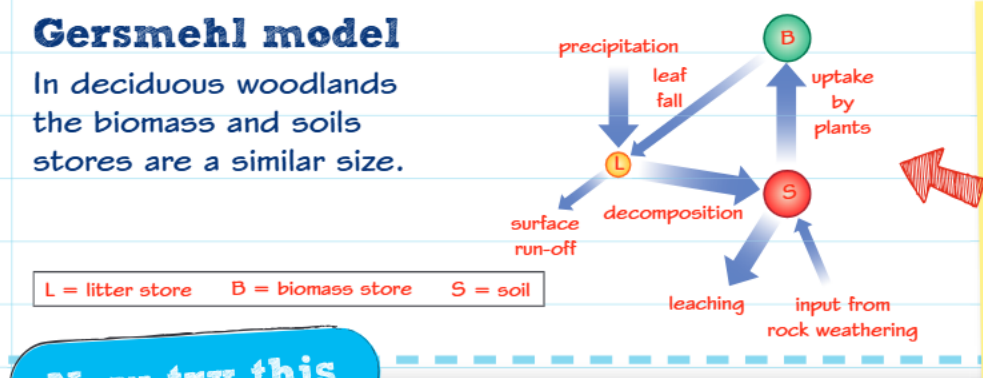
The Gersmehl model provides an excellent framework for understanding how nutrients cycle through deciduous woodland ecosystems. This model shows three main nutrient stores connected by various transfer processes:
The three stores:
- Biomass store (B): Nutrients stored in living plant and animal tissue
- Litter store (L): Nutrients contained in dead organic matter on the forest floor
- Soil store (S): Nutrients held within the soil system
Key processes:
- Precipitation: Brings nutrients into the system from the atmosphere
- Leaf fall: Transfers nutrients from biomass to litter store
- Decomposition: Moves nutrients from litter into soil
- Plant uptake: Returns nutrients from soil back to biomass
- Leaching: Removes nutrients from the system through water movement
- Surface run-off: Carries nutrients away across the land surface
- Rock weathering: Adds new nutrients to the soil from underlying geology
In deciduous woodlands, the biomass and soil stores are remarkably similar in size, which differs significantly from other ecosystem types. This balance reflects the seasonal nature of these forests, where substantial amounts of organic matter are regularly transferred between living vegetation and the forest floor through annual leaf fall.
Important
Unique Nutrient Balance
The similar size of biomass and soil stores in deciduous woodlands is unusual among ecosystem types. In tropical rainforests, most nutrients are locked in biomass, while in grasslands, most are in soil. This balanced distribution in deciduous woodlands reflects their seasonal cycle of growth and leaf fall.
Example
Worked Example: Annual Nutrient Cycle
Autumn (September-November):
- Leaf fall transfers nutrients from biomass store to litter store
- Litter store reaches maximum size
Winter (December-February):
- Slow decomposition moves some nutrients from litter to soil
- Minimal plant uptake due to dormancy
Spring (March-May):
- Rapid plant uptake transfers nutrients from soil back to biomass
- New growth increases biomass store size
Summer (June-August):
- Continued plant uptake and growth
- Some weathering adds new nutrients to soil store
Summary
Key Points to Remember:
- Deciduous woodlands are found mainly in Europe, south-east USA, China and Japan, with distinct seasonal characteristics
- These ecosystems have four main layers: canopy, sub-canopy, herb and ground layers, each supporting different species
- Annual leaf fall creates fertile soils and supports slower nutrient leaching compared to tropical forests
- The climate shows greater temperature variation than tropical rainforests, with more evenly distributed rainfall throughout the year
- Nutrient cycling follows the Gersmehl model, with biomass and soil stores being similar in size due to seasonal leaf shedding and decomposition processes