TRF goods and services (Edexcel GCSE Geography A): Revision Notes
📚Revision Notes
Tropical rainforest goods and services
What are tropical rainforest goods and services?
Tropical rainforests are incredibly important ecosystems that provide essential benefits to humans and the planet. These benefits are divided into two main categories: goods (physical products we can obtain) and services (important functions the forest performs). Understanding these benefits helps us appreciate why protecting tropical rainforests is so crucial, especially as they face increasing threats from climate change.
Note
The distinction between goods and services is fundamental to understanding how rainforests contribute to human welfare and environmental stability. Goods are tangible products we can harvest, while services are the natural processes that benefit us without being physically removed from the forest.
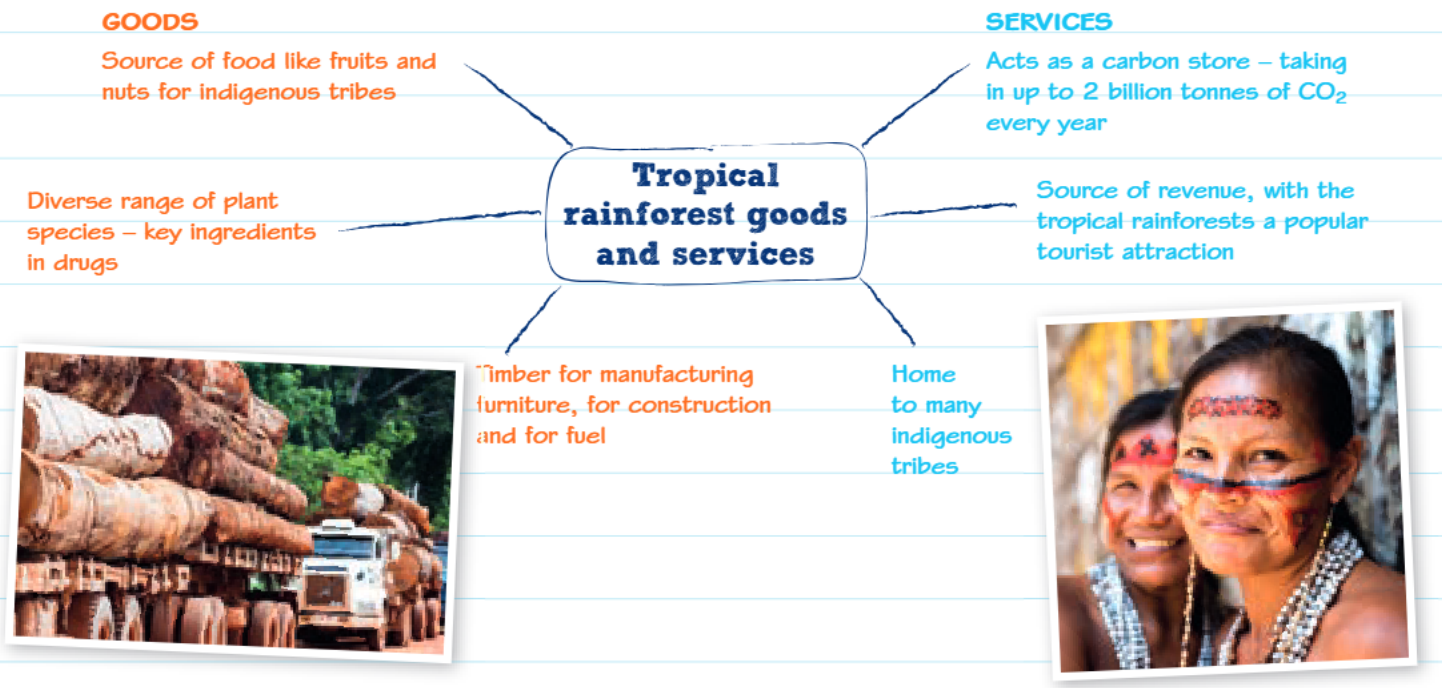
Goods provided by tropical rainforests
Goods are tangible products that we can physically obtain from the rainforest. These include:
Food sources
Indigenous communities living in tropical rainforests rely heavily on the forest for their nutrition. The rainforest provides a variety of fruits, nuts, and other edible plants that form an essential part of their diet. These natural food sources have sustained indigenous populations for thousands of years and represent an important cultural connection to the forest.
Medicinal plants
The incredible biodiversity of tropical rainforests means they contain thousands of plant species with medicinal properties. Many modern medicines have been developed from rainforest plants, and scientists continue to discover new compounds that could lead to treatments for various diseases. This makes the rainforest like a natural pharmacy that could hold cures for future medical challenges.
Note
Scientists estimate that less than 1% of rainforest plants have been studied for their medicinal potential, suggesting vast untapped resources for future medical discoveries.
Timber and construction materials
Tropical rainforests provide valuable timber that is used for manufacturing furniture, construction of buildings, and as fuel. The wood from these forests is often highly prized for its quality and durability, making it economically valuable. However, this has also led to significant deforestation pressures as demand for timber continues to grow.
Important
While timber provides economic value, unsustainable harvesting practices can permanently destroy the forest's ability to provide both goods and services, making sustainable management crucial.
Services provided by tropical rainforests
Services are the important functions that tropical rainforests perform naturally, which benefit both local communities and the global environment:
Carbon storage
One of the most critical services is carbon storage. Tropical rainforests act as massive carbon sinks, absorbing carbon dioxide from the atmosphere and storing it in their biomass. Research shows that tropical rainforests can store up to 2 billion tonnes of CO₂ annually, making them vital in the fight against climate change and global warming.
Tourism revenue
The unique biodiversity and natural beauty of tropical rainforests attract millions of tourists each year. This ecotourism generates significant revenue for local communities and national economies, providing jobs and income while encouraging forest conservation. Tourism offers an economic alternative to destructive activities like logging.
Indigenous homes and cultural preservation
Tropical rainforests serve as homes for many indigenous tribes who have lived there for generations. These communities have developed sustainable ways of living that don't damage the forest ecosystem. The forest provides not just shelter, but also supports their entire way of life, including cultural traditions and spiritual beliefs.
Climate change impacts on tropical rainforests
Climate change poses serious threats to tropical rainforests and their ability to provide goods and services. Scientists have identified several key areas of concern:
Structural impacts
Extended periods of drier conditions caused by climate change slow down the natural process of decomposition in the forest. This reduces the amount of biomass that forests can store, affecting their overall structure and health. When dead plant material doesn't decompose properly, nutrients aren't recycled effectively through the ecosystem.
Important
Disrupted decomposition doesn't just affect individual trees - it impacts the entire forest's ability to store carbon and maintain soil fertility, creating cascading effects throughout the ecosystem.
Functional disruptions
Climate change can disrupt important forest processes like "cloud functioning". This natural process helps provide water for the entire ecosystem through precipitation. If longer dry periods prevent this cloud functioning from occurring, it reduces the water available for all forest life, potentially causing widespread damage to the ecosystem.
Biodiversity threats
Changes in rainfall patterns and temperature threaten the survival of many plant and animal species that have adapted to specific conditions. As some species struggle to survive, this creates opportunities for non-rainforest species that are more tolerant of changing conditions to invade. This invasion can completely alter the balance of the ecosystem and reduce its overall biodiversity.
Important
The loss of biodiversity is particularly concerning because it reduces the forest's ability to provide both goods (like new medicines from undiscovered plants) and services (like maintaining ecosystem stability).
Summary
Key Points to Remember:
-
Tropical rainforests provide both goods (physical products like food, medicines, and timber) and services (functions like carbon storage and tourism)
-
They store approximately 2 billion tonnes of CO₂ annually, making them crucial for fighting climate change
-
Climate change threatens rainforests through impacts on structure (reduced decomposition), functioning (disrupted water cycles), and biodiversity (species loss and invasion)
-
Indigenous communities depend on rainforests for their homes, food, and cultural survival
-
Protecting tropical rainforests is essential because once these ecosystems are damaged, their ability to provide vital goods and services may be permanently reduced