Physical processes 2 (Edexcel GCSE Geography A): Revision Notes
📚Revision Notes
Physical processes in rivers
Rivers are powerful agents of change that continuously shape the landscape through three main physical processes: erosion, transport, and deposition. These processes work together to sculpt river valleys, move sediment downstream, and create distinctive landforms. Understanding how these processes operate is essential for explaining how river landscapes develop and change over time.
Note
These three processes are interconnected and work simultaneously - as one process operates, it directly influences the others. For example, erosion provides material for transport, which eventually leads to deposition when conditions change.
Erosion processes
Erosion refers to the wearing away and removal of rock and sediment from the river channel and its banks. Rivers erode their channels through four distinct processes, each operating in different ways and under different conditions.
Hydraulic action occurs when the sheer force of moving water hits against the riverbed and banks. The pressure of the water, especially during periods of high flow, can dislodge loose material and gradually wear away even solid rock. This process is particularly effective where the water flow is turbulent or where there are joints and cracks in the rock that water can penetrate.
Abrasion happens when the load (material already being carried by the river) scrapes and grinds against the channel bed and banks. Think of this like sandpaper - the rocks and sediment act as tools that gradually wear away the channel through friction. This process is most effective when the river is carrying a heavy load of coarse material.
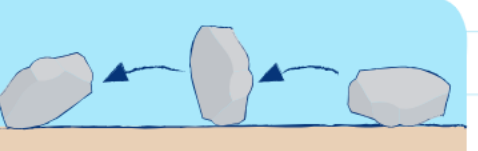
Attrition involves the load itself being worn down as particles bump into each other during transport. As rocks and pebbles collide, they break into smaller pieces and become more rounded and smoother. This explains why material tends to become finer and more rounded as you move downstream.
Important
Don't confuse abrasion and attrition! Abrasion is the load wearing away the channel, while attrition is the load particles wearing each other down. Both processes reduce particle size, but they work in different ways.
Solution occurs when certain rock minerals dissolve directly into the river water. This chemical erosion is particularly common in areas with limestone or chalk bedrock, where calcium carbonate readily dissolves in slightly acidic river water. Unlike the other erosion processes, solution leaves no visible trace of the eroded material.
Transport and deposition
Once material has been eroded, rivers must transport it downstream. The way a river carries its load depends on the size of the particles, the velocity of the water, and the volume of flow. There are four main methods of transport, each suited to different types and sizes of material.
Traction involves the largest material - boulders and large stones - being rolled or dragged along the riverbed. This requires considerable energy and typically occurs during periods of high flow when the river has sufficient power to move such heavy loads. The material stays in contact with the bed throughout transport.
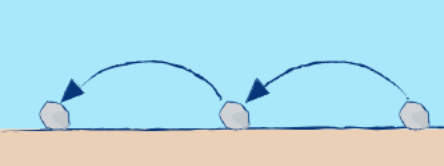
Saltation describes the bouncing motion of medium-sized particles like pebbles and small stones. These particles are picked up by the flow, carried a short distance, then dropped back to the bed before being picked up again. This creates a characteristic bouncing or leaping movement that gives saltation its name.
Note
The term "saltation" comes from the Latin word "saltare" meaning "to leap" or "to dance," which perfectly describes the bouncing motion of particles during this transport process.
Suspension carries the finest particles - sand, silt, and clay - within the water column itself. These particles are light enough to be held up by the turbulence in the water and can travel vast distances without settling. Rivers carrying large amounts of suspended sediment often appear brown or muddy.
Solution transports dissolved minerals invisibly within the water. Unlike suspended particles, dissolved material cannot be seen and will only be deposited under specific chemical conditions, often when the water evaporates or when chemical changes occur.
Deposition occurs when a river loses energy and can no longer carry its full load. This happens when the river slows down due to reduced gradient, increased friction, or decreased volume. The heaviest material is deposited first, followed by progressively finer particles as energy continues to decrease. This selective deposition creates sorted sediment deposits with the coarsest material upstream and finest material downstream.
Important
The relationship between river energy and particle size is crucial: as energy decreases, the river deposits material in order of size - largest first, smallest last. This creates the characteristic sorting seen in river deposits.
Key processes in action
Understanding these processes helps explain many river landscape features. Fast-flowing water in the upper course of a river has high energy for erosion and transport, creating steep-sided valleys through intensive vertical erosion. As rivers flow downstream and lose energy, they deposit material to form features like floodplains and deltas.
The effectiveness of each process varies with river conditions. During floods, all erosion and transport processes operate at maximum intensity, allowing rivers to move enormous amounts of material and dramatically reshape their channels. During low flow periods, only the finest particles remain in suspension while larger material is temporarily deposited.
Note
River processes operate on different timescales - some changes happen during single flood events, while others take thousands of years. This is why rivers can appear stable day-to-day but show dramatic changes when viewed over longer periods.
Summary
Key Points to Remember:
- Rivers erode through four processes: hydraulic action (water pressure), abrasion (load scraping), attrition (load collision), and solution (chemical dissolving)
- Transport occurs through traction (rolling), saltation (bouncing), suspension (carrying in water), and solution (dissolving)
- Deposition happens when rivers lose energy and drop their load, with heaviest material deposited first
- These processes work together continuously to shape river landscapes from source to mouth
- The intensity of all processes increases during high flow conditions like floods