Hurricane Sandy (Edexcel GCSE Geography A): Revision Notes
📚Revision Notes
Hurricane Sandy revision note
Introduction to Hurricane Sandy
Hurricane Sandy serves as a key case study for understanding how tropical cyclones impact named developed countries. This powerful storm system demonstrates the wide-ranging social, economic, and environmental consequences that can occur when extreme weather events strike densely populated and economically important regions.
Note
Hurricane Sandy is particularly valuable for study because it affected highly developed nations with advanced infrastructure, allowing us to examine how even the most prepared societies can be vulnerable to natural disasters.
Key facts about Hurricane Sandy
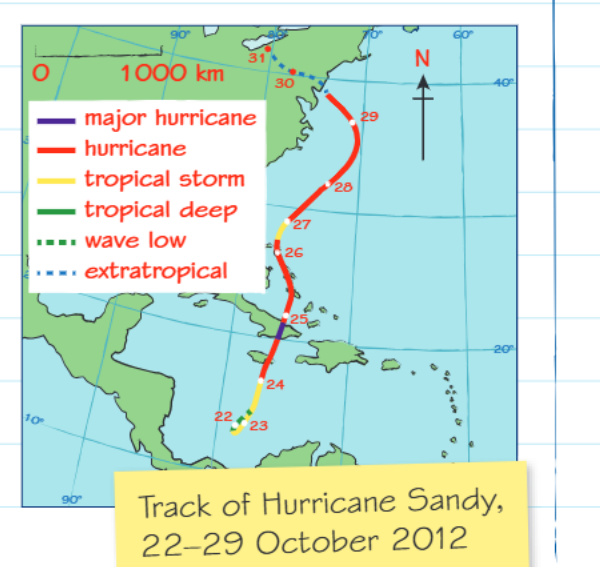
Hurricane Sandy was a significant tropical cyclone that occurred in late October 2012. The storm began its journey across the Caribbean Sea, where it initially affected several island nations including Jamaica, Cuba, and Haiti. From there, it continued its destructive path northward towards the United States mainland.
The hurricane made landfall in New Jersey on 29 October 2012, bringing with it devastating winds and storm surges. By the time Sandy reached the American coast, meteorologists recorded wind speeds of 129 km/h, classifying it as a major hurricane capable of causing extensive damage.
Important
Storm surges became the primary cause of destruction along the East Coast states. These powerful walls of water, driven inland by the hurricane's winds, caused widespread flooding and devastation in coastal communities.
The disaster also highlighted the important role of social media in modern emergency situations. Platforms such as Twitter and photograph-sharing sites like Flickr became crucial tools for damage assessment, allowing both authorities and citizens to document and share information about the storm's impact in real-time.
Note
The tracking map shows Hurricane Sandy's complete journey from 22-29 October 2012, illustrating how the storm evolved from a tropical system in the Caribbean to an extratropical storm as it approached the northeastern United States.
Impacts of Hurricane Sandy
Social impacts
The human cost of Hurricane Sandy was substantial, with the death toll reaching at least 150 people across the affected regions. The storm's impact on daily life was severe, with many areas experiencing complete loss of electricity for extended periods. This power outage affected not only homes but also essential services and infrastructure.
Educational systems faced significant disruption, with schools forced to close for several days as communities dealt with flooding, power outages, and damaged buildings. The hurricane also caused extensive damage to homes and businesses throughout the affected areas, displacing families and disrupting livelihoods.
Important
The complete loss of electricity for extended periods had cascading effects beyond simple inconvenience - it disrupted essential services, medical equipment, heating and cooling systems, and communication networks that communities depend on for safety and basic functioning.
Economic impacts
The financial consequences of Hurricane Sandy were enormous, with estimated property damage reaching US$65 billion. This massive figure reflects the extensive destruction to both residential and commercial properties along the Eastern seaboard.
The economic disruption extended beyond direct property damage. The government faced significant additional costs, including the expense of bringing in petrol supplies when normal distribution networks were disrupted. Tourism, an important economic sector for many affected areas, suffered considerably due to the cancellation of the New York Marathon and other major events that typically bring substantial revenue to the region.
Note
The economic impacts demonstrate how natural disasters create both immediate costs (emergency response, temporary housing) and long-term economic effects (lost tourism revenue, business closures, reduced property values) that can persist for years after the initial event.
Environmental impacts
Hurricane Sandy caused significant damage to the natural environment along the affected coastlines. Storm surges resulted in substantial harm to coastal nature reserves, including important wildlife habitats such as the Prime Hook National Wildlife Refuge in Delaware.
The hurricane also created serious pollution problems when raw sewage systems were overwhelmed by floodwaters. This contamination leaked into water sources around New York and New Jersey, creating long-term environmental and public health concerns. The combination of flooding and infrastructure damage meant that natural habitats faced both immediate destruction and ongoing pollution challenges.
Important
The sewage contamination represents a critical public health hazard that can persist long after floodwaters recede, as contaminated water sources can spread disease and require extensive cleanup efforts before they are safe for human use or wildlife.
Response to Hurricane Sandy
Individual response
Citizens and celebrities played important roles in the relief effort following Hurricane Sandy. Individual initiatives included benefit concerts, with artists such as Bon Jovi organising events specifically for Sandy Relief. These concerts raised both money and awareness for the recovery effort.
Organisational response
Major humanitarian organisations mobilised quickly to provide assistance to hurricane victims. The American Red Cross was particularly active, coordinating relief efforts and providing essential supplies and support to affected communities. These organisations worked to address immediate needs such as shelter, food, and medical care.
Note
The rapid mobilisation of humanitarian organisations demonstrates the importance of having established disaster response networks that can quickly deploy resources and coordinate relief efforts across multiple states and communities.
Government response
The government response to Hurricane Sandy involved significant financial commitments to support both immediate relief and long-term recovery. Billions of dollars were allocated through legislation specifically designed to help with rebuilding efforts and supporting affected communities.
New York established a specialised local government office dedicated to supporting the rebuilding process. This coordinated approach helped ensure that recovery efforts were systematic and effective, addressing both immediate emergency needs and longer-term reconstruction requirements.
Environmental impacts - worked example
Example
Worked Example: Environmental Impact Analysis
Hurricane Sandy provides an excellent example of how tropical cyclones can cause severe environmental damage in named developed countries.
Step 1: Identify the primary environmental cause The storm surge created large-scale flooding throughout coastal areas, which became the main driver of environmental damage.
Step 2: Analyse immediate environmental effects This flooding led to raw sewage leaking into nearby water sources and severely damaging natural habitats.
Step 3: Examine specific habitat damage Coastal nature reserves suffered particularly badly from the hurricane's impact. The Prime Hook National Wildlife Refuge in Delaware experienced significant damage from storm surges, illustrating how extreme weather events can have lasting effects on protected natural areas.
Step 4: Consider long-term implications This type of environmental impact shows how tropical cyclones affect not just human communities but entire ecosystems that may take years to recover.
Summary
Key Points to Remember:
- Hurricane Sandy struck the Caribbean and eastern USA in October 2012, making landfall in New Jersey on 29 October with wind speeds of 129 km/h
- The storm caused at least 150 deaths and US$65 billion in property damage, making it one of the most costly natural disasters in US history
- Storm surges were the main cause of damage, creating widespread flooding and infrastructure destruction along the East Coast
- Environmental impacts included pollution of water sources and damage to coastal nature reserves like Prime Hook National Wildlife Refuge in Delaware
- The response involved individuals (benefit concerts), organisations (American Red Cross relief efforts), and government (billions in rebuilding funds and specialised recovery offices)