Typhoon Haiyan (Edexcel GCSE Geography A): Revision Notes
📚Revision Notes
Typhoon Haiyan revision notes

Typhoon Haiyan serves as a crucial case study for understanding the impacts of tropical cyclones on developing countries. This devastating weather event demonstrates how extreme weather can affect societies, economies, and environments, particularly in vulnerable regions like the Philippines.
Formation and characteristics
Typhoon Haiyan developed on 2 November 2013 in the South Pacific Ocean, forming close to the Federated States of Micronesia. This tropical cyclone quickly intensified as it moved westward, eventually becoming one of the most powerful typhoons ever recorded in terms of wind speed.
When the typhoon made landfall in the Philippines, it generated catastrophic winds exceeding 300 kilometres per hour. These extreme wind speeds placed Haiyan in the highest categories of the Saffir-Simpson scale, which meteorologists use to classify the intensity of tropical cyclones based on their sustained wind speeds.
Note
The Saffir-Simpson scale is a 1-5 rating system used to categorise hurricanes and typhoons based on their sustained wind speeds. Category 5 storms, like Haiyan, represent the most destructive level with winds over 252 km/h.
The typhoon's track
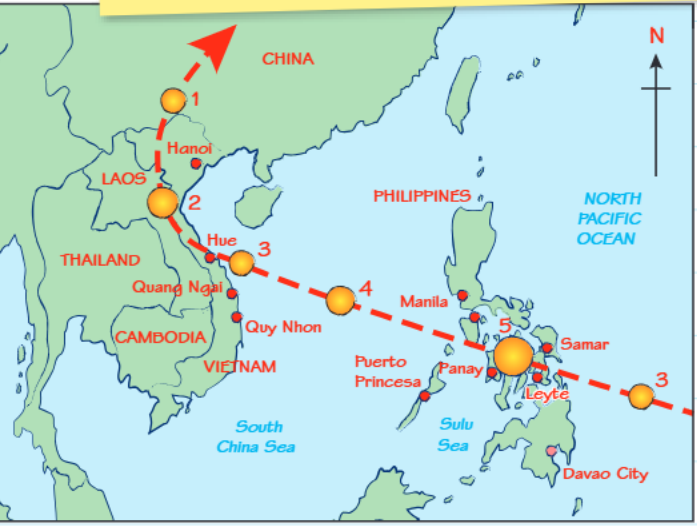
The typhoon followed a destructive path across the central Philippines, affecting multiple islands as it travelled westward. The storm's route took it directly through some of the most densely populated areas of the archipelago, maximising the potential for widespread damage and casualties.
The Philippine islands of Samar and Leyte bore the brunt of the typhoon's fury, experiencing the most severe destruction as the storm made its initial landfall. These islands faced the full force of the typhoon's winds and storm surge before the system continued its westward journey across the island nation.
Important
The typhoon's path through densely populated areas significantly increased the disaster's impact. Understanding the relationship between storm tracks and population density is crucial for disaster preparedness and risk assessment.
Impacts of Typhoon Haiyan
The typhoon's impacts can be categorised into three main areas: social, environmental, and economic consequences that affected millions of people across the Philippines.
Social impacts
The human cost of Typhoon Haiyan was devastating. The death toll reached approximately 6000 people, with many more reported missing in the aftermath of the disaster. Beyond the tragic loss of life, the typhoon created a massive humanitarian crisis.
An estimated 600,000 people were forced to flee their homes, becoming displaced persons who required emergency shelter and support. The destruction was so widespread that many residents lost not just their possessions but their entire homes, leaving countless families homeless and dependent on aid.
Note
Understanding Displacement
Displacement occurs when people are forced to leave their homes due to disasters. This creates secondary challenges including:
- Overcrowded emergency shelters
- Increased disease transmission risk
- Disrupted education and employment
- Psychological trauma and social stress
The scale of displacement meant that normal social services became overwhelmed, creating additional challenges for survivors who needed medical care, education for children, and basic necessities for daily survival.
Environmental impacts
The natural environment across the affected islands suffered extensive damage that took years to recover from. Coastal mangrove forests, which serve as natural barriers against storm surges and provide important ecosystem services, were severely damaged across the islands.
Widespread deforestation occurred as the typhoon's powerful winds uprooted and destroyed trees across vast areas. This loss of forest cover not only affected local ecosystems but also reduced the natural protection these areas normally provide against future storms.
Note
Environmental Chain Reactions
Environmental damage from typhoons creates cascading effects:
- Mangrove destruction reduces coastal protection
- Deforestation increases flood and landslide risks
- Pollution affects marine food chains
- Habitat loss threatens biodiversity
An additional environmental concern arose when an oil tanker was damaged during the storm, causing sea pollution that affected marine ecosystems and coastal areas. This type of secondary environmental damage often accompanies major disasters, creating long-term ecological challenges.
Economic impacts
The economic consequences of Typhoon Haiyan were enormous, with damage estimates reaching US$2 billion. This figure represents not just the immediate cost of destroyed infrastructure and property, but also the long-term economic disruption caused by the disaster.
Critical infrastructure across the islands was severely damaged or completely destroyed, making the provision of aid and support both difficult and expensive. Roads, bridges, airports, and ports all suffered damage that blocked transport networks, hampering rescue efforts and delaying the delivery of emergency supplies.
Example
Economic Impact Assessment: Infrastructure Damage
The economic losses included:
- Transportation: Airports, ports, and road networks destroyed
- Communications: Cell towers and internet infrastructure damaged
- Housing: Thousands of homes completely destroyed
- Agriculture: Crops and farmland severely affected
- Tourism: Resort areas devastated, affecting long-term income
Total reconstruction costs exceeded the annual GDP of many developing nations.
The widespread destruction meant that normal economic activities ceased in many areas, affecting everything from agriculture to manufacturing and services. The cost of rebuilding and recovery placed enormous strain on both local and national government resources.
Responses to Typhoon Haiyan
The response to this disaster involved efforts at individual, organisational, and governmental levels, demonstrating how major natural disasters require coordinated international action.
Individual responses
People in countries around the world, including the United Kingdom and Canada, made personal donations to support relief efforts. These individual contributions, whilst seemingly small, collectively provided significant resources for emergency aid and longer-term recovery programmes.
Many individuals also volunteered their time and skills to support relief organisations, contributing professional expertise in areas such as medicine, engineering, and logistics that proved crucial during the emergency response phase.
Organisational responses
The World Health Organisation played a vital role in coordinating the international response, helping to ensure that the Philippine government received appropriate support to address the acute healthcare needs created by the disaster.
Note
International Coordination
Major disasters require coordinated responses because:
- No single country has all necessary resources
- Specialised expertise must be shared globally
- Avoiding duplication of efforts maximises efficiency
- International standards ensure quality of aid
International humanitarian organisations mobilised rapidly to provide emergency supplies, medical care, and temporary shelter for displaced populations. These organisations brought both resources and expertise that complemented local response efforts.
Government responses
In recognition of the disaster's scale, the Philippines government declared a 'state of national calamity', which enabled special measures to be implemented for emergency response and recovery efforts.
International governments provided substantial aid packages to support both immediate relief and longer-term reconstruction. The United Kingdom, for example, contributed a £10 million aid package that included emergency shelter materials, clean water supplies, and essential household items for affected families.
Example
Government Aid Package: UK Response
The UK's £10 million contribution included:
- Emergency shelter materials: Tarpaulins and temporary housing supplies
- Clean water systems: Water purification tablets and filtration equipment
- Essential supplies: Blankets, hygiene kits, and cooking equipment
- Logistical support: Transport and distribution coordination
- Technical expertise: Disaster management specialists
These government responses involved not just financial support but also technical expertise, emergency supplies, and logistical support that proved essential for managing such a large-scale disaster.
Important
Exam Technique Tips
When answering questions about tropical cyclone case studies like Typhoon Haiyan:
- Always use specific located examples you have studied in class - examiners look for detailed evidence
- Include specific facts, figures, and place names to demonstrate comprehensive knowledge
- Structure impact questions by discussing social, environmental, and economic consequences separately
- Use specific examples from your case study to support each point
- Show understanding of how natural disasters affect different aspects of human and physical systems
Summary
Key Points to Remember:
-
Formation: Typhoon Haiyan formed on 2 November 2013 and generated winds exceeding 300 km/h, making it one of the most powerful typhoons ever recorded
-
Human Impact: The disaster caused approximately 6000 deaths and displaced around 600,000 people, primarily affecting the Philippine islands of Samar and Leyte
-
Economic Cost: Economic damage reached US$2 billion, with widespread destruction of infrastructure hampering relief efforts and long-term recovery
-
International Response: The response involved international coordination, with organisations like the WHO and governments such as the UK providing substantial aid packages
-
Case Study Significance: This demonstrates how tropical cyclones can have devastating social, environmental, and economic impacts, particularly in developing countries with vulnerable populations