A rapidly growing city (Edexcel GCSE Geography A): Revision Notes
📚Revision Notes
A rapidly growing city
Introduction
A rapidly growing city experiences significant population increases over relatively short time periods. These cities are typically found in developing or emerging countries and face unique challenges and opportunities as their populations expand. Understanding the patterns, causes, and consequences of rapid urban growth is essential for geographical analysis.
Note
Rapid urban growth is one of the most significant demographic phenomena of the modern world, particularly affecting cities in Asia, Africa, and Latin America where economic development is accelerating.
Case study: Mexico City
Mexico City serves as an excellent example of rapid urban growth, transforming from a modest city into one of the world's largest metropolitan areas within just a few decades.
Note
Why Mexico City?
Mexico City provides an ideal case study because it demonstrates all the key characteristics of rapid urban growth: dramatic population increase, multiple growth drivers, and significant urban challenges. Its transformation is well-documented and represents patterns seen across many developing world cities.
Population growth patterns
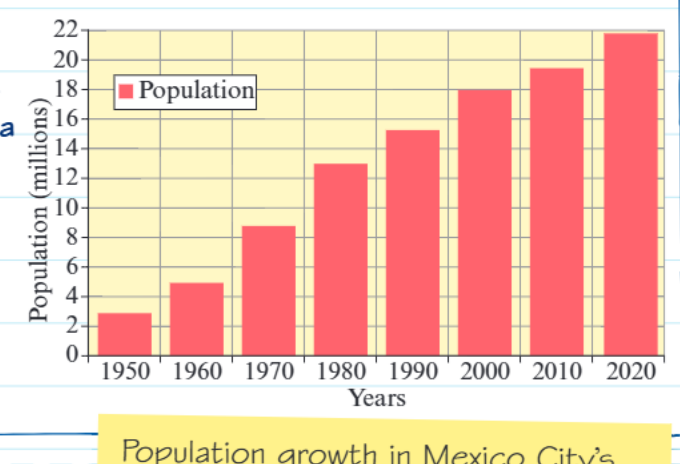
Mexico City has experienced extraordinary population growth since the mid-20th century. The city's expansion demonstrates how quickly urban areas can develop in emerging economies.
Important
Remarkable Urban Transformation
The data reveals a remarkable transformation. In the 1950s, Mexico City housed approximately 2 million people, but by 2024, the urban area had grown to accommodate roughly 22 million residents. This represents more than a ten-fold increase in population over seven decades.
The rate of growth has also changed significantly over time. During the 1950s, Mexico City experienced an annual growth rate of 5.5%, which was exceptionally high. However, by 2024, this growth rate had slowed to approximately 1% per year, indicating that whilst the city continues to expand, the pace of growth has moderated.
Greater Mexico City now holds the distinction of being the most populated metropolitan area in the Western Hemisphere, highlighting its significance as a major global urban centre.
Causes of population growth
The rapid expansion of Mexico City results from three primary factors that work together to drive urban growth.
Natural increase
During the 1950s, Mexico City experienced significant natural population increase. This occurred because the city had high birth rates whilst death rates were falling. Medical improvements, better healthcare access, and improved living conditions contributed to people living longer, whilst cultural factors maintained high fertility rates. This combination meant that many more people were born than died each year, causing the population to grow rapidly from within.
Note
Natural increase occurs when birth rates exceed death rates in a population. In developing cities during the mid-20th century, this was often the primary driver of population growth as healthcare improvements reduced mortality while birth rates remained high.
National and international migration
Migration represents the movement of people from one place to another, and this has been crucial for Mexico City's growth. National migration refers to people moving within Mexico, whilst international migration involves people moving to Mexico from other countries.
The primary source of migrants to Mexico City comes from rural areas within Mexico itself. People living in the countryside often face limited job opportunities, poor housing conditions, inadequate access to clean water, and limited healthcare. The promise of better employment prospects, improved housing, cleaner water supplies, and enhanced healthcare draws many rural residents to seek new lives in the capital city.
Note
Push and Pull Factors
Rural-urban migration is driven by "push factors" (problems in rural areas like poverty and lack of services) and "pull factors" (attractions of city life like jobs and better infrastructure). Understanding these factors helps explain why people choose to migrate despite the challenges they may face in cities.
International migration to Mexico City is less significant in terms of numbers, but still contributes to growth. Fewer migrants arrive from countries such as the USA, Germany, and France. These international migrants often have different characteristics from internal migrants, typically possessing more wealth and education, which means they tend to settle in the wealthier areas of the city.
Economic investment
The third major driver of population growth is economic investment, which creates job opportunities that attract people to the city. Increased investment in constructing factories and office buildings generates employment opportunities across various skill levels. These new jobs act as a magnet, drawing workers from both rural areas and other cities who seek better economic prospects.
Impacts of migration on Mexico City
The massive influx of people has created various challenges and changes within the city that affect both new arrivals and existing residents.
The enormous demand for housing has led to the development of extensive self-built housing and informal settlements around the city's edges. Many migrants cannot afford formal housing, so they construct their own homes using available materials, often without proper planning permission or infrastructure.
Important
Housing Crisis Challenge
The rapid population growth has created a severe housing shortage. When formal housing markets cannot meet demand, people create informal solutions, leading to sprawling settlements that often lack basic services like electricity, water, and sewage systems.
Population density has increased dramatically, with greater use of available open spaces. As more people crowd into the same areas, competition for space intensifies, leading to overcrowding and pressure on existing infrastructure.
The surge in population, particularly young adults seeking work, has increased car ownership levels. More vehicles on the roads contribute to both air pollution and noise pollution, creating health problems for residents and reducing quality of life.
Social segregation has become more pronounced, with wealthier residents increasingly living in gated communities that separate them from poorer areas. This fear of crime and desire for security has created distinct spatial divisions within the city.
Important
Infrastructure Under Pressure
Infrastructure struggles to keep pace with population growth, particularly in water supply systems. Rising demand places enormous pressure on the city's reservoirs and underground aquifers, making it difficult to provide clean water to all residents consistently.
Summary
Key Points to Remember:
- Mexico City grew from 2 million people in the 1950s to 22 million by 2024, making it the largest metropolitan area in the Western Hemisphere
- Three main causes drive rapid urban growth: natural increase (high birth rates, falling death rates), national migration (rural to urban movement), and economic investment (job creation)
- Rural-urban migration dominates population movement, with people seeking better jobs, housing, healthcare, and living conditions than available in countryside areas
- Rapid growth creates significant challenges including housing shortages, increased pollution, social segregation, and pressure on water supplies
- Growth rates can change over time - Mexico City's annual growth slowed from 5.5% in the 1950s to 1% by 2024 as the city matured