City living (Edexcel GCSE Geography A): Revision Notes
📚Revision Notes
City living
Understanding urban sustainability strategies
When studying changing cities, you need to understand how UK cities can implement various approaches to make urban living more environmentally friendly and improve residents' quality of life. Cities face numerous challenges including pollution, housing shortages, unemployment, and waste management issues. Successful urban sustainability requires coordinated strategies across multiple areas of city management.
Note
Urban sustainability is complex and multifaceted, requiring cities to address environmental, social, and economic challenges simultaneously. No single approach can solve all urban problems - success depends on integrated planning across different sectors.
Birmingham case study: strategies for urban sustainability
Birmingham provides an excellent example of how a major UK city can tackle sustainability challenges through comprehensive planning and investment.
Transport and air quality improvements
Birmingham City Council has focused heavily on reducing transport-related pollution and encouraging sustainable travel options. The city has developed several innovative approaches to tackle air quality issues.
One major initiative is the Clean Air Hydrogen Bus Pilot programme, which introduced a fleet of 20 hydrogen-powered buses as part of their zero-emission vehicle strategy. This represents a significant shift away from traditional diesel buses that contribute to urban air pollution.
Note
The transition from diesel to hydrogen buses represents a major technological shift in public transport. Hydrogen buses produce only water vapour as emissions, making them a truly zero-emission transport solution for urban areas.
The council also actively promotes alternative transport methods by encouraging residents to use public transport, participate in car-sharing schemes, walk, and cycle around the city. These combined efforts help reduce the number of private vehicles on the roads, leading to improved air quality and reduced traffic congestion.
Waste management and recycling
Birmingham has made substantial improvements to its recycling infrastructure to reduce the amount of waste sent to landfill sites. Currently, the city recycles approximately 30% of its waste, though this still falls short of the national average of 40%. This indicates there is room for further improvement, but the city has made progress in developing more effective waste collection and processing systems.
Important
Birmingham's recycling rate of 30% being below the national average of 40% highlights that even cities making progress in sustainability still face significant challenges in waste management. This gap represents both a challenge and an opportunity for further improvement.
Employment and education initiatives
Tackling youth unemployment
Youth unemployment remains a significant challenge in Birmingham, with rates that exceed the national average. In 2014, youth unemployment stood at 12%, but this figure rose to 15.5% by 2025. This compares unfavourably to the UK national rate of 8.1% in 2025, highlighting the need for targeted intervention strategies.
Important
The increase in Birmingham's youth unemployment from 12% to 15.5% between 2014 and 2025, while the national rate remained much lower at 8.1%, demonstrates that urban areas can face particular employment challenges that require specific local solutions.
Educational partnerships
Birmingham City Council works closely with educational institutions through the Birmingham Education Partnership to address employment challenges. This collaboration focuses on recruiting and retaining high-quality teachers across the city's schools.
The city operates 17 teaching schools, which represents one of the highest concentrations in the country. These schools play a crucial role in developing educational standards and training new teachers, creating a stronger foundation for young people's future employment prospects.
Housing and health improvements
Retrofitting existing homes
In December 2024, Birmingham City Council announced an ambitious programme to retrofit 3000 homes annually to improve their energy efficiency. This large-scale initiative involves several key improvements to existing housing stock.
The retrofitting programme includes installing new insulation and improving ventilation systems in older homes. Additionally, houses receive solar panel installations and more efficient heating systems to reduce overall energy consumption.
Example
Worked Example: Birmingham Home Retrofitting Process
Step 1: Assessment and Planning
- Survey existing home for energy efficiency gaps
- Identify areas needing insulation improvements
Step 2: Installation of Energy Efficiency Measures
- Install new insulation in walls, loft, and floors
- Upgrade ventilation systems for better air quality
Step 3: Renewable Energy Integration
- Install solar panels on suitable roofs
- Upgrade to efficient heating systems
Step 4: Impact Measurement
- Monitor energy consumption reduction
- Calculate cost savings for residents
These improvements are designed to reduce household fuel costs by £1.2 million per year across the city, making homes more affordable to heat while reducing carbon emissions.
Affordable housing development
Birmingham has addressed housing shortages through partnerships between Birmingham Municipal Housing Trust and Capita. These organisations work together to build new affordable housing for residents who struggle to access the private housing market.
Under this collaborative scheme, a total of 1576 houses have been constructed across different areas of the city. This represents a significant investment in providing quality, affordable accommodation for Birmingham residents.
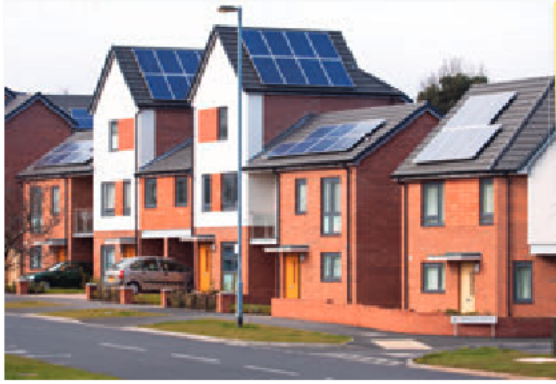
New affordable housing developments, such as those built in Kings Norton, Newton, and Northfield, feature modern design with integrated sustainability features. In 2015, a new affordable housing development was initiated in Solihull, including the construction of 13 one-bedroom and 14 two-bedroom apartments.
Summary
Key Points to Remember:
- UK cities use multiple integrated strategies to improve sustainability and quality of life for residents
- Birmingham's approach combines transport improvements, waste management, education partnerships, and housing initiatives
- The Clean Air Hydrogen Bus Pilot demonstrates how cities can reduce emissions through innovative public transport
- Retrofitting existing homes with solar panels and better insulation can significantly reduce energy costs while improving sustainability
- Partnerships between local councils, housing trusts, and educational institutions are essential for successful urban regeneration programmes