Global development (Edexcel GCSE Geography A): Revision Notes
📚Revision Notes
Geopolitics and technology in global development

Understanding how political relationships and technological advances influence global development is crucial for explaining why some countries and regions develop faster than others. This topic explores how geography shapes international politics and how technology creates both opportunities and challenges for development.
Understanding geopolitics
Geopolitics refers to how a country's location, physical features, and resources influence its relationships and political interactions with other nations. A country's geographical position can determine its economic opportunities, security concerns, and diplomatic strategies.
Note
Definition: Geopolitics is the impact of a country's human and physical geography on its international politics and relations. This includes factors like natural resources, strategic location, population size, and economic capacity.
Countries with strategic locations, abundant natural resources, or advanced economies often wield greater geopolitical influence. For example, nations like Japan and China have become economic rivals, with Japan working to strengthen political ties with India, which serves as China's economically powerful neighbour.
The world's most influential countries typically combine several factors: large economies, military capabilities, technological advancement, and strategic geographic positions. The United States, China, and Russia consistently rank among the most powerful nations globally, followed by countries like the UK, Germany, France, Japan, and South Korea.
How geopolitics shapes development

Countries actively use geopolitical strategies to promote their development through various approaches:
International partnerships help countries access new markets, technologies, and resources. Nations build relationships with leading economies to encourage investment in critical areas like defence, energy, and infrastructure development. These partnerships can provide access to advanced technology, financial resources, and expertise that accelerate development.
Military cooperation serves multiple development purposes beyond security. Defence agreements can include technology transfer, joint manufacturing projects, and access to advanced equipment. These arrangements often create jobs, develop local industries, and provide countries with income from exports.
Territorial management affects development by determining access to valuable resources like water, minerals, or strategic trade routes. Countries must carefully balance competitive relationships while avoiding conflicts that could disrupt development progress.
Note
Key Point: Geopolitical strategies work best when they create mutual benefits for all partners involved. One-sided relationships often prove unsustainable and can lead to diplomatic tensions.
Case study: India's geopolitical development strategy
India demonstrates how emerging economies use geopolitical relationships to support development. The country has implemented several strategies:
India has struck deals with countries like Canada to secure uranium supplies, essential for its nuclear energy programme. This partnership provides India with 3.2 million kilos of uranium, supporting energy security and economic growth.
The country has also negotiated defence agreements with major powers like the USA and Russia. These partnerships provide access to advanced military technology, create domestic manufacturing opportunities, and offer shared logistics for international operations including humanitarian assistance and disaster relief.
However, geopolitical relationships also create challenges. India faces territorial disputes with neighbouring countries like China and Pakistan, particularly over water resources and border regions. These conflicts require careful diplomatic management to prevent them from undermining development progress.
Technology as a driver of development
Technology plays an increasingly important role in global development, creating new opportunities for economic growth and social progress. Countries that successfully adopt and develop technology often experience faster development.
India's experience illustrates technology's development potential. The country now operates the world's second-largest wireless network and has developed its own advanced ICT (Information and Communication Technology) industry. This technological advancement has created employment opportunities, attracted international investment, and improved access to services like education and healthcare.
Technology supports development by:
- Improving communication and access to information
- Creating new industries and employment opportunities
- Enhancing efficiency in agriculture, manufacturing, and services
- Connecting remote areas to markets and opportunities
- Enabling better delivery of education and healthcare services
The digital divide challenge
Despite technology's potential, unequal access creates development challenges known as the digital divide. This divide exists between different groups:
Core and periphery regions experience vastly different levels of technological access. Urban, wealthy areas (core regions) typically have excellent connectivity, while rural, poorer areas (periphery regions) lag behind significantly.
Income-based divisions create stark contrasts in technology access. In many developing countries, the wealthiest 20% of households enjoy internet access rates exceeding 50%, while the poorest 20% of households may have access rates as low as 9%.
Important
Critical Impact: This digital divide can widen existing development gaps, as those with better technology access gain more opportunities for education, employment, and economic participation. Without targeted policies, the gap between connected and disconnected populations will continue to grow.
Measuring development variations within countries
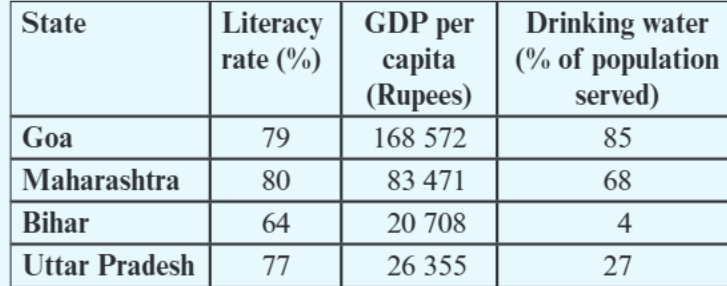
Development varies significantly within countries, not just between them. Regional data helps understand these variations and plan targeted development strategies.
Different regions within the same country can show remarkable development contrasts. When examining key development indicators like literacy rates, economic output per person (GDP per capita), and access to basic services like clean drinking water, significant variations become apparent.
Example
Worked Example: Calculating Mean Literacy Rate
To calculate the average literacy rate across different regions, use the formula:
If four regions have literacy rates of 79%, 80%, 64%, and 77%:
Step 1: Add all values together
Step 2: Divide by the number of regions
Therefore, the mean literacy rate is 75%.
However, this average can hide important variations. While some regions may achieve literacy rates approaching 80%, others might struggle with rates below 65%. Similarly, economic prosperity and access to basic services like clean water can vary dramatically between regions within the same country.
These variations often reflect the core-periphery pattern, where central, urban regions develop faster than remote, rural areas. Understanding these patterns helps governments and international organisations target development support where it's most needed.
Summary
Key Points to Remember:
- Geopolitics combines geography and politics - a country's location and resources shape its international relationships and development opportunities
- Strategic partnerships help countries access technology, resources, and markets that accelerate development, but also create dependencies and potential conflicts
- Technology drives development by creating opportunities and improving services, but the digital divide means benefits are unequally distributed
- Development varies significantly within countries - core regions typically develop faster than periphery areas, creating internal inequalities that require targeted policies
- Multiple indicators (literacy, income, basic services) are needed to understand development patterns and measure progress effectively