Defining development (Edexcel GCSE Geography A): Revision Notes
📚Revision Notes
Defining development
Understanding what development means is crucial for studying global patterns and processes. Development is much more complex than simply measuring a country's wealth, and there are multiple ways to assess how developed a nation truly is.
What is development?
Development refers to how advanced one country is when compared to others around the world. At its core, development measures the standard of living within a country - essentially whether people can afford the basic necessities they need to survive and thrive. However, modern understanding of development goes far beyond just economic wealth.
Note
True development encompasses the overall quality of life that people experience within their country. This means considering not just income levels, but also factors like health care access, educational opportunities, personal freedoms, and environmental quality.
A country might have significant natural resources or industrial output, but if its citizens lack access to clean water, education, or healthcare, it cannot be considered truly developed. This comprehensive view of development helps us understand why some wealthy nations may still struggle with development challenges in certain areas.
Factors affecting human development
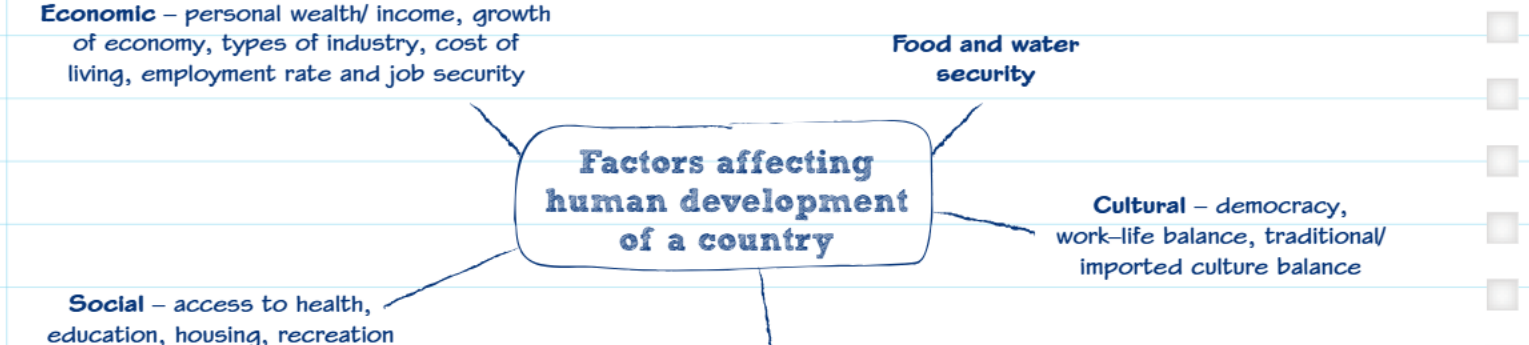
Multiple interconnected factors influence how developed a country becomes. These factors work together to create the overall development picture for any nation.
Economic factors
Economic elements form the foundation of development, affecting people's ability to meet their basic needs and improve their circumstances. Personal wealth and income levels determine what individuals can afford, whilst broader economic growth creates opportunities for everyone. The types of industries present in a country matter significantly - manufacturing and service industries typically provide better wages and more stable employment than purely agricultural economies.
Cost of living varies dramatically between countries and affects how far people's incomes stretch. Employment rates and job security give people confidence to invest in their futures, whether through education, housing, or starting families. Countries with diverse, stable economies tend to offer better development outcomes for their citizens.
Social factors
Social development focuses on the services and opportunities available to people within society. Access to quality healthcare ensures people can live longer, healthier lives and remain productive members of society. Educational opportunities, from primary school through to higher education and vocational training, provide people with the skills they need to improve their circumstances.
Housing quality affects health, safety, and dignity, whilst access to recreational facilities contributes to mental wellbeing and community cohesion. Countries that invest heavily in social infrastructure typically see better overall development outcomes, as healthy, educated populations are more productive and innovative.
Cultural factors
Cultural aspects of development involve the political and social freedoms that people enjoy. Democratic systems allow citizens to have a voice in decisions that affect their lives, leading to policies that better serve the population's needs. Work-life balance affects quality of life and family stability, whilst the relationship between traditional and imported cultural influences shapes how societies adapt to globalisation whilst maintaining their identity.
Technological factors
Technology plays an increasingly important role in modern development. Access to electricity enables education after dark, powers healthcare equipment, and allows businesses to operate more efficiently. Internet connectivity opens up educational opportunities, enables communication with distant markets, and allows people to access information and services.
Better agricultural and industrial machinery improves productivity, meaning fewer people need to work in basic food production and more can pursue education or other economic activities. Countries that successfully adopt and adapt new technologies tend to develop more rapidly.
Food and water security
Having reliable access to adequate nutrition and clean water forms the most basic requirement for human development. Without these essentials, people cannot participate fully in education, work, or community life.
Important
Food and water security are fundamental prerequisites for all other aspects of development. No country can achieve true development if its population lacks access to these basic necessities.
How low-income countries develop
Countries at earlier stages of development can improve their situations through several key strategies. Investment in agricultural improvements leads to higher crop yields, allowing farmers to sell more produce and communities to eat better. Expanding electricity grids to reach rural areas enables education, healthcare, and business opportunities in previously isolated regions.
Building transport infrastructure like new roads and railways connects remote communities with cities, allowing people to access markets, jobs, and services. Rising literacy rates create better employment prospects for individuals whilst providing the country with a more skilled workforce. Promoting gender equality ensures that the talents and contributions of all citizens can be utilised, rather than limiting half the population's potential.
Food security explained
Food security exists when all people have reliable access to sufficient quantities of affordable, nutritious food. Many countries struggle with food security due to an imbalance between what they can produce and what their populations need to consume.
Example
Understanding Food Security Components
Food security depends on three critical components working together:
1. Availability: Having enough food produced or imported to meet the population's needs throughout the year.
2. Access: People's ability to obtain appropriate food - they might live in areas where food is available but lack the income to purchase it or the transport to reach it.
3. Knowledge: Understanding how to make the best use of available food resources, including knowing how to prepare nutritious meals, store food safely, and maintain balanced diets.
Without all three components, populations remain food insecure even when some elements are present.
Water security and development
Access to safe, clean water serves as a fundamental building block for human development. When people have reliable water access, it creates positive ripple effects throughout society. Families no longer need to spend hours each day collecting water from distant sources, freeing up time for education and productive work.
Children can attend school regularly rather than missing classes to help fetch water, whilst women can engage in income-generating activities instead of dedicating their entire day to water collection. Having clean water nearby also dramatically improves health outcomes, as people suffer fewer water-related illnesses that prevent them from working or learning.
Important
Critical Water Security Statistics
- Approximately one in four people worldwide lack access to safely managed drinking water
- This affects roughly 2 billion people globally
- Each year, around 1 million people die from water-related diseases
These statistics highlight how critical water security is for basic human survival and development.
Summary
Key Points to Remember:
- Development measures much more than just wealth - it includes quality of life, health, education, and freedoms
- Five main factor categories affect development: economic, social, cultural, technological, and food/water security
- Low-income countries can develop through strategic investments in agriculture, infrastructure, education, and equality
- Food security requires availability, access, and knowledge working together
- Water security creates positive effects across education, health, gender equality, and economic opportunities