Measuring development (Edexcel GCSE Geography A): Revision Notes
📚Revision Notes
Measuring development
Development can be assessed using various methods, each providing different insights into a country's progress and quality of life. Understanding these different measures helps us get a more complete picture of how developed a country really is.
What is development measurement?
Development measurement involves using statistics to assess the level of progress in a country or region. These measurements fall into two main categories:
- Economic indicators - focusing on wealth and financial progress
- Social and political measures - looking at quality of life and governance
Some aspects of development are straightforward to measure (such as birth rates), while others are much more complex (like how safe people feel in their communities).
Note
The complexity of measuring development means that no single indicator can tell the whole story. This is why economists and policymakers use multiple measures to build a comprehensive understanding of a country's development status.
Key development indicators
Gross domestic product (GDP)
GDP represents the total value of all goods and services produced within a country during one year. It's essentially a measure of a country's economic output and is often used to compare the economic size of different nations.
However, GDP alone doesn't tell us much about individual living standards because it doesn't account for population size. A country might have a large GDP simply because it has many people, not because each person is wealthy.
Important
Critical Limitation of GDP: GDP measures total economic output but tells us nothing about how that wealth is distributed among the population. A country could have high GDP but most citizens could still be living in poverty.
GDP per capita
This measure divides a country's total GDP by its population, giving us the average economic output per person. GDP per capita provides a much better indication of individual wealth and living standards than total GDP alone.
Example
Worked Example: Comparing GDP vs GDP per capita
Consider Luxembourg and India:
- India: Large total GDP due to massive population, but lower GDP per capita
- Luxembourg: Much smaller total GDP, but very high GDP per capita due to small, wealthy population
This shows why GDP per capita is a better measure for comparing individual living standards between countries.
Human development index (HDI)
The HDI takes a broader approach to measuring development by combining three key factors:
- Gross National Income (similar to GDP per capita)
- Life expectancy at birth
- Average years of education
This creates a more comprehensive picture of development that goes beyond just economic wealth to include health and education outcomes.
Note
The HDI was developed by the United Nations to address the limitations of purely economic measures. By including health and education alongside income, it provides a more holistic view of human development and quality of life.
Comparing countries by different measures
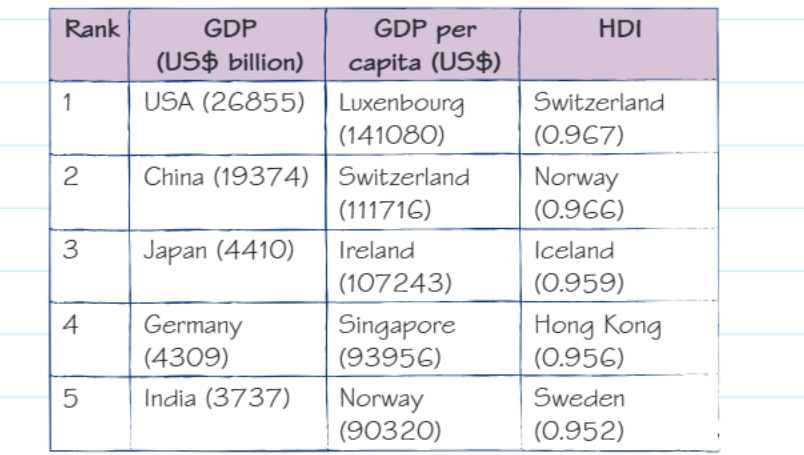
Different countries rank very differently depending on which development measure we use:
Important
Why Multiple Measures Matter: This table demonstrates a crucial point - economic size, individual wealth, and overall human development don't always align. The USA leads in total GDP, Luxembourg in GDP per capita, and Switzerland in HDI rankings. This is why economists always recommend using multiple indicators together.
Limitations of development measures

All development measures have significant limitations that we must consider:
Important
Critical Limitations to Remember:
Averages only: These measures show national averages, which can hide huge inequalities within countries. A country might have a high GDP per capita overall, but this could mask the fact that most people are poor whilst a small elite are extremely wealthy.
Data accuracy: Information may not always be reliable or up-to-date, particularly in developing countries where data collection systems might be less sophisticated.
Missing economic activity: GDP figures don't capture the informal or 'cash economy' - economic activity that isn't officially recorded, such as subsistence farming or small-scale trading.
Political corruption and development
The quality of government significantly impacts a country's development. Political corruption can hinder progress by diverting resources away from public services and creating an unfair business environment.
Note
The Corruption Perceptions Index This index measures government quality on a scale from 'highly corrupt' to 'very clean'. Research consistently shows that countries with cleaner governments typically achieve better development outcomes because resources are used more effectively for public benefit.
Measuring inequality: the Gini coefficient
Economic inequality within countries can be measured using the Gini coefficient. This statistical measure is expressed as a ratio from to :
Example
Understanding the Gini Coefficient Scale
- = perfect equality (everyone has exactly the same income)
- = perfect inequality (one person has all the income, everyone else has nothing)
Most countries fall somewhere between these extremes, with lower numbers indicating more equal income distribution and higher numbers showing greater inequality.
Summary
Key Points to Remember:
- GDP measures total economic output - useful for comparing economic size but not individual wealth
- GDP per capita shows average wealth per person - better for comparing living standards between countries
- HDI combines income, health and education - gives the most complete picture of human development
- All measures have limitations - they show averages and may not reflect reality for all citizens
- Multiple measures needed - using different indicators together gives a more accurate assessment of development