Trade, aid and investment (Edexcel GCSE Geography A): Revision Notes
📚Revision Notes
Trade, aid and investment
Introduction
Trade, aid and investment are three crucial economic processes that significantly influence a country's development. These processes work together to shape economic growth, social progress and demographic changes. For developing or emerging countries, understanding how these elements interact is essential for promoting sustainable development.
Note
These three economic processes are deeply interconnected - changes in one area often trigger developments in the others. For example, increased trade often attracts more investment, while successful development may reduce a country's need for aid.
International trade patterns
International trade involves the exchange of goods and services between countries. Countries export products they can produce efficiently and import those they need but cannot produce as effectively themselves.
Important
Understanding comparative advantage is crucial: countries benefit most when they specialise in producing goods and services where they have the greatest efficiency advantage, then trade for other necessities.
India's trade characteristics
India provides an excellent example of how trade patterns can transform as a country develops. During the 1990s, significant changes in India's trading policies resulted in a dramatic increase in both imports (goods coming into the country) and exports (goods leaving the country).
Example
India's Trade Integration Example
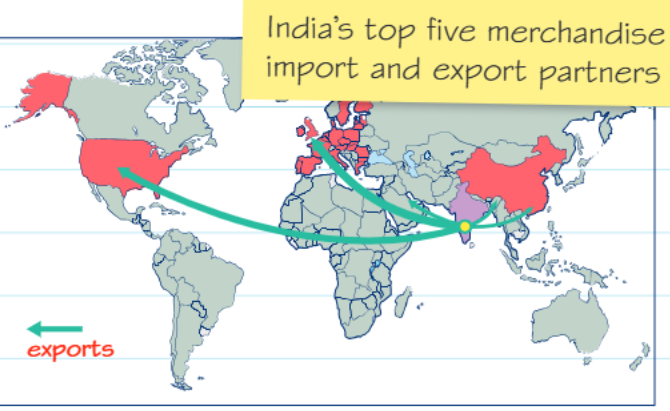
India has established strong trading relationships with several major economies around the world. The country's main trading partners include the United States, China, and various European nations. These partnerships demonstrate India's integration into global supply chains and international markets.
Trade performance and rankings
India's position in global trade has improved considerably over recent decades. By 2014, India had achieved the 17th position worldwide for exporting merchandise (physical goods). Even more impressively, by 2022, India ranked 7th globally for exporting commercial services, which include areas like information technology, business services, and telecommunications.
Note
The improvement from 17th in merchandise exports to 7th in commercial services exports highlights India's economic transformation towards high-value service industries, particularly in technology and business services.
Key trade products
India's export economy focuses on several high-value sectors. The country's most important exports by value include:
- Oil products
- Gems and jewellery
These reflect both India's manufacturing capabilities and its role in global value chains. On the import side, India primarily brings in:
- Crude oil
- Gold
- Silver
- Electrical goods
This highlights the country's energy needs and consumer demands.
International aid patterns
International aid refers to financial assistance, resources, or expertise provided by one country to another to support development goals. The relationship between countries regarding aid can change significantly as economic conditions evolve.
Changing aid relationships
Important
As countries develop economically, their relationship with international aid typically transforms. This transition represents a key milestone in development success.
India demonstrates this transition clearly - as the country has developed, international aid flowing into India has decreased substantially. Simultaneously, India has begun providing aid to other developing nations, particularly Nepal and other countries in its region.
Example
India's Aid Transformation
India's journey from aid recipient to aid donor illustrates successful development. The country now uses its growing economic strength to support regional development, demonstrating how successful development can create positive cycles of assistance.
Aid distribution priorities
Most of the aid that India now provides focuses on supporting the poorest areas or improving essential infrastructure in recipient countries. This approach reflects how developed countries can use their resources to support sustainable development elsewhere.
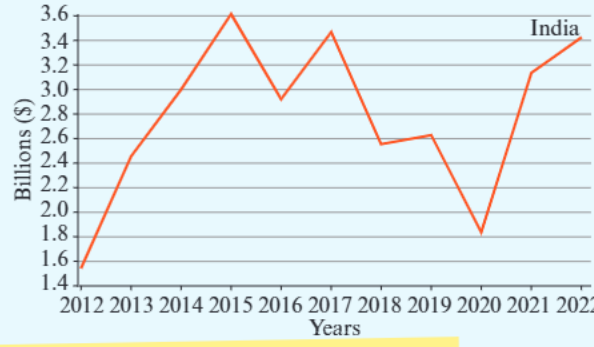
The graph showing India's net foreign aid from 2012-2022 reveals interesting patterns. Net foreign aid represents the difference between aid received and aid given by a country. The data shows that the gap between aid received and aid given shrank dramatically in 2020, falling from over 3 billion dollars to less than 2 billion, before recovering in subsequent years.
Investment in development
Investment plays a fundamental role in economic development, and it can come from different sources with varying characteristics and impacts.

Public investment
Public investment involves government spending on essential services and infrastructure. In India, this includes significant government expenditure on:
- Education
- Health
- Transport
- Housing
Note
These investments are crucial for development because they provide the foundation that enables economic growth and improves quality of life. Unlike private investment, public investment often focuses on areas that may not be immediately profitable but are essential for society.
India's public sector remains substantial, employing more people than equivalent sectors in the UK or USA. This reflects the important role that government plays in providing services and driving development in emerging economies.
Private investment
Private investment comes from transnational corporations (TNCs) and smaller businesses. This type of investment has become increasingly important for India's economic development and has grown significantly over recent decades.
Private investment often brings advantages such as:
- Advanced technology
- Management expertise
- Access to global markets
Important
However, private investment typically focuses on profitable sectors rather than basic services that might not generate immediate returns. This is why balancing public and private investment is crucial for comprehensive development.
Balancing public and private investment
Since the 1990s, India has worked to reduce the divide between public and private sectors, encouraging both types of investment to work together more effectively. This balanced approach helps ensure that essential services receive adequate funding while also promoting economic growth through private enterprise.
Summary
Key Points to Remember:
- Trade relationships evolve with development - As countries like India develop, they become more integrated into global trade networks and improve their international rankings
- Aid patterns reverse with growth - Successful developing countries transition from aid recipients to aid donors, supporting other nations' development
- Investment requires balance - Both public investment (government spending on essentials) and private investment (business spending for profit) are necessary for comprehensive development
- Economic integration matters - Countries benefit from participating in international trade, receiving appropriate aid, and attracting diverse forms of investment
- Development is interconnected - Trade, aid and investment work together to create the conditions for sustainable economic and social progress