Attitudes and technology (Edexcel GCSE Geography A): Revision Notes
📚Revision Notes
Attitudes and technology
Different people and groups have varying approaches to using and managing water resources. Understanding these different attitudes helps explain why water management strategies differ across regions. Technology also plays a crucial role in addressing water scarcity through innovative solutions like desalination.
Different stakeholder attitudes to water use
Water resource management involves multiple stakeholders who each have different priorities and approaches. These stakeholders include individual people, organisations like businesses, and government bodies. Their varying attitudes towards water exploitation and consumption create different management strategies.
Note
Understanding the diverse perspectives of different stakeholders is crucial for developing effective water management policies. Each group brings unique priorities, resources, and constraints to water conservation efforts.
Las Vegas case study: varied approaches to water management
Las Vegas in Nevada provides an excellent example of how different groups respond to water scarcity challenges in contrasting ways.
Note
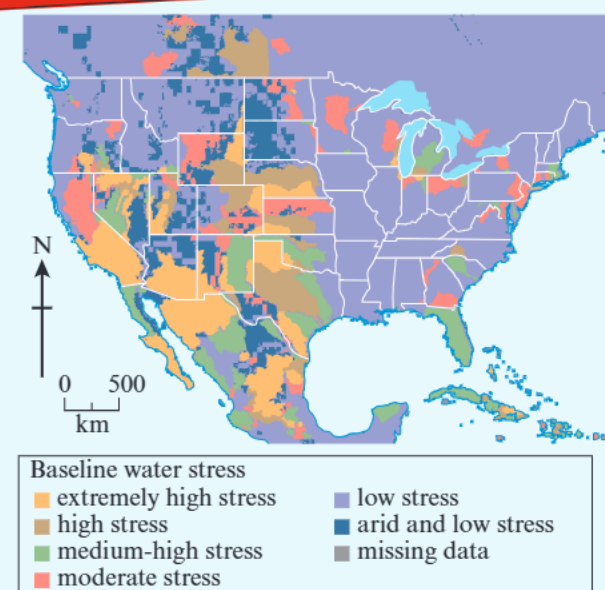
The map above shows that the western United States, including Nevada where Las Vegas is located, experiences extremely high water stress levels. This creates pressure for different stakeholders to adapt their water use practices.
Individual responses
People living in Las Vegas have responded to water scarcity in different ways. Some residents have embraced xeriscaping, which involves removing traditional grass lawns and replacing them with desert-friendly landscaping. This includes using rocky materials and planting desert plants such as cacti that need much less water to survive. However, not all individuals have adopted these changes - some residents prefer to maintain their traditional grass lawns despite the water shortage.
Note
The mixed adoption of water-saving practices by individuals demonstrates how personal preferences and cultural attitudes can influence conservation efforts. While some embrace sustainable alternatives, others resist changing established lifestyle patterns.
Organisational approaches
Business organisations in Las Vegas have shown mixed responses to water conservation needs. Some casino operators, such as those running the Bellagio, have implemented sustainable water management practices. These include systems for recycling and reusing wastewater, demonstrating how businesses can reduce their environmental impact while continuing operations.
Government initiatives
The Las Vegas local government has taken a proactive stance on water conservation by implementing policies that encourage sustainable domestic water use. These measures include providing financial incentives for residents who remove their lawns and replace them with water-efficient desert gardens. Additionally, the government has introduced regulations that prevent new housing developments from including grass in their front garden designs.
Important
Government intervention plays a crucial role in water conservation success. Through a combination of incentives and regulations, authorities can encourage behavioural change and ensure new developments meet sustainability standards.
Desalination technology
Desalination represents a major technological solution for addressing water scarcity. This process removes salt and other minerals from seawater, converting it into fresh water suitable for human consumption, agricultural irrigation, and industrial use. Given that approximately 97% of the world's water exists in oceans, desalination offers access to an enormous potential water source.
Advantages of desalination
Desalination technology offers several significant benefits for water-stressed regions. The ocean provides an abundant and reliable water source that doesn't depend on unpredictable factors like rainfall or seasonal variations. This means communities can access water supplies without relying on groundwater reserves or competing with other users for limited freshwater resources. The technology provides a consistent solution that can operate regardless of weather conditions or climate changes.
Note
Key Benefits of Desalination:
- Provides access to virtually unlimited ocean water resources
- Operates independently of weather patterns and seasonal variations
- Reduces competition for limited freshwater sources
- Offers reliable water security for coastal communities
Disadvantages of desalination
Despite its benefits, desalination faces several important challenges. The technology requires substantial ongoing maintenance, with equipment needing regular cleaning to prevent salt buildup and maintain efficiency. The initial construction costs for desalination plants are extremely high, making them expensive investments for communities. Additionally, the process can harm marine ecosystems as fish and other sea creatures may be drawn into the intake systems and killed during the desalination process.
Important
Critical Challenges to Consider:
- High capital investment costs can be prohibitive for many communities
- Ongoing maintenance requirements increase operational expenses
- Environmental impact on marine life through intake systems
- Significant energy consumption contributes to carbon footprint
The desalination process
The desalination process works by drawing seawater through intake systems and using energy-intensive methods to separate salt and minerals from the water. The process produces both fresh water for human use and a concentrated salt/mineral byproduct. While the technology is effective, it requires significant energy inputs, which contributes to its high operational costs.
Example
Desalination Process Overview:
Step 1: Seawater intake through specialised systems
Step 2: Pre-treatment to remove large particles and organisms
Step 3: High-pressure filtration through reverse osmosis membranes
Step 4: Post-treatment to adjust mineral content and pH levels
Step 5: Distribution of fresh water and disposal of concentrated brine
Summary
Key Points to Remember:
- Different stakeholders (individuals, organisations, governments) have varying attitudes towards water conservation, leading to diverse management strategies
- Las Vegas demonstrates how water stress creates different responses - from individual xeriscaping to government incentive programmes
- Desalination technology offers access to ocean water resources but comes with high costs and maintenance requirements
- Understanding stakeholder attitudes helps explain why some water management strategies succeed while others face resistance
- Technology like desalination provides solutions to water scarcity but requires careful consideration of environmental and economic impacts