Changing water use (Edexcel GCSE Geography A): Revision Notes
📚Revision Notes
Changing water use
What is changing water use?
Over the past 50 years, patterns of water supply and demand across the globe have shifted dramatically due to human activities and development. These changes reflect how different regions have developed economically and socially, leading to varying levels of water consumption worldwide.
Note
Understanding changing water use patterns is crucial for predicting future water resource challenges and planning sustainable water management strategies as global development continues.
Global patterns of water consumption
Water consumption patterns vary significantly between different world regions, largely reflecting their level of economic development.
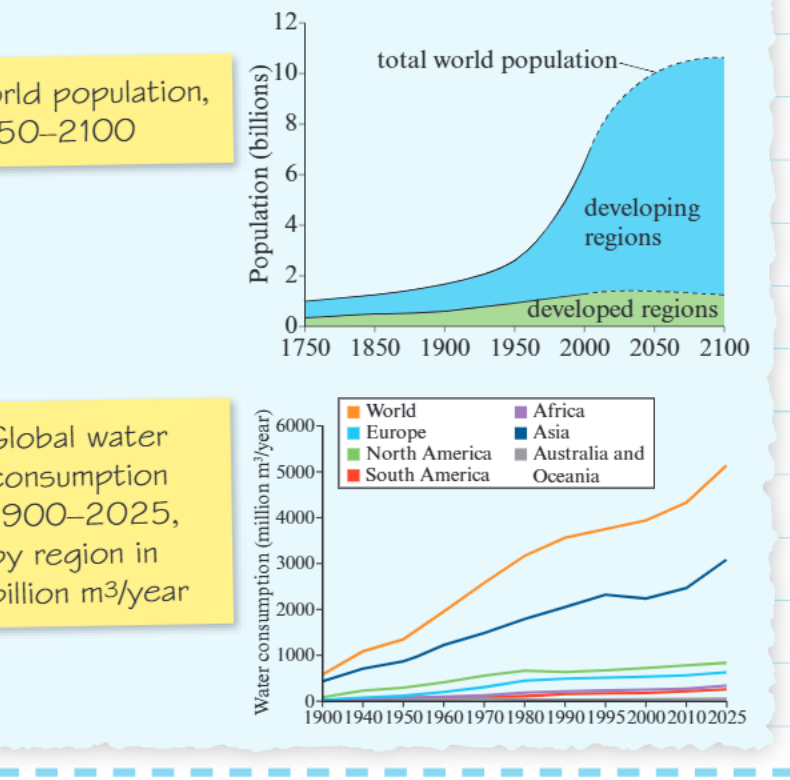
Developing regions have experienced the most dramatic changes in water use. Asia, as a developing region, saw the largest increase in water consumption from 1900 onwards. However, this growth wasn't consistent - there was actually a temporary decrease after 1995, followed by renewed increases from 2010 onwards as development accelerated again.
Developed regions show different patterns. North America and Europe, being already developed by 1980, experienced only modest increases in water consumption from that point forwards. These regions have maintained relatively stable water use patterns because their infrastructure and living standards were already established.
:::note Development-Water Consumption Relationship
The relationship between economic development and water consumption isn't linear. Developing regions show rapid increases during industrialisation phases, while developed regions maintain more stable consumption levels once infrastructure and living standards are established. :::
Other developing regions like Africa and South America currently have lower overall water consumption compared to Asia, but both have shown gradual increases since the 1970s as development progresses in these areas.
Oceania and Australia represent unique cases, maintaining the lowest water consumption levels by continent with minimal changes between 1900 and 2025, largely due to their smaller populations and geographic characteristics.
Reasons for changing water use patterns
As countries develop economically, their standard of living improves, which directly impacts water consumption in five key ways:
Industrial mechanisation
When countries industrialise, they require significantly more water for manufacturing processes. Industries need water to produce food and beverages, and large amounts are also needed to cool down heavy machinery during production. This industrial demand represents one of the largest increases in water use as countries develop.
Labour-saving household devices
Modern appliances have transformed domestic water use. Washing machines consume approximately 80 litres of water per wash cycle, while dishwashers use around 35 litres per cycle. As more households can afford these conveniences, total residential water consumption increases substantially.
:::example Household Water Consumption Example
Consider a typical household with both appliances:
- Washing machine: 80 litres × 4 washes per week = 320 litres weekly
- Dishwasher: 35 litres × 7 cycles per week = 245 litres weekly
- Total from appliances alone: 565 litres per week (not including other household uses) :::
Lifestyle and luxury water use
Improved living standards lead to increased water use for non-essential activities. People begin using more water for washing cars and maintaining gardens. Additionally, luxury amenities like swimming pools and hot tubs become more common, requiring significant amounts of water for filling and maintenance.
Personal hygiene improvements
Developing societies typically transition towards what can be called a "showering society." Regular bathing becomes the norm, with individuals using approximately 8 litres of water daily just for personal hygiene. This cultural shift towards higher cleanliness standards dramatically increases per-person water consumption.
Leisure and tourism expansion
As economies grow, leisure industries develop to serve both local populations and tourists. Water parks, spas, and golf courses all require substantial water supplies. Golf courses in particular need constant irrigation to maintain their green appearance, representing a significant ongoing water demand.
:::important Key Insight: Multiplier Effect
These five factors don't operate independently - they combine and reinforce each other. A developing country experiences industrial growth, rising incomes, cultural changes, and tourism development simultaneously, creating a multiplier effect on water consumption that far exceeds simple population growth. :::
Understanding the data trends
When examining global water consumption data alongside population growth, several important patterns emerge. While world population has grown steadily from 1750 to the present and is projected to continue growing until 2100, water consumption has increased at different rates across regions.
The data reveals that water consumption growth isn't simply proportional to population growth. Instead, it's heavily influenced by economic development levels. Regions experiencing rapid economic development show steeper increases in water consumption per person, while already-developed regions show more stable consumption patterns despite continued population growth.
:::important Critical Understanding
This suggests that as developing nations continue to grow economically, global water demand will likely increase significantly, even if population growth rates begin to slow in some regions. The challenge isn't just about more people - it's about higher consumption per person as living standards improve. :::
Remember!
:::summary Key Points to Remember:
-
Regional differences matter - Developing regions like Asia show the biggest increases in water consumption, while developed regions like North America and Europe have more stable patterns
-
Development drives demand - As countries develop economically, their water consumption increases due to industrialisation, modern appliances, and improved living standards
-
Multiple factors combine - Water use increases come from industrial needs, household appliances, lifestyle choices, personal hygiene improvements, and leisure activities working together
-
Population vs consumption - Water consumption doesn't just increase with population growth - it increases much more rapidly as societies develop and living standards improve
-
Future implications - Continued development in currently developing regions will likely lead to significant increases in global water demand over the coming decades :::