Global distribution of water (Edexcel GCSE Geography A): Revision Notes
📚Revision Notes
Global distribution of water
Introduction to water as a global resource
Water serves as one of the most essential resources for human survival, yet its availability varies dramatically across different regions of our planet. Understanding these patterns of distribution is crucial for recognising why some areas experience abundance while others face severe shortages. The uneven spread of freshwater resources creates significant challenges for sustainable development and human wellbeing worldwide.
Note
Understanding global water distribution patterns is fundamental to addressing water security challenges and planning for sustainable development in different regions.
Understanding freshwater availability
When we examine global water resources, it becomes clear that the vast majority of Earth's water remains unusable for human consumption. An overwhelming 97% of all global water exists as saline water in our oceans, leaving only a small fraction suitable for human needs. Of the remaining 3% that consists of freshwater, approximately 2% remains locked away in glaciers and ice caps, making it inaccessible for immediate use.
This leaves just 1% of all global water available for our expanding population's needs. This tiny percentage must support drinking water, agriculture, industry, and all other human activities, making water one of our most precious and limited resources.
Important
Critical Fact: Only 1% of Earth's total water is available for human use - this tiny fraction must support all of humanity's water needs including drinking, agriculture, and industry.
Global patterns of water availability
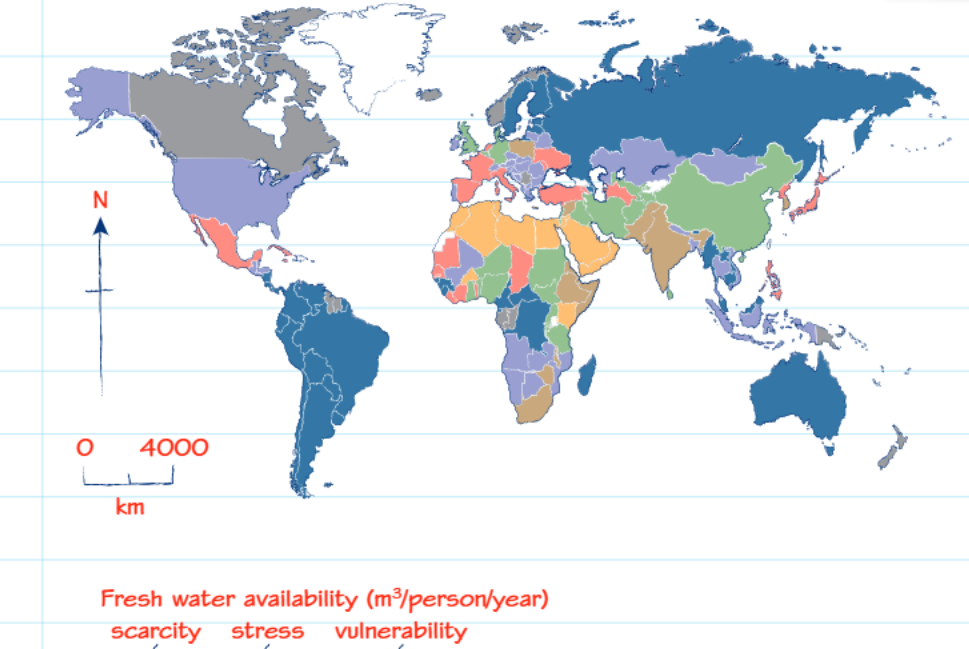
The world map reveals striking patterns in how freshwater resources are distributed globally. These patterns reflect the complex interplay between climate, geography, and natural water cycles that determine regional water availability.
Regions with high water availability typically appear in darker blue shades on the map and include countries like Canada, Russia, parts of South America, and Australia. These areas generally receive substantial precipitation and have favourable conditions for maintaining freshwater supplies.
In contrast, areas experiencing water scarcity show up in red and orange colours, particularly visible across parts of North Africa, the Middle East, and certain regions of Asia. These locations often coincide with areas near the Equator, especially in North Africa, where climatic conditions create challenging environments for maintaining adequate water supplies.
Note
Map Reading Tip: Darker blue areas indicate water abundance, while red and orange areas show water scarcity. The most water-rich countries include Canada and Iceland, while the Sahel region of North Africa shows severe water stress.
Countries like Canada and Iceland demonstrate some of the highest levels of freshwater availability per person globally, benefiting from abundant natural water resources and relatively smaller populations.
Water surplus and water deficit
Understanding the concepts of water surplus and water deficit helps explain why certain regions have abundant water while others struggle with shortages.
Water surplus occurs when a region receives more water through precipitation than it loses through evaporation and transpiration combined. These areas typically experience regular rainfall, moderate temperatures, and conditions that favour water retention. Tropical rainforests and mountainous regions often exemplify water surplus conditions, as they receive substantial rainfall while losing relatively less water to evaporation.
Water deficit describes the opposite situation, where a region loses more water through evaporation and transpiration than it receives from precipitation. This commonly occurs in arid and semi-arid regions where high temperatures increase evaporation rates, while low precipitation fails to replenish water supplies adequately.
Important
Key Distinction: Water surplus = Precipitation > Evaporation + Transpiration Water deficit = Precipitation < Evaporation + Transpiration
Regional examples and variations
The regional variation in water availability can be clearly seen through specific examples that demonstrate both water surplus and deficit conditions.
Example
Example: The Sahel Region - Water Deficit
The Sahel region of North Africa provides a clear example of water deficit conditions:
- Receives minimal rainfall throughout the year
- Experiences high rates of evaporation due to elevated temperatures
- High transpiration rates from vegetation
- Result: Persistent water shortages affecting millions of people and limiting agricultural development
Conversely, tropical rainforests and mountainous areas typically maintain water surplus conditions. These regions benefit from regular precipitation patterns and cooler temperatures that reduce water loss, creating environments where water supply exceeds demand.
Example
Example: Surprising Water Availability
Even within developed countries, significant variations exist. Southern England actually has less water available per person than Spain, demonstrating how population density and local climate conditions can create unexpected patterns of water availability.
Factors influencing water distribution
Several key factors determine why water distribution varies so dramatically across the globe, creating the complex patterns we observe on global water availability maps.
Note
Primary Factors Affecting Water Distribution:
Climate patterns play the primary role, with areas receiving consistent precipitation having greater water security than those in arid climates. Temperature also matters significantly, as higher temperatures increase evaporation rates and reduce available water supplies.
Geographic features such as mountains, rivers, and proximity to water bodies influence local water availability. Mountain ranges can create rain shadows, while river systems help distribute water across wider areas.
Population density affects per-capita water availability, with highly populated regions potentially experiencing greater water stress even when absolute water supplies remain adequate.
Summary
Key Points to Remember:
- Only 1% of Earth's water is available for human use, making it an extremely limited resource
- Water distribution is highly uneven globally, with some regions having abundant supplies while others face severe scarcity
- Water surplus occurs when precipitation exceeds evaporation and transpiration, while water deficit happens when losses exceed inputs
- Areas near the Equator, particularly in North Africa, commonly experience water scarcity due to high evaporation rates and low rainfall
- Countries like Canada and Iceland have the highest per-person water availability, while regions like the Sahel face persistent water shortages