Water consumption differences (Edexcel GCSE Geography A): Revision Notes
📚Revision Notes
Water consumption differences
Understanding water consumption
Water consumption refers to how much water people use in different countries and for different purposes. Average water consumption shows the total amount of water used in a country divided by its population. This measurement helps us compare how much water people use in different parts of the world.
There are significant differences in water consumption patterns between developed and developing countries. People in developed countries use much more water than those in developing countries.
Important
On average, each person in a developed country uses about 1200 m³ of water per year, which is three times more than people in developing countries who use around 400 m³ per year.
Sectoral differences in water use
Water is used for three main purposes: agriculture, industry, and domestic use. However, the proportion of water used for each purpose varies dramatically between developed and developing countries.
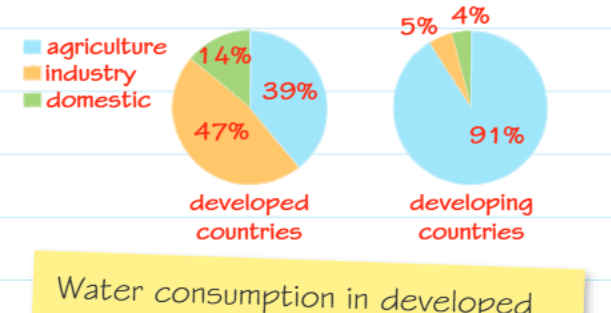
In developed countries, industry accounts for the largest share of water consumption at 47%, followed by agriculture at 39%, and domestic use at 14%. This pattern reflects the industrialised nature of these economies and the high levels of domestic water infrastructure.
Note
In contrast, developing countries show a completely different pattern. Agriculture dominates water consumption, using 91% of all water resources. Industry uses only 5% and domestic consumption accounts for just 4%.
This massive difference highlights how developing countries rely heavily on farming and have less industrial development and domestic water infrastructure.
Reasons for different water usage patterns
The differences in water consumption between developed and developing countries can be explained by examining each sector individually.
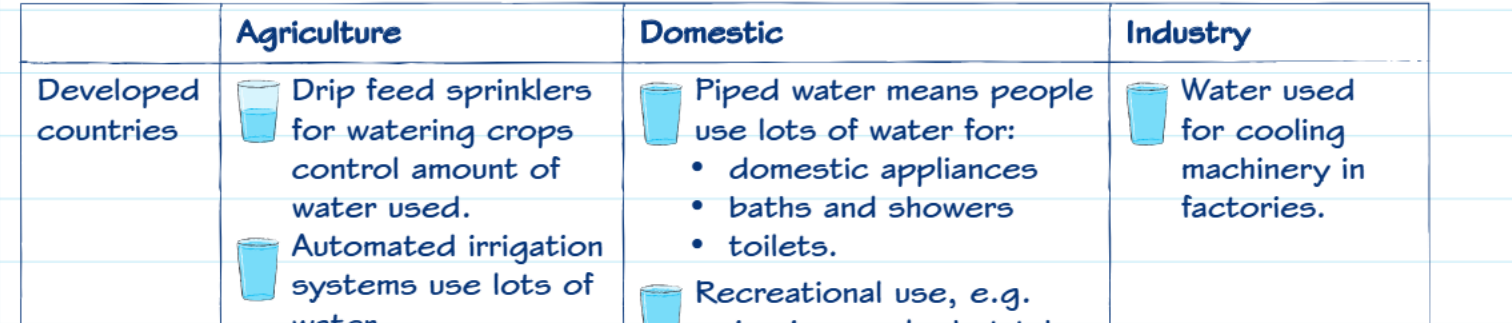
Agriculture
In developed countries, farming uses advanced technology like drip feed sprinklers that provide controlled watering for crops. However, automated irrigation systems can actually use large amounts of water despite being more efficient than traditional methods.
In developing countries, agriculture relies on less efficient irrigation methods. Hand pumps limit water use, but surplus water is often wasted as it drains away, evaporates, or runs off the surface. This inefficient use means more water is needed overall to achieve the same agricultural output.
Domestic use
Developed countries have extensive piped water systems that deliver water directly to homes. This convenience leads to high water consumption for domestic appliances, baths, showers, toilets, and recreational activities like swimming pools and hot tubs. Easy access means people use water more freely.
Note
In developing countries, many people rely on communal taps and wells for their water supply. Water must often be collected and carried, which naturally limits consumption. People also frequently bathe in rivers rather than using large amounts of treated water at home.
Industry
Industrial water use in developed countries is substantial, primarily for cooling machinery in factories. Manufacturing processes and industrial activities require significant amounts of water, contributing to the high industrial consumption figures.
Developing countries typically have small-scale industries such as basket weaving and pottery, which use very little water. The limited industrial development means this sector accounts for a much smaller proportion of total water consumption.
Country examples and patterns
Example
Country Example: Water Usage Patterns
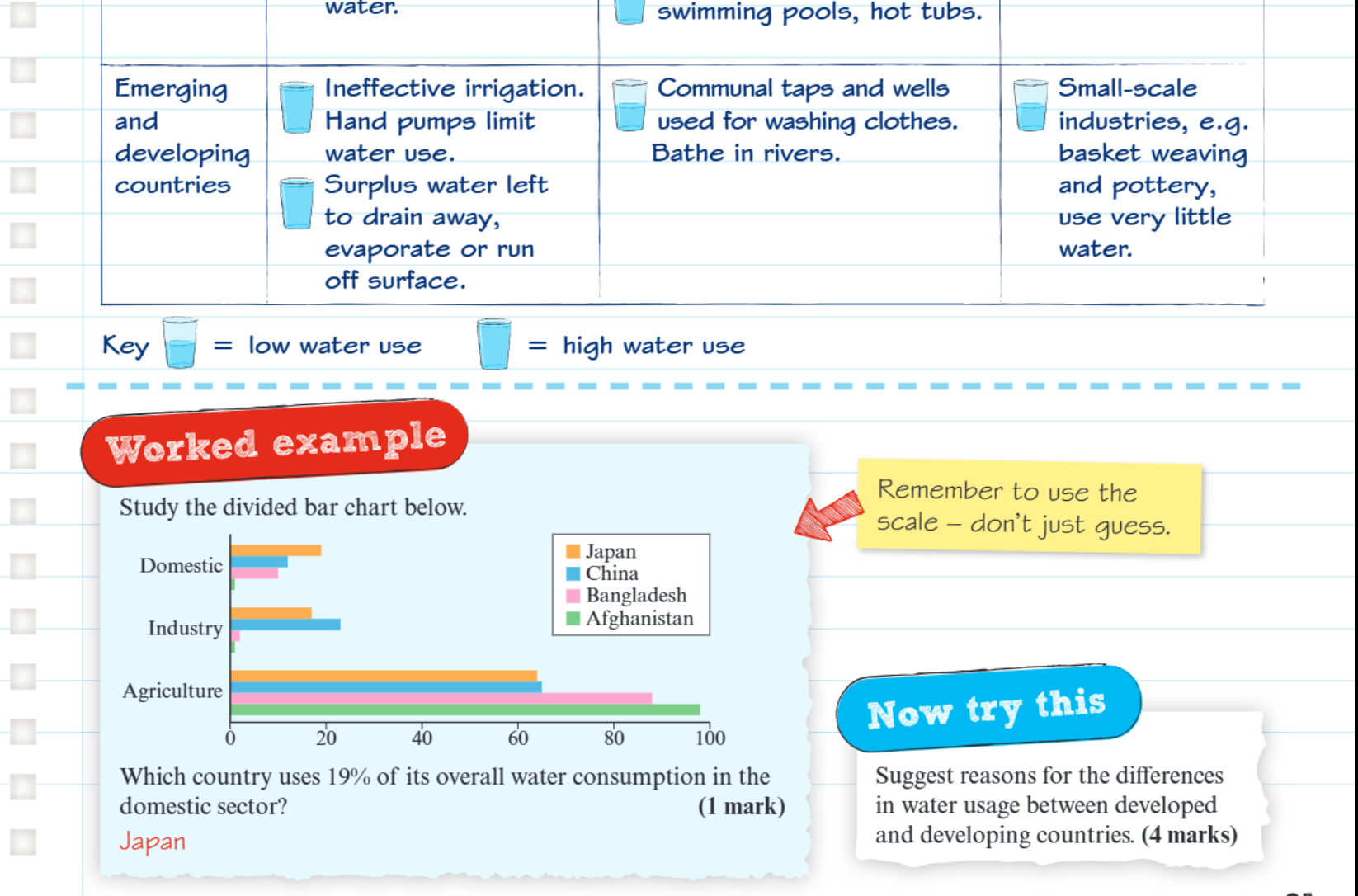
Looking at specific countries helps illustrate these patterns. For example, Japan uses 19% of its water for domestic purposes, reflecting its developed status with extensive domestic water infrastructure. Countries like Afghanistan show the opposite pattern, with agriculture dominating their water consumption due to their developing economy and reliance on farming.
The data shows that as countries become more developed, their water usage patterns shift from agriculture-dominated to more balanced consumption across industry and domestic sectors.
Summary
Key Points to Remember:
- Developed countries use three times more water per person than developing countries (1200 m³ vs 400 m³ per year)
- Agriculture dominates water use in developing countries (91%), while industry is the largest consumer in developed countries (47%)
- Advanced infrastructure in developed countries leads to higher domestic water consumption through piped systems and appliances
- Developing countries rely on less efficient irrigation and have limited industrial water use due to smaller-scale industries
- Water consumption patterns reflect a country's level of economic development and technological advancement