Water supply problems: UK (Edexcel GCSE Geography A): Revision Notes
📚Revision Notes
Water supply problems in the UK
Introduction
The United Kingdom faces significant challenges in providing adequate water supplies to its population. Understanding these problems is crucial as England and Wales alone consume approximately 14 billion litres of water daily through public usage. The distribution and severity of these problems varies considerably across different regions, creating a complex pattern of water security issues.
Note
The scale of water consumption in the UK is enormous - 14 billion litres daily represents enough water to fill approximately 5,600 Olympic-sized swimming pools every single day across England and Wales alone.
Three main causes of water supply problems
Ageing infrastructure
Britain's water distribution system suffers from outdated infrastructure that cannot adequately handle modern demands. Many water pipes were installed decades ago and are now struggling to cope with the increased water pressures required to serve today's population effectively. This ageing network leads to significant water losses through leaks and reduced efficiency in water delivery, particularly problematic when demand is highest.
Important
Critical Infrastructure Challenge: Ageing water pipes not only struggle with increased demand but also result in substantial water losses through leaks - a major concern when water resources are already under pressure.
Rainfall imbalance
One of the most significant challenges stems from the geographical mismatch between where rain falls and where people live. The UK experiences higher rainfall levels in upland regions, such as the Scottish Highlands, where population density remains relatively low. Conversely, lowland areas, particularly in the south-east near London, receive considerably less rainfall despite having much higher population densities. This creates a fundamental supply and demand imbalance that requires extensive water transfer systems to address.
Note
This imbalance creates a paradox: areas with the most water have the fewest people, while areas with the most people have the least water. This is why complex water transfer schemes are essential for the UK's water security.
Seasonal imbalance
Certain regions experience dramatic differences between summer and winter rainfall patterns, creating seasonal water stress. Eastern Britain, for example, shows particularly pronounced seasonal variations. During dry periods, this imbalance can lead to serious drought conditions, as seen when drier weather in 2019 resulted in significantly reduced reservoir levels throughout 2020. These seasonal fluctuations make water management challenging and can create periodic supply crises.
Important
Seasonal Impact: The 2019-2020 example demonstrates how weather patterns in one year can have lasting effects on water supplies, highlighting the vulnerability of the UK's water system to climate variability.
Regional distribution patterns
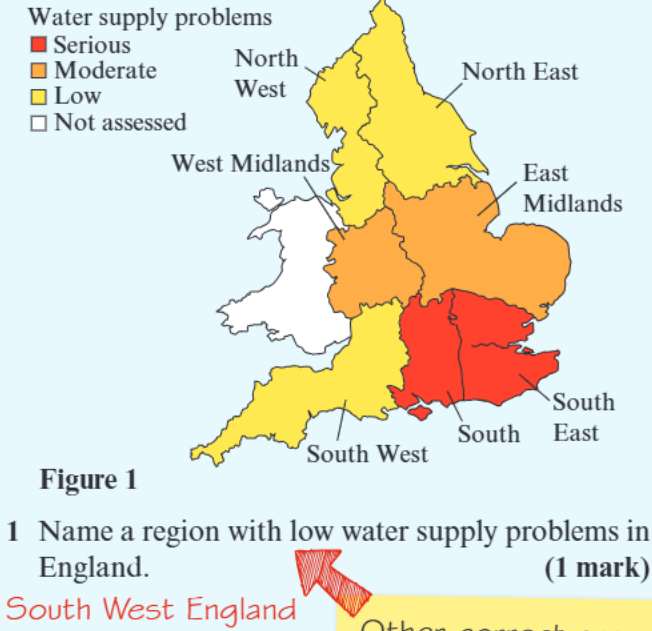
The distribution of water supply problems across England reveals clear geographical patterns. The map demonstrates that the most serious water supply issues concentrate in the southern and south-eastern regions of England. These areas, marked in red on the distribution map, face the greatest challenges in meeting water demand.
The East Midlands experiences moderate water supply problems, whilst northern regions including the North West and North East, along with the South West, generally face lower levels of water supply stress. This pattern reflects the combination of rainfall distribution, population density, and infrastructure challenges discussed earlier.
Note
Regional Classification System: The map uses a four-tier system - serious (red), moderate (orange/yellow), low (light), and not assessed (grey) - to categorise water supply problems across different regions of England.
Understanding the spatial patterns
The concentration of serious water supply problems in the south and south-east occurs due to several interconnected factors. These regions combine high population densities with relatively low rainfall, creating intense pressure on water resources. Additionally, these areas often rely on older infrastructure systems that struggle to meet modern demand levels.
The contrast is particularly stark when comparing the North West, which benefits from higher rainfall and lower population pressure, with the South East, where millions of people depend on limited local water resources. This geographical disparity explains why water transfer schemes and careful resource management become essential for maintaining adequate supplies.
Note
The moderate problems in the East Midlands represent a transitional zone where some challenges exist but not to the extent seen further south. This demonstrates how water supply problems exist on a spectrum rather than as simple categories.
The moderate problems in the East Midlands represent a transitional zone where some challenges exist but not to the extent seen further south. Meanwhile, regions classified as having low problems benefit from either higher rainfall, lower population densities, or more recent infrastructure investments.
Factors contributing to regional variations
Several key factors explain why certain regions experience more severe water supply problems than others. Climate plays a crucial role, with southern and eastern areas receiving less annual rainfall than western and northern regions. Population distribution creates additional pressure, as the highest concentrations of people often live in areas least able to supply adequate water naturally.
Example
Regional Comparison Example:
North West England:
- High rainfall (over 1000mm annually)
- Lower population density
- Result: Low water supply problems
South East England:
- Low rainfall (under 700mm annually)
- High population density (including London)
- Result: Serious water supply problems
Economic and industrial factors also contribute to regional variations. Areas with significant industrial water usage place additional strain on supplies, whilst regions with major urban centres require extensive infrastructure to distribute water effectively. The age and condition of existing water infrastructure varies considerably between regions, with some areas benefiting from recent modernisation whilst others rely on systems installed many decades ago.
Summary
Key Points to Remember:
- The UK faces three main water supply challenges: ageing infrastructure, rainfall imbalance, and seasonal imbalance
- England and Wales consume around 14 billion litres of water daily through public usage
- The most serious water supply problems occur in southern and south-eastern England due to high population density and low rainfall
- Northern and western regions generally experience fewer water supply problems due to higher rainfall and lower population pressure
- Seasonal variations can create significant challenges, with dry periods leading to reduced reservoir levels and potential supply issues