Landscape challenges (Edexcel GCSE Geography A): Revision Notes
📚Revision Notes
Landscape challenges
The UK faces significant landscape challenges that require careful management to balance conservation needs with development pressures. Understanding how National Parks are managed and how flood risks are controlled is essential for maintaining the country's natural environments while supporting human activities.
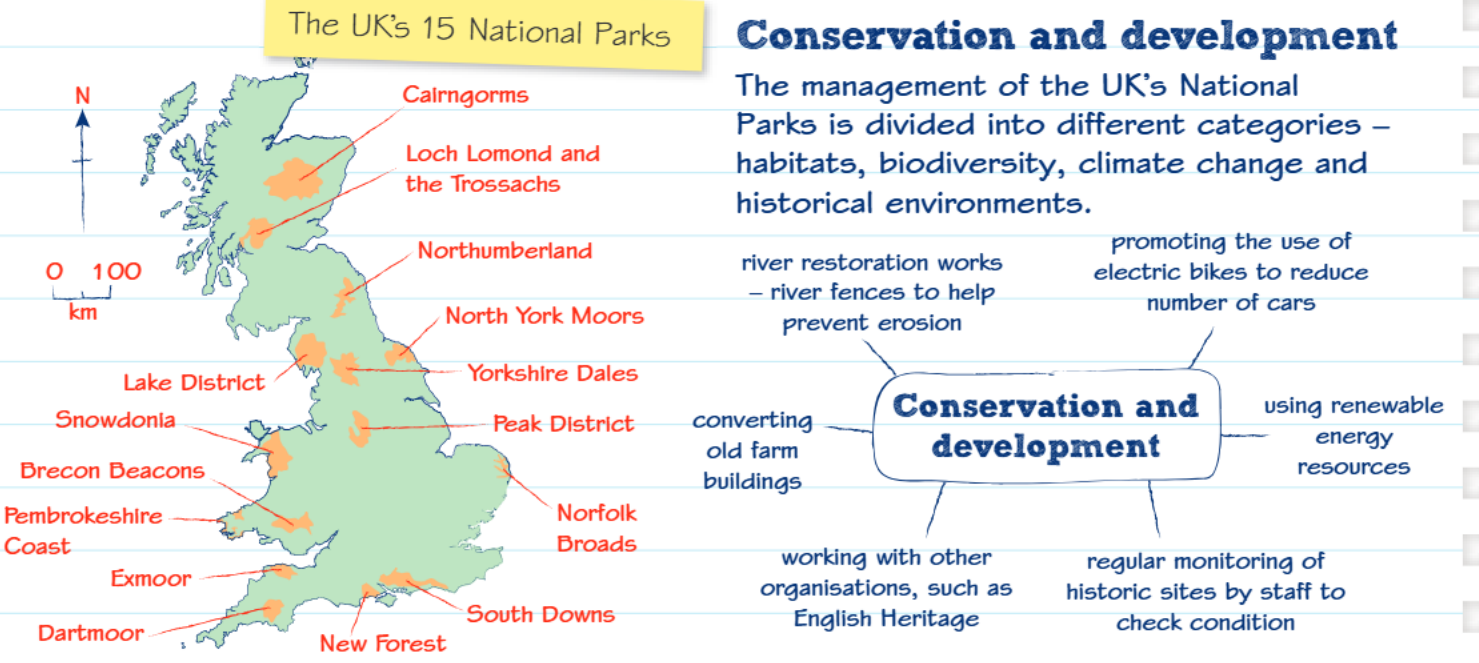
UK National Parks
Overview and distribution
The United Kingdom is home to 15 National Parks that are spread across England, Wales and Scotland. These protected areas cover some of the country's most spectacular landscapes, from the mountainous terrain of Snowdonia and the Cairngorms to the rolling hills of the Yorkshire Dales and South Downs. Each park represents a unique ecosystem that requires specific management approaches to preserve its distinctive characteristics.
Note
The National Parks serve multiple purposes beyond simple conservation. They provide recreational opportunities for millions of visitors annually, support local economies through tourism, and maintain traditional farming practices that have shaped these landscapes over centuries.
However, this multi-functional role creates complex challenges as park authorities must balance competing demands between conservation, recreation, and economic development.
Conservation and development approaches
Managing National Parks involves addressing four main categories of environmental concern. Habitat protection focuses on preserving the natural homes of wildlife species, ensuring that development doesn't fragment important ecological corridors. Biodiversity conservation works to maintain the variety of plant and animal species that make each park unique, often requiring active intervention to prevent the loss of rare species.
Climate change adaptation has become increasingly important as parks must help ecosystems cope with changing temperature and rainfall patterns. Historical environment preservation ensures that archaeological sites, traditional buildings, and cultural landscapes are maintained for future generations to understand and appreciate.
Important
Balancing Act Challenge
National Parks must constantly navigate the tension between protecting natural environments and accommodating the needs of local communities, tourists, and economic development. This requires sophisticated management strategies that can adapt to changing circumstances while maintaining core conservation principles.
Management strategies in practice
National Parks employ numerous practical strategies to achieve their conservation goals. River restoration projects remove artificial barriers and restore natural flow patterns, helping to improve water quality and create better habitats for aquatic wildlife. The promotion of sustainable transport, particularly electric bicycles, helps reduce air pollution and traffic congestion in sensitive areas.
Example
Conservation Strategy in Action: Integrated Approach
A typical National Park conservation project might involve:
Step 1: River restoration - removing old weirs and creating natural meanders Step 2: Sustainable transport - installing electric bike charging stations Step 3: Energy sustainability - fitting solar panels on visitor centres Step 4: Heritage preservation - converting traditional stone barns into educational facilities Step 5: Monitoring - regular assessment of wildlife populations and habitat quality
Energy sustainability is addressed through the adoption of renewable energy sources like solar panels and wind turbines, reducing the parks' carbon footprint. Traditional buildings are given new life through conversion projects that maintain their historical character while providing modern facilities for visitors or local communities.
Regular monitoring programmes ensure that staff can track the condition of historic sites and respond quickly to any deterioration. Partnerships with organisations such as English Heritage provide additional expertise and resources for complex conservation projects.
Managing UK river flooding
Environment Agency responsibilities
The Environment Agency holds primary responsibility for managing flood risks across England's rivers and coastal areas. This organisation coordinates a comprehensive approach to flood management that recognises flooding as a natural process while working to minimise its impact on human communities and infrastructure.
Note
Flood management has evolved from simple reactive measures to sophisticated integrated systems that work with natural processes. The Agency must consider the entire river catchment when developing flood management strategies, recognising that actions upstream can significantly affect flood risks downstream.
Flood management approaches
Modern flood management employs multiple complementary strategies. Monitoring and early warning systems use advanced technology to track rainfall, river levels, and coastal conditions, providing communities with crucial advance notice of potential flooding events. These systems allow residents and businesses to take protective measures before flood waters arrive.
Education programmes help local residents understand their flood risks and know how to respond effectively during flood events. This community-based approach recognises that informed citizens are better able to protect themselves and their property.
Engineering solutions include both soft and hard approaches. Soft engineering works with natural processes through techniques like wetland creation and floodplain restoration, which provide natural flood storage while creating valuable habitats. Hard engineering involves constructed defences like flood barriers, levees, and pumping stations that directly control water flow.
Important
Critical Distinction: Soft vs Hard Engineering
- Soft engineering works with natural processes (wetlands, afforestation, floodplains) - sustainable but requires more space
- Hard engineering uses constructed barriers (walls, barriers, pumps) - immediate protection but can transfer problems downstream
- Most effective flood management combines both approaches strategically
Building regulations now restrict development in high-risk flood areas and require flood-resistant construction methods in areas that must be developed. River catchment management takes a holistic approach through strategies like afforestation, which increases the landscape's ability to absorb rainfall and reduce surface runoff.
Thames Barrier case study
Example
Major Infrastructure Case Study: Thames Barrier Protection System
The Challenge: Protecting central London from devastating tidal surges
The Solution: The Thames Barrier - the largest movable flood barrier in the world
How it Works:
- Normal conditions: Gates remain open, allowing regular river traffic
- Threat detected: Advanced monitoring systems identify dangerous tidal conditions
- Barrier activation: Massive steel gates rotate upward to create complete barrier
- Protection achieved: Central London's densely populated areas safeguarded from surge waters
Key Success Factors:
- Sophisticated engineering allows dual function (protection + navigation)
- Integrated with comprehensive Thames flood defence system
- Influenced flood defence planning in other major cities worldwide
The barrier's sophisticated engineering allows it to remain open during normal conditions, permitting regular river traffic to continue flowing. However, when dangerous tidal conditions are forecast, the massive steel gates can be raised to create a complete barrier across the Thames, preventing surge waters from reaching London's densely populated and economically vital central areas.
This infrastructure demonstrates how hard engineering solutions can provide essential protection for major urban areas while allowing normal river functions to continue most of the time. The barrier's success has influenced flood defence planning in other major cities facing similar tidal flood risks.
Summary
Key Points to Remember:
-
National Parks balance multiple functions - they must protect natural environments while supporting tourism, local communities, and traditional land uses through integrated management approaches
-
Conservation strategies are diverse - successful National Park management combines habitat protection, renewable energy adoption, sustainable transport promotion, and heritage preservation
-
Flood management is multi-layered - the Environment Agency coordinates monitoring systems, engineering solutions, education programmes, and planning regulations to reduce flood risks
-
Natural and engineered solutions work together - effective flood management combines soft engineering like afforestation with hard engineering like the Thames Barrier
-
Local community involvement is essential - both National Park conservation and flood management depend on educating and engaging local residents in protective strategies