Gate Fulford and Stamford Bridge (Edexcel GCSE History): Revision Notes
📚Revision Notes
Gate Fulford and Stamford Bridge
The northern crisis of September 1066
In September 1066, Harold Godwinson faced a critical challenge that would ultimately shape the fate of England. While preparing to defend against William's expected invasion from Normandy, a Viking force led by Harald Hardrada of Norway landed in the north. This northern threat forced Harold into a desperate two-front campaign that would test both his military leadership and England's defences.
Note
The timing couldn't have been worse for Harold. His fyrd (the Anglo-Saxon militia) had been disbanded in mid-September to allow soldiers to return home for the harvest season. This left England's defences significantly weakened just as multiple invasion threats materialised.
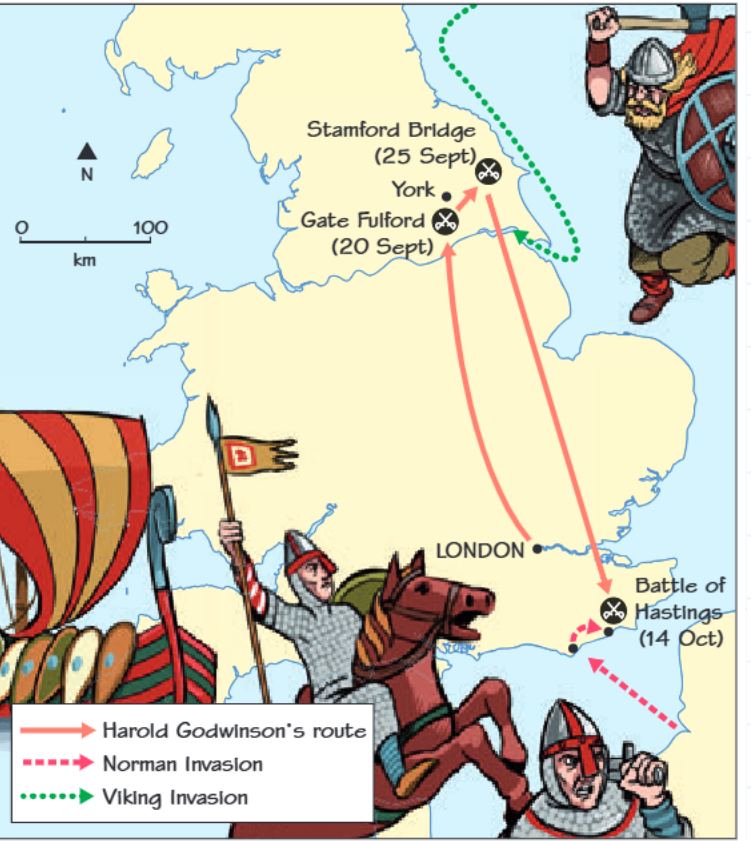
The Battle of Gate Fulford (20 September 1066)
The Viking invasion
Harald Hardrada, one of Europe's most feared warriors, arrived with approximately 10,000 men alongside Harold's exiled brother Tostig. After landing on the River Humber, they marched towards York, the key stronghold of northern England. Standing in their way were the northern earls - Morcar of Northumbria and his brother Edwin of Mercia - who had gathered their forces to defend the region.
The battle unfolds
Rather than defend York's fortified walls, the English earls chose to meet the invaders in open battle at Gate Fulford. This decision would prove disastrous.
Example
Battle Tactics at Gate Fulford
The English Position: The English forces positioned themselves poorly, with treacherous marshland at their rear that would later trap them during retreat.
Hardrada's Strategy: When his forces pushed forwards against Tostig's weaker troops, Hardrada struck the English line from the side in a devastating flanking manoeuvre.
The Outcome: This tactical brilliance shattered the English shield wall formation and turned an organised defence into a massacre.
Important
Consequences of defeat
The defeat at Gate Fulford was catastrophic for England's northern defences. Thousands of English warriors were killed or wounded, with many more drowning in the marshland as they tried to flee. The earls Morcar and Edwin survived but were badly wounded, and Hardrada and Tostig captured numerous English hostages.
This victory opened the path to York for the Vikings and forced Harold Godwinson to abandon his southern coastal defences to march north and deal with the invasion personally.
The Battle of Stamford Bridge (25 September 1066)
Harold's rapid response
Upon hearing of the disaster at Gate Fulford, Harold Godwinson gathered his housearls (professional warriors) and whatever forces he could muster for a rapid march north. His speed surprised everyone - the Viking army was caught completely off guard when Harold's forces appeared at Stamford Bridge, just five days after Gate Fulford.
A decisive English victory
Example
The Stamford Bridge Victory
The Surprise Attack: Harold's surprise attack shattered the Viking army, catching them completely unprepared.
Key Casualties: Both Harald Hardrada and Tostig were killed in the fighting, eliminating the leadership of the invasion.
Strategic Advantage: The Vikings had left much of their armour aboard their ships, making them vulnerable to the English assault.
Scale of Victory: The victory was so complete that the surviving Vikings needed only 24 ships to carry home the remnants of an army that had arrived in 300 vessels.
Harold had successfully eliminated the northern threat and demonstrated his military capabilities as a commander.
Significance and consequences
Strategic impact
Harold's victory at Stamford Bridge achieved its immediate goal of defending England from the Viking invasion. However, the campaign had serious strategic consequences that would affect the subsequent Norman invasion.
Important
The Price of Victory
The northern campaign exhausted Harold's army and depleted his forces just when he needed them most. While Harold was fighting in Yorkshire, William of Normandy was landing in the south, taking advantage of England's undefended coast.
Harold was forced to march his tired troops rapidly south again to face the Norman invasion, leaving him little time to gather fresh forces or rest his army.
Note
Some historians argue that Harold's decisive victory may have made him overconfident about facing William's threat, potentially affecting his tactical decisions in the final confrontation. The battles in the north may have prevented additional northern troops from reaching the critical Battle of Hastings on 14 October.
Timeline of events
- Mid-September 1066: Harold disbands the fyrd for harvest
- September 1066: Hardrada and Tostig land in northern England
- 20 September 1066: Battle of Gate Fulford - Viking victory
- 25 September 1066: Battle of Stamford Bridge - English victory
- 14 October 1066: Battle of Hastings
Summary
Key Points to Remember:
-
Gate Fulford (20 September) was a devastating English defeat that opened northern England to Viking conquest and forced Harold north
-
Stamford Bridge (25 September) was Harold's greatest victory, completely destroying the Viking threat and killing both Hardrada and Tostig
-
The northern campaign exhausted Harold's forces just before the crucial Norman invasion, contributing to his eventual defeat at Hastings
-
Harold's rapid marching demonstrated excellent military leadership but left his army tired and depleted for the final confrontation with William
-
The timing was crucial - these battles occurred in just five days, showing how quickly events moved during this critical period in English history