The economy and social system (Edexcel GCSE History): Revision Notes
📚Revision Notes
The economy and social system
England's economic strength
Anglo-Saxon England stood out as one of Europe's most prosperous nations by 1060, with extensive trading networks spanning across the seas. While most people worked in agriculture, England's towns served as vital commercial hubs that drove the kingdom's wealth.
Note
England's prosperity was built on a combination of favourable geography, strategic trade relationships, and sophisticated administrative systems that were advanced for their time.
Several key factors contributed to England's economic success. The country benefited from favourable farming conditions, particularly in the southern and eastern regions where crops thrived, while the western areas provided excellent pasture for livestock. England had also developed strong commercial relationships across the North Sea with Scandinavia and across the Channel with Normandy and Flanders, creating profitable trade routes.
The monarchy had established an effective taxation system that generated substantial revenue for the crown while also providing income for nobles and the Church, who collected portions of these taxes. Additionally, the central government maintained strict control over the money supply and established designated trading centres called burhs, ensuring that currency remained stable and trade could be properly regulated and taxed, which ultimately benefited the nobility.
Anglo-Saxon social structure
Anglo-Saxon society in 1060 consisted of approximately 2 million people organised into a clear but somewhat flexible hierarchy. At the top were the thegns, the Anglo-Saxon warrior-noble class who possessed five or more hides of land. This elite group numbered only between 4,000 to 6,000 individuals, making them less than 1% of the total population.
Important
The social hierarchy was rigid in structure but allowed for some mobility based on land ownership and economic success, which was unusual for mediaeval societies.
The vast majority of people - about 90% of the population - were ceorl, essentially peasant farmers who depended on the thegns for land and employment opportunities. While most ceorl worked the land, some had achieved freedom from direct dependence on nobles.
At the bottom of society were enslaved people, who comprised approximately 9.7% of the population. These individuals were considered property and could be purchased and sold, though they could potentially gain freedom through their owners' decision and subsequently become peasants.
Example
Social Structure Example: The Path to Nobility
A successful ceorl farmer could theoretically become a thegn by:
- Accumulating wealth through farming or trade
- Purchasing five or more hides of land (roughly 600+ acres)
- Acquiring the weapons, armour, and horses expected of the warrior class
- Demonstrating military service and loyalty to a lord
Burhs and urban life
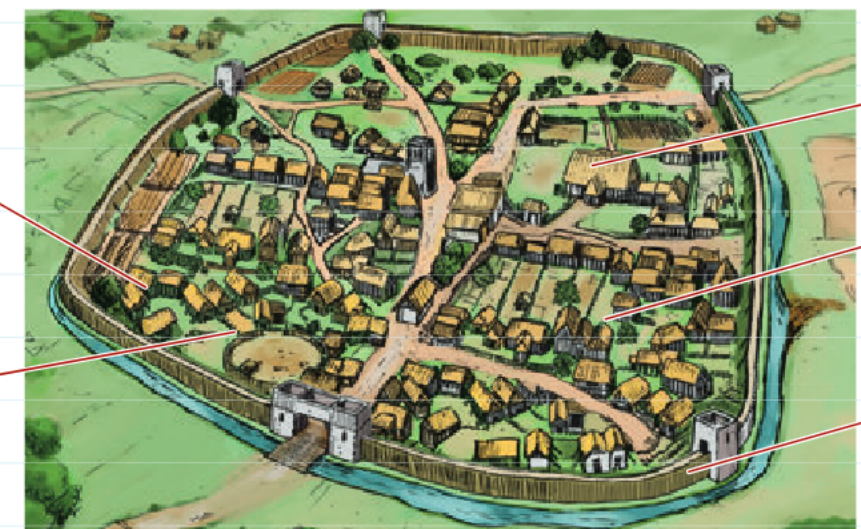
The burhs represented a crucial innovation in Anglo-Saxon administration and defence. These fortified settlements served as the primary town for each shire, combining military defence with commercial activity.
Important
Legal requirements mandated that all significant trade transactions occur within these burhs, allowing authorities to monitor and tax commercial activity effectively.
Around 10% of England's population lived in these towns by 1060, with families typically residing in family groups rather than as individuals.
The burhs featured strong defensive walls and ramparts that made them extremely difficult for Viking raiding parties to capture successfully. During times of danger, people from the surrounding countryside would seek protection within these fortified walls, demonstrating their importance as both economic and military centres.
Note
The dual function of burhs as both commercial centres and military fortifications made them essential to England's stability and prosperity, representing an early form of planned urban development.
The Church's role in society
The Anglo-Saxon Church wielded considerable influence through five main characteristics. Bishops possessed significant wealth and political power, controlling extensive Church districts and frequently serving as advisors in the Witan, the king's council of important nobles and church leaders.
Education remained extremely limited throughout Anglo-Saxon England, with very few people able to read or write. The Church provided virtually all educational services and maintained the kingdom's written records. Most local priests shared the same social background as peasants, lacked formal education, and often married despite church rules.
Note
The Church's monopoly on literacy and education gave it enormous influence over government administration, legal records, and cultural preservation, making bishops some of the most powerful figures in the kingdom.
Monks and nuns lived differently from the general population, farming church lands while maintaining separate religious communities apart from secular society. The English Church showed considerable resistance to reform movements originating from continental Europe, with bishops preferring to maintain their traditional practices and customs.
Social mobility and flexibility
Despite its hierarchical structure, Anglo-Saxon society allowed for some movement between social classes. Peasant farmers who prospered economically could potentially become thegns by acquiring sufficient land - specifically, five or more hides. Conversely, peasants facing severe economic hardship might sell themselves into slavery as a survival strategy.
Enslaved individuals could gain their freedom through their owners' decisions and subsequently join the peasant class. The thegns maintained their position as the warrior class through their land ownership, which enabled them to afford weapons, armour, and horses. Society expected them to remain prepared for military service and to fight to the death defending their lord when called upon.
Important
This flexibility in the social system contributed to the overall stability of Anglo-Saxon society, as it provided hope for advancement while maintaining clear expectations for each social group's roles and responsibilities.
Summary
Key Points to Remember:
- Anglo-Saxon England's economic strength came from good farming conditions, extensive trade networks, effective taxation, and controlled currency systems
- Society was hierarchical but flexible: thegns (nobles) at the top, ceorl (peasants) making up 90%, and about 9.7% enslaved people
- Burhs served as fortified trading centres where all major commerce had to occur, housing about 10% of the population
- The Church controlled education and record-keeping, with wealthy bishops holding significant political influence
- Social mobility was possible - successful peasants could become thegns, while those in desperate circumstances might become enslaved