Changes to government (Edexcel GCSE History): Revision Notes
📚Revision Notes
Changes to government in Norman England, 1066-88
The transformation of sheriff power
Under Norman rule, the role of sheriffs underwent significant changes that demonstrated William's centralisation of government power. These changes represented a major shift from the Anglo-Saxon system of governance and became a source of considerable resentment among the English population.
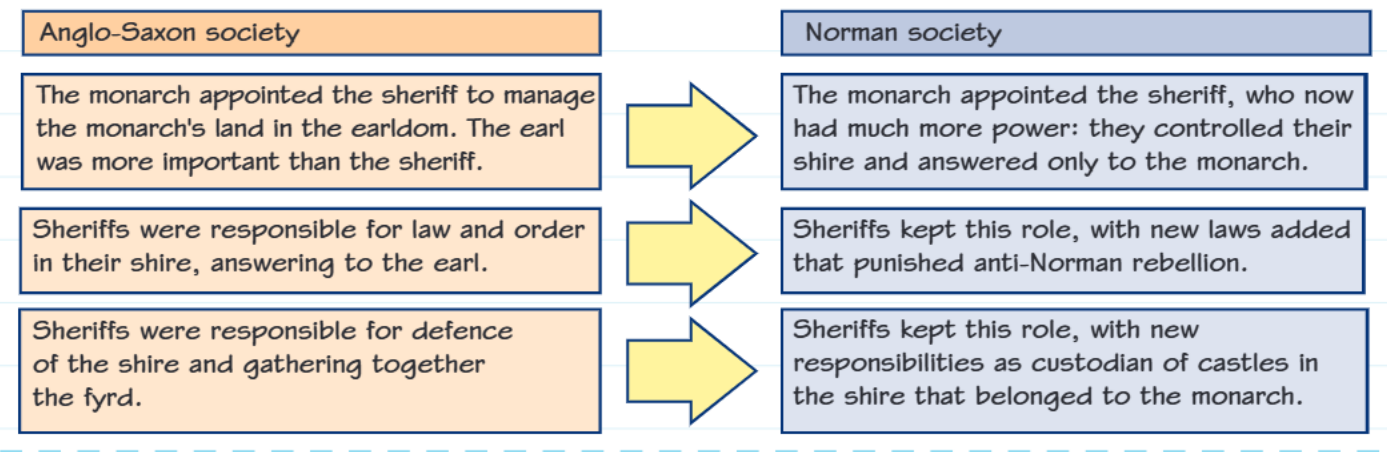
During the Anglo-Saxon period, sheriffs held a relatively limited position within the governmental hierarchy. The monarch would appoint sheriffs to oversee the administration of individual shires, but their authority was secondary to that of the earls, who held the primary power in each region. Sheriffs were responsible for maintaining law and order within their designated areas, though they answered to the earl rather than directly to the king. Additionally, they organised the defence of their shire by gathering together the local militia, known as the fyrd, when needed for military purposes.
Note
The Anglo-Saxon system had a clear hierarchy: Monarch → Earls → Sheriffs. This meant that earls held the real regional power, while sheriffs were essentially their administrative assistants at the shire level.
The Norman conquest brought dramatic changes to this system. William restructured the sheriff's role to make them far more powerful and influential within the new governmental framework. Most significantly, sheriffs now answered directly to the monarch rather than to earls, giving them considerably more authority and making them key agents of royal control. They retained their responsibility for law and order but gained additional powers, including the enforcement of new laws specifically designed to suppress anti-Norman rebellion activities.
Furthermore, Norman sheriffs took on new defensive responsibilities that reflected the changed political landscape. They became custodians of royal castles within their shires, which were crucial strategic points for maintaining Norman control over the conquered territory. This role made them essential to the military administration of Norman England.
Important
Key Change in Sheriff Authority:
- Anglo-Saxon system: Monarch → Earls → Sheriffs
- Norman system: Monarch → Sheriffs (direct control)
This change eliminated the earls as intermediaries, giving William direct control over local administration throughout England.
Why sheriffs became resented figures
The expanded powers of Norman sheriffs created multiple sources of tension with the local English population. Following the Anglo-Saxon resistance between 1068-71, many English sheriffs were replaced by Norman appointees who had little connection to or sympathy for local communities.
These new sheriffs developed a reputation for exploiting their positions for personal gain. They collected taxes and revenues on behalf of the monarch, but this system created opportunities for corruption. The more money sheriffs could extract from their shires above the required amount, the more they could keep for themselves. This incentivised them to place heavy financial burdens on local people, leading to widespread resentment.
Sheriffs also managed the monarch's estates, known as demesne lands, and were allowed to keep any profits they generated above a set fee. This arrangement provided another avenue for personal enrichment at the expense of local communities.
Important
Common Sheriff Corruption Practices:
- Overtaxing communities to keep surplus revenues
- Exploiting their management of royal estates for personal profit
- Using their authority to legitimise land seizures
- Creating barriers to justice for ordinary people seeking redress
Perhaps most controversially, sheriffs played active roles in the land seizures that followed the Norman conquest. Their authority was often used to legitimise the taking of English-held lands, and victims of these land grabs found that they had little recourse unless they could gain direct access to the monarch - which was rarely possible for ordinary people.
The creation and significance of royal forests
William introduced the concept of royal forests as another method of asserting Norman control and generating revenue. He expanded the hunting lands he controlled by seizing territory from other landowners and reclassifying it as protected hunting ground reserved for royal use.
The designation of land as royal forest often resulted in local communities being forcibly removed from areas they had traditionally inhabited. When land received forest status, it became subject to a harsh new legal framework specifically designed to protect the animals and vegetation that William wanted to preserve for hunting.
Important
Harsh Forest Law Punishments:
Forest laws imposed severe restrictions on local people's activities within these areas. Poaching - which included hunting any of the protected animals or even possessing tools that could be used for hunting - carried brutal punishments. People caught breaking forest laws could face blinding or other violent penalties that demonstrated the ruthless nature of Norman rule.
The laws also prohibited damage to forest vegetation, meaning that local people could face punishment for activities as basic as collecting wood for fuel or clearing land for building homes. These restrictions severely impacted the livelihoods of communities living near forest areas.
Note
The term "forest" in Norman England didn't necessarily mean woodland. It was a legal designation that could apply to any land reserved for royal hunting, including open heathland and agricultural areas.
The broader impact of governmental changes
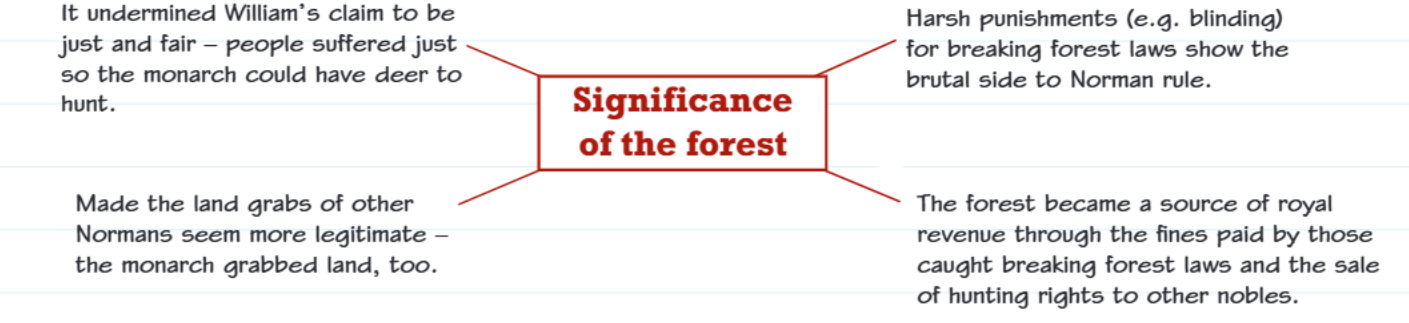
These changes to sheriffs and the introduction of forest laws served multiple purposes for Norman rule beyond their immediate practical functions. The harsh enforcement of forest laws undermined William's claims to be a just and legitimate ruler, as people suffered severe consequences simply so that the king could enjoy better hunting opportunities.
The brutal punishments associated with forest law violations, such as blinding, provided clear demonstrations of the violent nature of Norman control. These served as warnings to anyone considering resistance against the new regime.
The system of royal forests also helped to legitimise the broader pattern of land seizures that characterised the Norman conquest. If the monarch could arbitrarily redesignate land for his own use, it provided precedent for other Norman nobles to claim English-held territories.
Finally, forests became an important source of royal income. The monarch collected fines from people caught breaking forest laws and also generated revenue by selling hunting rights within forest areas to other nobles.
Timeline of key developments
- 1066: Norman conquest begins transformation of English government
- 1068-71: Period of Anglo-Saxon resistance; many English sheriffs subsequently replaced
- Post-1071: Systematic replacement of English sheriffs with Norman appointees
- 1060s-1080s: Gradual expansion of royal forest areas under William's rule
Summary
Key Points to Remember:
- Sheriffs gained massive power under Norman rule, answering directly to the king rather than earls and becoming key agents of royal control
- Sheriff corruption and land grabbing made them deeply resented figures who exploited their positions for personal gain
- Royal forests represented harsh Norman control, with brutal punishments like blinding for simple activities like hunting or collecting wood
- These changes centralised government power in William's hands while providing new sources of royal revenue through fines and fees
- The new systems undermined English communities through land seizures, heavy taxation, and restrictions on traditional ways of life