Robert Curthose and revolt, 1077-80 (Edexcel GCSE History): Revision Notes
📚Revision Notes
Robert Curthose and revolt, 1077-80
The disputed succession crisis (1087)
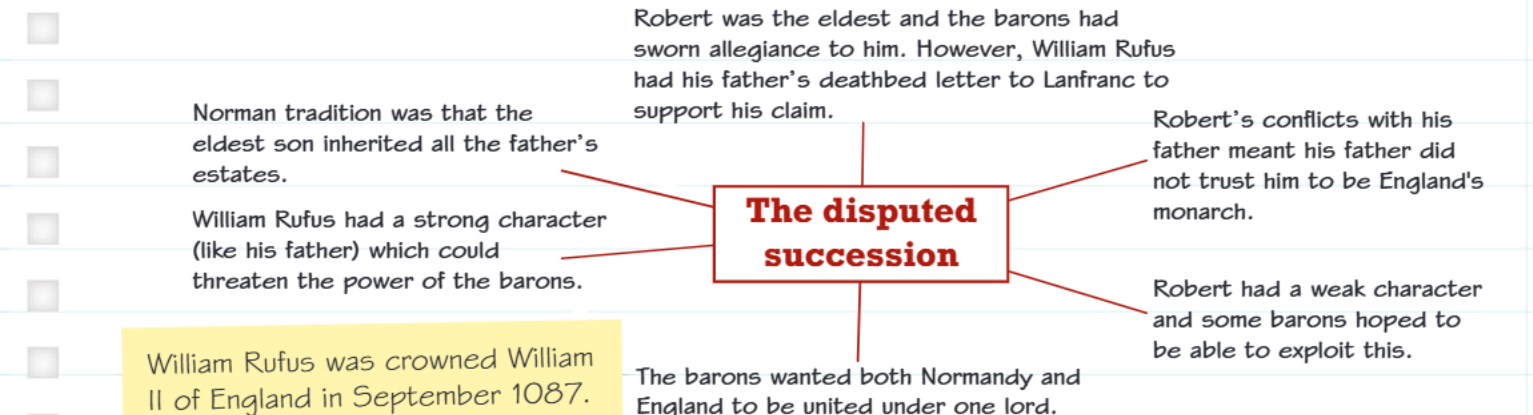
When William the Conqueror died in 1087, England faced a serious succession crisis. According to Norman customs, the eldest son should inherit all of his father's lands and titles. This meant Robert Curthose, William's eldest son, should have become king of both England and Duke of Normandy. However, William I had different plans for his inheritance.
Important
Norman Inheritance Crisis
William the Conqueror's decision to split his lands went directly against traditional Norman inheritance laws, which stated that the eldest son should inherit all territories. This unprecedented break from custom created the foundation for decades of conflict between England and Normandy.
William the Conqueror chose to split his lands between his sons, giving Normandy to Robert Curthose but leaving England to his younger son, William Rufus. This decision created immediate problems because it went against traditional Norman inheritance laws. Many Norman barons had already pledged their loyalty to Robert as the rightful heir, expecting him to rule both territories.
The situation became even more complicated because William Rufus possessed stronger leadership qualities than his older brother. While Robert was seen as having a weaker character, William Rufus demonstrated the decisive nature needed to control the powerful Norman barons. William I had also sent a deathbed letter to Lanfranc, the Archbishop of Canterbury, supporting William Rufus's claim to the English throne.
In September 1087, William Rufus was successfully crowned as William II of England, but this did not end the controversy. The Norman barons faced a difficult choice - they wanted both England and Normandy to remain united under one ruler, but now found themselves torn between two brothers with competing claims.
The rebellion of 1088
The tensions created by the disputed succession soon erupted into open rebellion. In 1088, Bishop Odo of Bayeux, who was William the Conqueror's half-brother, led a major uprising against the new king William II. Odo had been released from prison in 1087 and immediately began plotting to overthrow William Rufus in favour of Robert Curthose.
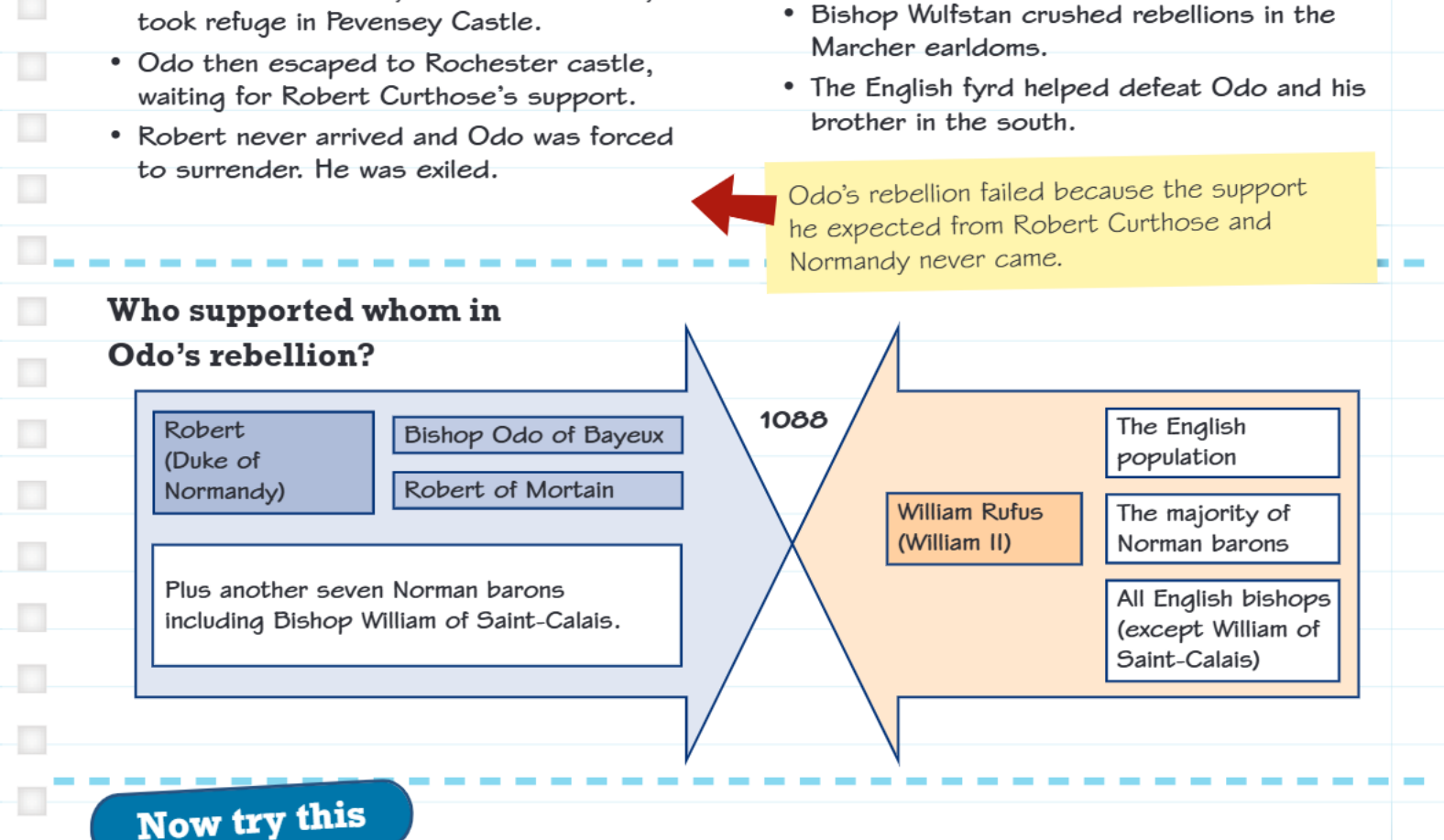
The rebellion revealed the deep divisions within Norman England. Supporting Robert Curthose and the rebellion were Bishop Odo of Bayeux, Robert of Mortain, and seven other Norman barons, including Bishop William of Saint-Calais. These rebels believed that Robert, as the eldest son, had the stronger claim to England and that reuniting England and Normandy under one ruler would be beneficial.
Note
The Power of Popular Support
William II's success demonstrates the crucial importance of securing broad-based support. While the rebels had some powerful Norman barons on their side, William II secured support from the majority of Norman barons, all English bishops (except one), and crucially, the entire English population. This widespread backing proved more valuable than the prestigious but limited rebel alliance.
However, William II managed to gather significantly more support. The majority of Norman barons remained loyal to him, along with all the English bishops (except William of Saint-Calais) and crucially, the entire English population. This widespread English support proved decisive in determining the rebellion's outcome.
Key events and timeline
The rebellion unfolded through several important stages during 1088:
Early 1088: Odo began organising resistance against William II after his release from prison the previous year.
Spring 1088: Open rebellion broke out, with Odo and Robert of Mortain taking refuge in Pevensey Castle as their stronghold.
Mid-1088: When their position at Pevensey became untenable, Odo escaped to Rochester Castle, where he continued to wait for promised support from Robert Curthose in Normandy.
Late 1088: The rebellion collapsed when Robert Curthose failed to arrive with reinforcements from Normandy. Without this crucial support, Odo was forced to surrender and was subsequently exiled from England.
Why the rebellion failed
The defeat of Odo's rebellion can be explained by several key factors. Most importantly, the support that Odo had expected from Robert Curthose and Normandy never materialised. Without military assistance from across the Channel, the rebels lacked the resources to challenge William II effectively.
William II also proved to be a capable military leader who could coordinate multiple campaigns. While dealing with Odo's main rebellion, he successfully defeated Robert of Mortain and crushed smaller uprisings across England. Additionally, he received crucial assistance from other loyal commanders - Bishop Wulfstan helped defeat rebellions in the Marcher earldoms, while the Englishman Fyrd provided military support in the south.
Note
Military Strategy and Coordination
William II's ability to fight on multiple fronts simultaneously showed his tactical expertise. Rather than being overwhelmed by widespread rebellion, he systematically dealt with each threat while maintaining overall control of his kingdom.
Perhaps most significantly, William II had secured the loyalty of both the English population and the majority of Norman barons. This broad base of support gave him access to far greater military and financial resources than the rebels could muster.
Historical significance
This rebellion was crucial in establishing William II's authority as king and demonstrating that the Norman settlement of England could survive internal challenges. The failure of the uprising also showed that England and Normandy would remain as separate territories under different rulers, creating ongoing tensions that would influence Anglo-Norman politics for decades to come.
The revolt revealed the continuing importance of English support for Norman rule. William II's success partly depended on maintaining good relations with his English subjects, while the rebels' failure to gain popular support contributed to their defeat.
Timeline of key events
- 1087: William the Conqueror dies; William Rufus becomes William II of England in September
- 1087: Odo released from prison and begins plotting rebellion
- 1088: Odo leads rebellion in support of Robert Curthose's claim
- 1088: Rebels take refuge in Pevensey Castle, then Rochester Castle
- 1088: Rebellion collapses when expected support from Normandy fails to arrive
- 1088: Odo forced to surrender and is exiled from England
Remember!
Summary
Key Points to Remember:
-
The succession crisis of 1087 split Norman lands between William Rufus (England) and Robert Curthose (Normandy), breaking traditional inheritance customs
-
Odo's 1088 rebellion failed primarily because promised support from Robert Curthose in Normandy never arrived
-
William II succeeded because he secured support from both the English population and the majority of Norman barons
-
The rebellion's failure established that England and Normandy would remain separate, creating ongoing political tensions
-
English support proved crucial for Norman rulers, showing the importance of maintaining good relations with conquered populations