The Domesday Book (Edexcel GCSE History): Revision Notes
📚Revision Notes
The Domesday Book
Note: The provided image focuses on Norman aristocratic culture rather than the Domesday Book specifically. This revision note covers the content shown, which provides important context about Norman society during the period when the Domesday Book was created.
Introduction to Norman aristocratic society
Following the Norman Conquest of 1066, the Normans established themselves as England's new ruling class, creating a distinct aristocratic culture that transformed English society. As the conquerors and new rulers, they influenced every aspect of English life, from language and law to architecture and social customs. Understanding this aristocratic structure helps explain the context in which major Norman administrative projects, like the Domesday Book, were undertaken.
Language hierarchy in Norman England
The Norman Conquest created a complex linguistic landscape that clearly reflected the social hierarchy and power structures of mediaeval England.
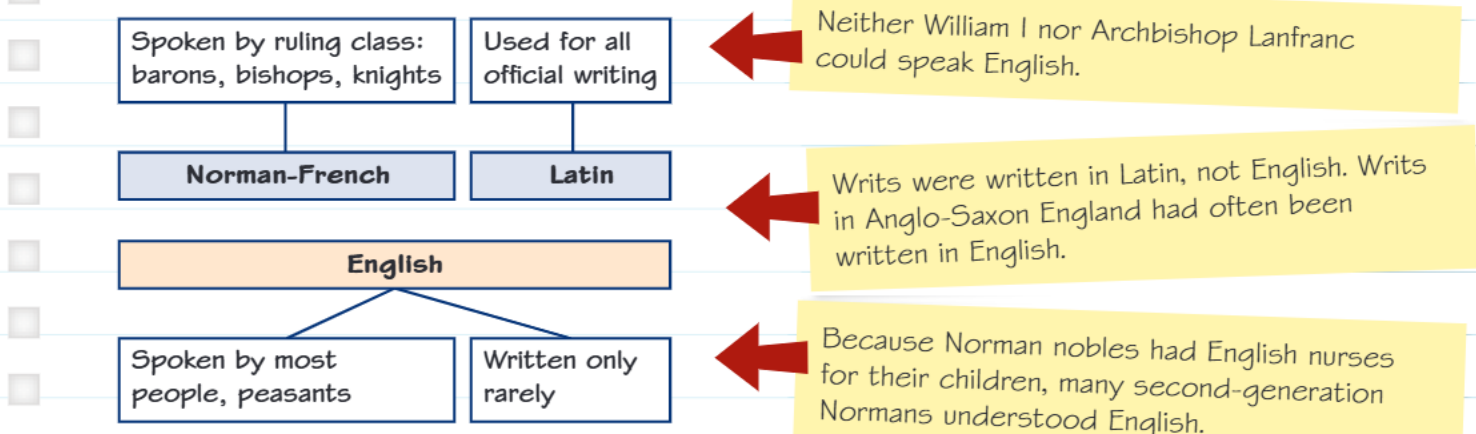
Note
The linguistic divisions created by the Norman Conquest weren't just about communication - they were powerful symbols of social status and political control that lasted for centuries.
The ruling class and Norman-French
The Norman elite, including barons, bishops, and knights, spoke exclusively Norman-French in their daily lives and official business. This linguistic separation reinforced their distinct identity as conquerors and rulers. Remarkably, even King William I and Archbishop Lanfranc were unable to communicate in English, demonstrating how the Norman leadership remained culturally separate from their English subjects.
Latin as the administrative language
All official government documents and writs transitioned to Latin under Norman rule. This represented a significant change from Anglo-Saxon England, where many official documents had been written in English. The adoption of Latin aligned English administrative practices with continental European standards and further emphasised Norman control over government institutions.
English among the common people
Despite Norman dominance at the top of society, English remained the primary spoken language for the majority of the population, particularly peasants and common folk. However, English was rarely used in written form during the early Norman period. An interesting development occurred with second-generation Normans, who often understood English because Norman noble families employed English nurses to care for their children, creating important cultural connections between the two communities.
Aristocratic culture and displays of wealth
Norman aristocrats developed markedly different cultural practices compared to their Anglo-Saxon predecessors, particularly in how they chose to display their wealth and establish their status.
Contrasting priorities
Anglo-Saxon aristocrats had typically invested their wealth in personal luxury items such as expensive clothing, elaborate jewellery, generous gifts, and lavish entertainment for their followers. Norman nobles took a fundamentally different approach, channelling their considerable resources into ambitious building projects, especially churches and cathedrals.
Important
This shift from personal luxury to architectural projects represented more than just different tastes - it was a strategic way for Normans to permanently mark the landscape and demonstrate their authority over conquered territory.
Architectural statements of power
Norman aristocrats used construction projects to demonstrate both their wealth and their authority over the landscape. They built massive structures using innovative and daring architectural techniques that made powerful visual statements about Norman dominance and sophistication.
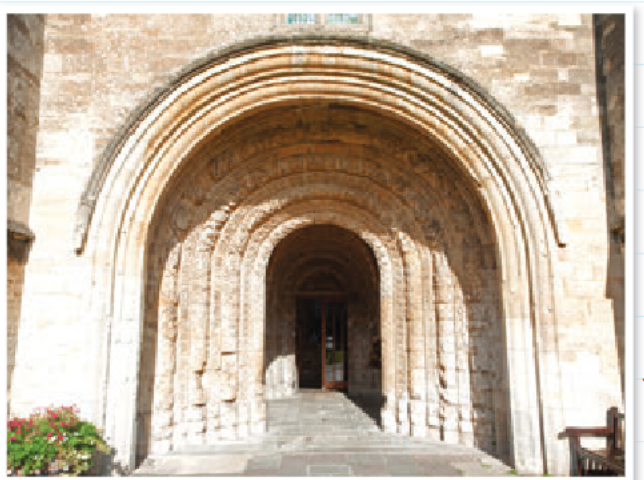
The elaborate stonework and multiple concentric arches of Norman religious buildings served both spiritual and political purposes, showing visitors the impressive resources and advanced building techniques available to the new ruling class.
Norman cultural practices and values
Revolutionary landholding system
The Normans introduced a completely different approach to inheritance that fundamentally strengthened aristocratic power. Under the traditional Anglo-Saxon system, earls and thegns typically divided their estates among multiple family members upon death, which often weakened individual holdings over time. Norman aristocrats rejected this practice entirely, instead ensuring that their entire estates passed to a single heir, keeping landholdings unified, powerful, and economically viable.
The development of chivalry
Chivalry emerged as a sophisticated moral code governing the behaviour of knights and nobles. This complex system of values attempted to reconcile seemingly contradictory elements: Christian teachings about mercy, protection of the weak, and service to God, alongside the celebration of martial prowess and military violence. Knights were expected to demonstrate both pious devotion and warrior skills, creating a unique aristocratic identity.
Note
The chivalric code wasn't just about battlefield behaviour - it encompassed everything from how nobles should treat their social inferiors to their obligations towards the Church and fellow aristocrats.
Religious obligations and penance
Norman nobles felt a profound religious responsibility to atone for the violence involved in conquering England and maintaining their rule over the native population. They believed they needed to perform penance for the bloodshed of invasion and ongoing control. This religious duty led to extensive church-building projects, generous donations to religious institutions, and regular prayer practices. The Normans also systematically replaced Anglo-Saxon religious traditions, demolishing many Anglo-Saxon churches and destroying tombs and relics of Anglo-Saxon and Celtic saints, whom they viewed as religiously questionable.
Timeline of Norman aristocratic development
- 1066: Norman Conquest establishes new aristocratic hierarchy
- 1066-1070: Transition from English to Latin in official documentation begins
- 1070s-1080s: Major Norman church construction projects commence
- Late 11th century: Second-generation Normans begin understanding English through cultural contact
- Throughout Norman period: Development and refinement of chivalric culture
Summary
Key Points to Remember:
- Language reflected social power: Norman-French for the ruling class, Latin for official business, English for the common people, creating clear social divisions
- Building projects over personal luxury: Normans invested in impressive architecture and churches rather than the clothing and jewellery favoured by Anglo-Saxon nobles
- Inheritance revolution: Norman estates passed to single heirs rather than being divided among family members, concentrating wealth and power
- Religious guilt and penance: Normans built churches and performed religious acts to atone for the violence of conquest and rule
- Cultural connections: English nurses caring for Norman children helped create understanding between the communities, especially among second-generation Normans