The sheriff and the forest (Edexcel GCSE History): Revision Notes
📚Revision Notes
The Domesday survey and Domesday book
Background and purpose
In December 1085, William I ordered a comprehensive investigation of England's landholdings. This survey aimed to identify who owned what land across the kingdom and determine what obligations these landowners had to the crown. The results of this massive undertaking were compiled into what became known as the Domesday Book.
The survey represented William's determination to understand and control his new realm more effectively. By gathering detailed information about land ownership, taxation, and resources, William could strengthen his authority over England and ensure maximum revenue from his territories.
Note
The name "Domesday Book" reflects the survey's comprehensive and final nature - like the Last Judgement (Doomsday), nothing could escape its record. The survey was so thorough that contemporaries compared it to the biblical Day of Judgement when all would be revealed.
The Domesday survey process
The survey involved a systematic examination of landholdings in each shire across England. Royal commissioners travelled throughout the country, investigating who held land, what taxes they currently paid, and whether they could contribute more to the royal treasury.
This investigation was remarkably thorough for its time. The commissioners gathered information not just about current landowners, but also about the previous Anglo-Saxon holders of the land. This helped establish the legal basis for Norman claims to English territories.
Important
By August 1086, the survey work was largely complete, demonstrating the impressive efficiency of the administrative system that William had inherited from the Anglo-Saxons and adapted for his own purposes. This completion time of less than a year was extraordinary for mediaeval standards.
Key facts and figures
The Domesday Book provides fascinating insights into 11th-century English society. The survey recorded approximately 13,400 place names throughout England, creating an invaluable snapshot of the country's settlements and administrative structure.
Population analysis based on the Domesday records suggests England had around 2 million inhabitants in the 1060s. The social breakdown recorded in the Book reveals the hierarchical nature of mediaeval society:
- 28,235 people held in slavery
- 110,000 villeins (peasants bound to their lords through labour obligations)
- 14,000 freemen who owned their own land
- 24,000 sokemen (a type of freeman with specific obligations)
- 1,000 tenants-in-chief who held land directly from the king
- 8,000 under-tenants who held land from the tenants-in-chief
Note
These figures only represent household heads, so historians estimate the total population by multiplying these numbers to account for entire families. The calculation suggests the total population was approximately inhabitants, making England one of the more densely populated regions of mediaeval Europe.
The three main uses of the Domesday book
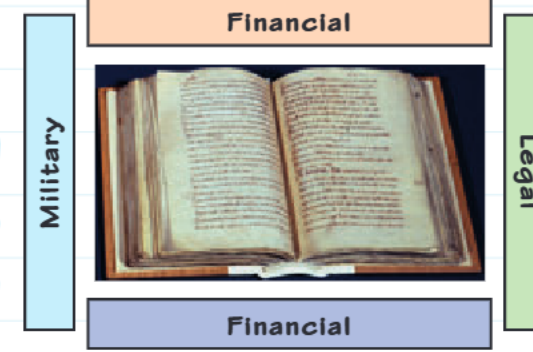
The Domesday Book served multiple crucial purposes for William's government, falling into three main categories:
Financial purposes
The survey enabled William to identify areas where landowners should be contributing more money to the royal treasury. It provided a comprehensive overview of England's wealth and resources, allowing for more effective taxation. The Book also helped resolve questions about land inheritance and the financial obligations that came with different properties.
Military applications
William could use the Domesday records to determine how many additional knights his tenants could provide for military service. The threat of Viking invasion in 1085 had prompted the original survey, and the resulting data helped William assess his military resources more accurately. The Book showed which landowners had the capacity to contribute more to England's defence.
Legal functions
The Domesday Book contained detailed records of land ownership claims, including information about previous Anglo-Saxon holders. This made it invaluable for settling legal disputes over land rights. Norman lords could use the Book to establish their legitimate claims to English territories, while the survey was conducted fairly, with input from local communities about ownership and boundaries.
Note
The three-fold purpose of the Domesday Book demonstrates the sophisticated nature of Norman administration. Unlike purely military conquests, the Normans sought to create a systematic and sustainable governmental structure that could effectively manage their new territory.
Significance for Norman control
The Domesday survey demonstrated the remarkable efficiency of Anglo-Saxon administrative systems, which the Normans had successfully adopted and adapted. The fact that such a comprehensive survey could be completed in less than a year shows the sophisticated governmental machinery that existed in England.
The handwriting analysis of the Domesday Book reveals that most records were written by a single scribe, almost certainly an Anglo-Saxon, since place names and personal names were spelled correctly according to Anglo-Saxon conventions rather than Norman ones. This suggests that William wisely utilised existing English administrative expertise.
Important
The Book also served as a powerful symbol of Norman authority. Its comprehensive nature meant that very little could be hidden from royal oversight, reinforcing William's control over his new kingdom. This represented a new level of governmental surveillance and control unprecedented in mediaeval Europe.
Timeline of key events
- December 1085: William I orders the Domesday survey following the threat of Viking invasion
- 1085-1086: Royal commissioners travel throughout England gathering information
- August 1086: Survey work is largely completed
- Post-1086: Results compiled into the Domesday Book for ongoing administrative use
Summary
Key Points to Remember:
- William I ordered the Domesday survey in December 1085 to better understand and control his English kingdom
- The survey was completed by August 1086, demonstrating impressive administrative efficiency
- The Domesday Book recorded 13,400 place names and provided detailed population data suggesting around 2 million inhabitants
- The Book served three main purposes: financial (taxation and inheritance), military (assessing knight service obligations), and legal (settling land disputes)
- The survey showed that Norman rulers successfully adapted and utilised existing Anglo-Saxon administrative systems rather than replacing them entirely