Castles (Edexcel GCSE History): Revision Notes
📚Revision Notes
Castles
Introduction to Norman castles
Norman motte and bailey castles were revolutionary defensive structures that were almost completely unknown in Anglo-Saxon England before 1066. These fortifications had both enormous military value and powerful psychological effects that helped William I establish and maintain control over his new kingdom. The introduction of these castles represented a dramatic change in English military architecture and marked a clear break from Anglo-Saxon defensive traditions.
Note
The term "revolutionary" is particularly important here - these castles introduced completely new military concepts to England that had never been seen before in Anglo-Saxon defensive systems.
Structure and features of motte and bailey castles
The motte and bailey castle was a carefully designed defensive system that maximised protection while remaining relatively quick to build. The design consisted of several key components that worked together to create an formidable fortress.
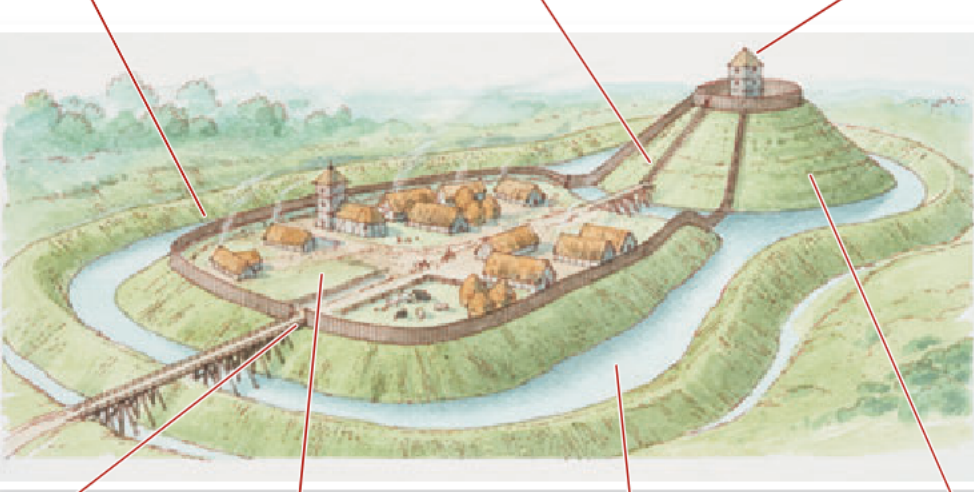
The motte formed the heart of the castle - this was a large artificial mound of earth that typically stood 5-7 metres high. Despite appearing natural, the motte was entirely man-made using local soil and required enormous amounts of manual labour to construct. The height advantage was crucial because it provided commanding views over the surrounding area and made attacks extremely difficult.
Note
The motte's artificial nature is often overlooked - these weren't natural hills that were fortified, but completely man-made earthworks requiring massive amounts of labour and engineering skill.
At the top of the motte stood the keep, a strong wooden tower that served multiple purposes. This elevated structure functioned as both a lookout point for spotting approaching enemies and an attack position where archers could rain down arrows on attackers. The keep also served as the final point of defence if the rest of the castle was overrun, providing a last refuge for the garrison.
Surrounding the base of the motte was the bailey - an enclosed courtyard area that was protected by a wooden fence called a palisade and additional outer defences. The bailey housed essential facilities including stables, barracks for troops, and storage areas. During peacetime, local people and livestock could take shelter within the bailey when danger threatened.
Note
The bailey wasn't just a military space - it served as a community refuge during times of conflict, showing how castles integrated with local civilian needs while maintaining their primary military function.
The entire complex was surrounded by defensive earthworks. A deep ditch was excavated around both the motte and bailey, and this ditch was often filled with water to create additional obstacles for attackers. The soil from digging the ditch was used to build up the motte and create defensive banks, making the construction process more efficient.
Access into the castle was carefully controlled through a fortified gatehouse. In some designs, a drawbridge could be raised over the ditch to completely cut off access, while others featured steep steps cut into the motte or wooden bridges that could be destroyed if the castle came under attack.
The palisade formed a crucial defensive barrier - this was a strong wooden fence made from solid timber posts driven deep into the ground. The fence was designed to be both sturdy and quick to build, and sometimes featured a double layer with earth packed between for extra strength.
Why castles were strategically important
Norman castles served multiple military and political functions that made them essential tools for controlling conquered territory. Their strategic value went far beyond simple defence, as they actively projected Norman power across the landscape.
Strategic positioning was crucial to their effectiveness. Castles were deliberately located in strategically important places, particularly at river crossings, major roads, and key transportation routes. This placement allowed the Norman garrison to monitor and control movement throughout their territory, keeping both the local population and any potential rebels under constant surveillance.
Important
The location of castles wasn't random - they were carefully positioned to control key strategic points that would allow Normans to dominate entire regions with relatively small garrisons.
Offensive military base capabilities made castles centres for active military operations rather than just defensive positions. When trouble arose in the surrounding area, a garrison of troops stationed in the castle could quickly ride out to suppress any disturbances or rebellions. If they encountered serious resistance, the same troops could retreat back to the safety of their castle's defences to regroup and call for reinforcements.
Area control and domination was achieved through the psychological impact of having a Norman stronghold overlooking local communities. When a town or village found itself under the shadow of a Norman castle, it created a constant reminder of foreign domination that made the local population feel intimidated and less likely to resist. This psychological warfare was often as effective as physical force in maintaining control.
Note
The psychological impact of castles cannot be underestimated - their imposing presence served as a 24/7 reminder to local populations that they were now under foreign rule.
How castles differed from Anglo-Saxon burhs
The contrast between Norman castles and existing Anglo-Saxon defensive structures reveals the revolutionary nature of the Norman approach to military architecture and territorial control.
Important
Understanding the differences between castles and burhs is crucial - they represent completely different military philosophies and approaches to controlling territory.
Purpose and function marked the most significant difference between the two systems. Burhs were designed to protect Anglo-Saxon communities and populations during times of war - they were essentially fortified towns where people could take refuge. Castles, by contrast, were built specifically to control and dominate Anglo-Saxon populations, serving as centres of foreign military occupation rather than community protection.
Size and scope also differed dramatically. Burhs were typically large defensive complexes designed to accommodate entire communities during sieges, with space for hundreds or even thousands of people along with their animals and possessions. Norman castles were much smaller and more focused, designed primarily as military installations with space mainly for the garrison and essential supplies.
Military strategy reflected completely different approaches to warfare and control. Burhs were part of a defensive network designed to protect existing communities from external invasion, particularly Viking raids. Castles represented an offensive strategy focused on projecting power outward from fortified bases to control conquered territory and suppress any resistance from the local population.
Example
Primary Source Evidence: Anglo-Saxon Chronicle
The Anglo-Saxon Chronicle provides contemporary evidence of how these changes were perceived by the English population. The chronicler recorded that the Normans were "building castles everywhere, oppressing the unhappy local people" and making things "always go from bad to worse".
This primary source demonstrates that the English clearly understood that castles represented a new and more oppressive form of military occupation.
Construction and timeline
The speed of castle construction was one of their greatest military advantages. Norman engineers and builders could complete a basic motte and bailey castle in just four to nine months, depending on the size and local conditions. This rapid construction was possible because the design relied heavily on earth and timber - materials that were readily available in most locations and could be worked by relatively unskilled labour.
Important
The speed of construction was a crucial military advantage - Normans could quickly establish fortified bases across conquered territory before local populations could organise effective resistance.
The construction process began with surveying and marking out the site, followed by the massive earthmoving project of creating the motte and digging the defensive ditch. Local populations were often forced to provide labour for these projects, turning castle building into another form of Norman domination over English communities.
Timeline of major events
- 1066: Battle of Hastings and Norman conquest begins
- 1066-1067: First wave of castle building begins immediately after conquest
- 1067-1070: Intensive castle construction period across England
- 1070s-1080s: Castle network expanded and consolidated
- 1087: Death of William I, with castle network firmly established
Summary
Key Points to Remember:
-
Revolutionary design: Motte and bailey castles introduced completely new military architecture to England, combining artificial earthworks with wooden fortifications for maximum defensive advantage.
-
Multi-purpose strategic tools: Castles served as military bases, administrative centres, and symbols of Norman domination, allowing control over large areas with relatively small garrisons.
-
Rapid construction advantage: The ability to build effective fortifications in just 4-9 months gave Normans a crucial military edge in consolidating control over conquered territory.
-
Psychological warfare: The imposing presence of castles created fear and intimidation among local populations, often proving as effective as actual military force in preventing rebellion.
-
Break from Anglo-Saxon tradition: Unlike defensive burhs that protected communities, Norman castles were designed specifically to control and dominate conquered populations, representing a fundamental shift in military strategy.