Establishing control (Edexcel GCSE History): Revision Notes
📚Revision Notes
Establishing control
After winning the Battle of Hastings in 1066, William faced the enormous challenge of establishing control over his new kingdom. He needed to secure the submission of the remaining English nobles, reward his supporters, and protect his realm's borders. William achieved this through a combination of intimidation, strategic rewards, and clever political manoeuvring.
The march on London
Following his victory at Hastings, William did not immediately attack London. Instead, he led his army on a devastating march through southeast England that served multiple strategic purposes.
After the battle, William and his troops initially marched to Dover, where they fell ill with dysentery. Once recovered, William chose not to attack London directly. The remaining English nobility in London had chosen Edgar the Aethling as Harold's successor, but crucially, they did not launch an attack against William while he was weakened at Dover.
William's march was deliberately brutal and destructive. His army moved through the countryside, destroying homes and farms as they went. Towns and villages were intimidated into surrender through this show of force. Rather than attacking London head-on, William led his army in a circle around the city to Berkhamsted, demonstrating his military strength and control over the surrounding area.
Note
This strategic approach served to cut London off from potential supplies and reinforcements while showing the English nobles that resistance would result in widespread destruction.
The submission of the earls
The English earls, including Edgar the Aethling, Edwin, Morcar, and others, ultimately chose to submit to William without putting up significant resistance. Several factors contributed to this crucial decision.
William had seized control of the royal treasury, which meant Edgar the Aethling had very limited resources to offer potential supporters or hire mercenaries. The devastating march around London demonstrated that continued resistance would likely result in further destruction and suffering for the English people.
Many of England's most experienced warriors had been killed at the Battle of Hastings, leaving the remaining English forces significantly weakened. The surviving English nobles may have questioned whether their victory truly had God's blessing, given their defeat at Hastings.
Important
Perhaps most importantly, the English leadership could not agree on what action to take. The earls should have attacked William when his forces were vulnerable at Dover, but their inability to coordinate an effective response ultimately sealed their fate.
William's reward system
William needed to balance rewarding his Norman supporters with maintaining some English cooperation. His approach involved a complex system of rewards and limitations that secured loyalty while reducing potential threats.
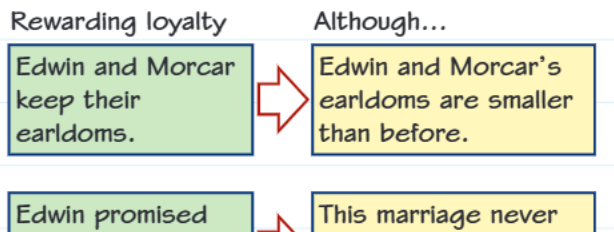
William kept some Anglo-Saxon nobles in positions of power as a reward for their submission. Edwin and Morcar were allowed to keep their earldoms, demonstrating that cooperation with the new regime could be beneficial. William also promised Edwin that he could marry William's daughter, creating a political alliance between Norman and English nobility.
However, these apparent rewards came with significant limitations. Edwin and Morcar's territories were actually reduced in size, limiting their power and resources. The promised marriage between Edwin and William's daughter never actually took place, showing that William's commitments to English nobles were often temporary or unfulfilled.
Example
Case Study: Gospatric's Appointment
Gospatric was made Earl of northern Northumbria, but he had to pay William a substantial sum for this privilege, turning the appointment into a financial transaction rather than a genuine reward. This demonstrates how William monetized even his apparent acts of generosity.
Most significantly, anyone who had fought against William at Hastings lost their land entirely. This property was then redistributed to William's Norman followers, fundamentally changing England's land ownership structure.
Rewarding Norman followers
William had made extensive promises to his supporters during the invasion, and fulfilling these commitments was essential for maintaining their loyalty and securing his rule.
William distributed lavish gifts, likely funded by wealth from the English royal treasury that he had seized. He established a heavy geld tax system to pay his mercenaries and professional soldiers, ensuring he could maintain military control.
Note
Most importantly, William declared that all land in England belonged to him personally. He then granted significant territories and earldoms to his most important followers, creating a new Norman aristocracy that owed their positions entirely to his favour.
Controlling the borderlands
William recognised that England's borders, particularly with Wales, required special attention and strong military leadership. His solution was to create three new earldoms along the Welsh border, known as the Marcher earldoms.
William appointed Hugh d'Avranches, William FitzOsbern, and Roger de Montgomery as the first three Marcher earls. These men had been among William's most loyal supporters during the invasion and had proven their military capabilities.
The Marcher earls received extraordinary powers that other English nobles did not possess:
- They could create new towns to promote Norman settlement in the border regions, helping to establish Norman control and culture in these strategic areas
- These earls had complete control over their territories, with their sheriffs reporting directly to them rather than to the king
- The Marcher earls were not required to pay tax on their lands to the crown, allowing them to invest heavily in defence
- They had the authority to build castles wherever they deemed necessary, creating a strong defensive network along England's vulnerable western border
Note
This financial independence allowed the Marcher earls to build castles and maintain strong military forces without depleting their resources, making them highly effective border defenders.
Timeline of key events
- October 1066: Battle of Hastings, Harold II killed
- October-November 1066: William's army falls ill at Dover
- November-December 1066: William's destructive march around London
- December 1066: English earls submit to William at Berkhamsted
- 1066-1067: William redistributes land to Norman followers
- 1067: Creation of the three Marcher earldoms
Summary
Key Points to Remember:
- William used intimidation rather than direct attack to secure London's submission, demonstrating strategic thinking over brute force
- The English earls submitted because they lacked resources, military strength, and unified leadership after Hastings
- William's reward system balanced keeping some English nobles loyal while ensuring Norman supporters received the greatest benefits
- The creation of Marcher earldoms with special powers was essential for defending England's borders with Wales
- All of William's actions were designed to establish Norman control while preventing future rebellions through a combination of rewards and limitations