Landownership, 1066-87 (Edexcel GCSE History): Revision Notes
📚Revision Notes
Landownership, 1066-87
Introduction to the Norman land revolution
One of the most significant long-term consequences of William's conquest was the complete transformation of England's landownership structure. The Norman Conquest led to the systematic removal of the Anglo-Saxon aristocracy from power, with their lands redistributed to Norman followers. This dramatic shift fundamentally changed English society and strengthened royal authority.
Note
This transformation was not just a change of ownership - it represented a complete restructuring of English society that would have lasting effects for centuries. The speed and thoroughness of this change was unprecedented in mediaeval European history.
The scale of change by 1087
The transformation of landownership was remarkably thorough and swift. Within just over twenty years of the conquest, the entire structure of English land holding had been revolutionised.
By 1087, the statistics reveal the extent of this change:
- More than half of England's land was controlled by just 190 tenants-in-chief
- Of these 190 major landholders, only two were Anglo-Saxons
- Anglo-Saxon aristocrats retained control of merely 5% of the land, mostly in small, scattered estates
- The king's royal estates comprised 20% of all land
- Church lands made up 25% of the total
Important
The statistic that only two Anglo-Saxons remained among the 190 major landholders demonstrates the almost complete elimination of the native aristocracy from positions of power and wealth.
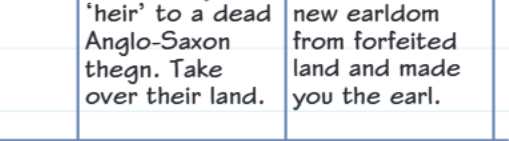
How land could be gained or lost
The redistribution of land followed several patterns, creating both opportunities for advancement and risks of losing everything. Understanding these mechanisms helps explain how the Normans secured their dominance so effectively.
Ways to lose land:
- Rebellion against the monarchy resulted in immediate forfeiture of all lands
- Legal disputes where sheriffs could seize land if owners couldn't prove their rights in Norman courts
- Financial difficulties - inability to afford redemption payments to the king meant losing ancestral lands
- Death without a clear heir, allowing the monarch to reclaim the estate
Ways to gain land:
- Royal favour could lead to inheritance of a dead Anglo-Saxon thegn's estates
- Military service and loyalty were rewarded with grants of forfeited lands
- The king could create new earldoms from confiscated territories
- Norman followers received land as payment for their support during the conquest
Important
The Norman legal system was fundamentally different from Anglo-Saxon law. Many Anglo-Saxons lost their lands not through rebellion, but because they couldn't prove their ownership rights under the new legal framework that favoured written documentation over traditional oral agreements.
Strengthened royal power
These landownership changes significantly increased William's authority and reduced the likelihood of future rebellions. The new system created multiple mechanisms for royal control.
The king gained power through several means. Anglo-Saxons who wanted to reclaim their ancestral lands had to pay William substantial redemption payments, generating royal revenue while demonstrating their submission. When landholders died, their heirs were required to pay inheritance fees to the monarch before taking possession. Most importantly, William could confiscate lands from anyone who opposed his rule, creating a powerful deterrent against rebellion.
Note
This system of financial obligations created a continuous stream of revenue for the crown while ensuring that landholders remained dependent on royal approval. It was a key innovation in mediaeval governance that strengthened monarchical power.
This system meant that all major landholders owed their position directly to royal favour, making them dependent on maintaining the king's approval.
Impact on different social groups
The conquest affected various social classes differently, with the changes being most dramatic for the nobility but also reaching down to affect peasants and free farmers.
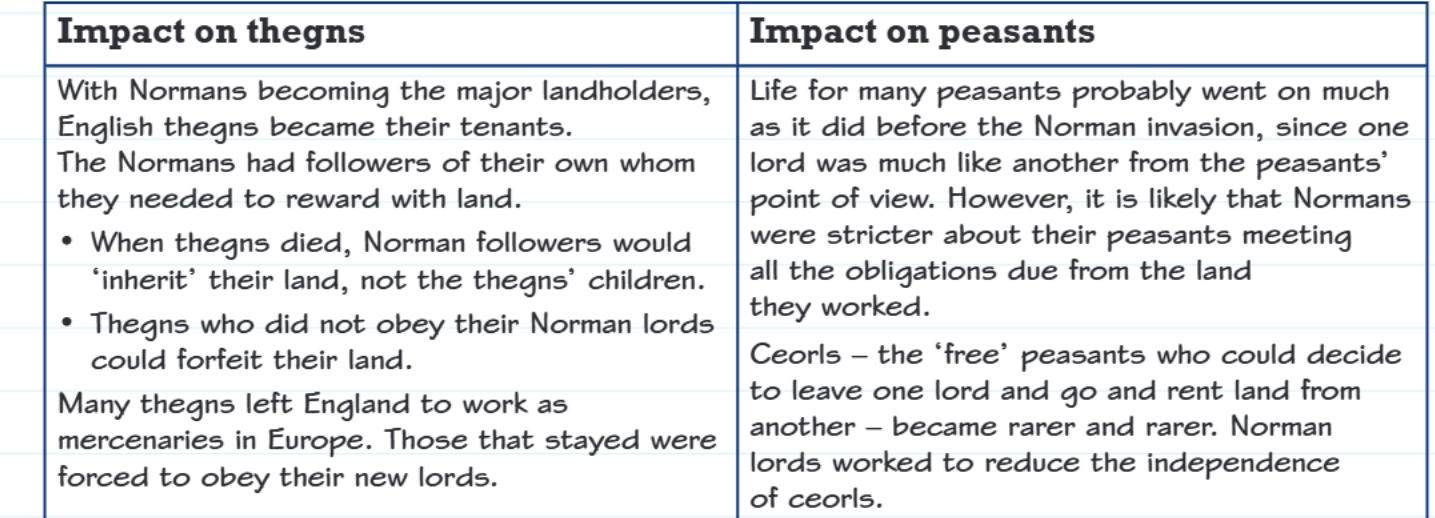
Effects on thegns
The Anglo-Saxon thegns, who had formed the backbone of pre-conquest English nobility, faced devastating changes to their status and prospects. With Normans becoming the primary landholders, English thegns were reduced to the position of tenants on lands their families may have owned for generations.
The new Norman system operated differently from Anglo-Saxon traditions. When thegns died, their lands typically passed to Norman followers rather than to the thegn's own children, breaking traditional inheritance patterns. Those thegns who failed to demonstrate absolute loyalty to their new Norman lords faced the constant threat of losing their remaining lands.
Example
Case Study: The Fate of English Thegns
Many thegns faced impossible choices after the conquest. They could:
- Accept reduced status as tenants under Norman lords
- Pay substantial sums to "redeem" their ancestral lands
- Leave England to seek fortune as mercenaries abroad
Contemporary sources suggest that significant numbers chose exile over submission, with many English nobles serving in Byzantine armies or other European courts.
Many thegns chose to leave England entirely, seeking employment as professional soldiers in other parts of Europe rather than accepting their reduced circumstances. Those who remained had to adapt to serving new masters and accepting a dramatically lower social position.
Effects on peasants
For the peasant population, life after the conquest showed both continuity and change. Many peasants experienced little immediate difference in their daily routines, as agricultural work continued much as before regardless of who owned the land.
However, Norman lords typically enforced obligations more strictly than their Anglo-Saxon predecessors. Peasants found themselves subject to more rigorous demands regarding labour services and payments owed to landowners.
The situation of ceorls - free peasants who had enjoyed certain rights under Anglo-Saxon law - deteriorated significantly. These formerly free farmers found their independence increasingly restricted as Norman lords worked to reduce their autonomy and bring them under tighter feudal control. Many ceorls discovered that their traditional freedoms were no longer recognised under Norman law.
Timeline of key events
- 1066: Norman Conquest begins the process of land redistribution
- 1067-70: Major rebellions lead to widespread confiscations, particularly in the North
- 1071: Edwin forfeits his lands after being killed by his own men
- 1070: Morcar loses his lands after joining rebellions
- 1087: By William's death, the transformation is complete with Normans controlling 95% of aristocratic lands
Summary
Key Points to Remember:
-
Complete transformation: Only 5% of land remained in Anglo-Saxon hands by 1087, showing the thoroughness of Norman control
-
Royal power increased: William used landownership changes to strengthen monarchy through inheritance fees, redemption payments, and the threat of forfeiture
-
Social hierarchy disrupted: Anglo-Saxon thegns lost their dominant position, becoming tenants of Norman lords or leaving England entirely
-
Peasant freedoms restricted: While daily life continued, Norman lords enforced obligations more strictly and reduced the independence of free peasants (ceorls)
-
Strategic redistribution: Land grants to Norman followers ensured loyalty while creating a new aristocracy dependent on royal favour