Crime in early modern England (Edexcel GCSE History): Revision Notes
📚Revision Notes
Crime in early modern England
Introduction
During the period between c1500 and c1700, England experienced massive social and religious transformations that significantly changed the nature of crime. While many traditional crimes from mediaeval times continued, new types of criminal activity emerged as society evolved. Understanding these changes helps explain why certain crimes became more common and how law enforcement adapted to new challenges.
Note
This period marked a crucial transition in English society, moving from mediaeval feudalism to early modern social structures. The changes in crime patterns directly reflect these broader societal transformations.
Social changes and their impact on crime
The early modern period brought three major social changes that directly influenced crime patterns. Each transformation created specific conditions that made certain types of criminal activity more likely to occur.
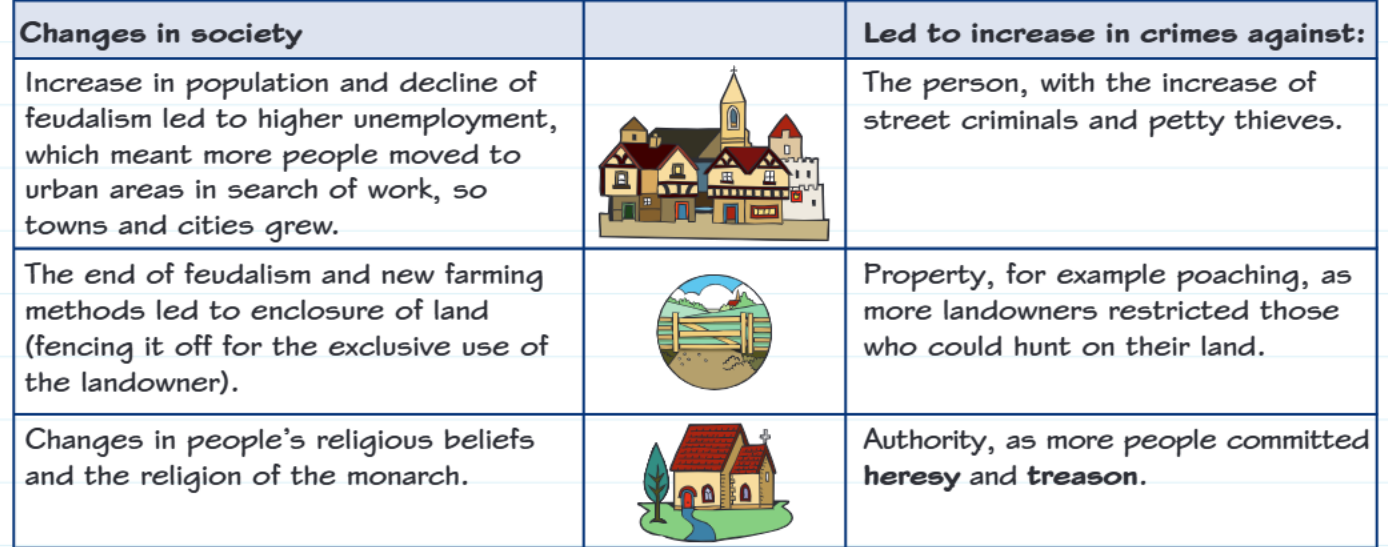
Population growth and urbanisation
As England's population increased and the feudal system declined, more people found themselves without work and moved to towns and cities seeking employment. This urbanisation created new opportunities for criminal activity, particularly crimes targeting individuals. Street crime and petty theft became much more common as larger numbers of people lived in closer proximity, creating both more potential victims and more desperate individuals willing to commit crimes to survive.
Important
The shift from rural to urban living fundamentally changed the nature of criminal opportunity. In rural areas, everyone knew each other, making crime difficult to conceal. In towns and cities, anonymity made criminal activity much easier to carry out.
The end of feudalism and land enclosure
The transformation of farming methods and the end of the feudal system led to significant changes in land ownership. Landowners began enclosing their land by fencing it off for their exclusive use, preventing common people from accessing areas they had traditionally used for hunting or gathering food. This change directly contributed to an increase in property crimes, particularly poaching, as people who had previously hunted legally now found themselves breaking the law when trying to obtain food in traditional ways.
Religious upheaval and changing beliefs
The period saw dramatic shifts in England's official religion and people's religious beliefs, particularly regarding the monarch's role as head of the Church. These changes created new categories of crime, specifically crimes against authority such as heresy and treason. As different monarchs promoted different religious practices, what had been acceptable under one ruler could become criminal under the next.
Types of crime in early modern England
Criminal activity during this period can be categorised into three main types, each reflecting different aspects of social change and conflict.
Note
The Three Main Categories of Crime:
-
Crimes against the person increased as urbanisation brought more people into contact with each other. Street criminals and petty thieves targeted individuals in towns and cities where anonymity was easier to maintain.
-
Crimes against property grew as land ownership patterns changed. Poaching became a significant issue as landowners restricted access to areas previously available for common use.
-
Crimes against authority became particularly prominent due to religious and political instability. These included both heresy and treason, which often became interlinked as religious and political loyalties conflicted.
Crimes against authority: heresy and treason
The most distinctive feature of crime in early modern England was the dramatic increase in offences against authority. This occurred because England was ruled by the Tudors and then the Stuarts during a time of intense religious change, leading to numerous rebellions and plots against monarchs.
Understanding heresy and treason
These crimes became more common because disputes arose about who should rule and what the official religion should be. The situation became particularly complex when the official religion changed from Catholic to Protestant and back again. Important members of both the Catholic and Protestant clergy played significant roles in challenging people with heresy charges and determining guilt.
An important development occurred in 1382 when heresy first became a crime. Both the Church and monarch felt threatened by beliefs that differed from official doctrine, so heresy was classified as a crime against authority and became punishable by death at the stake.
Important
The criminalization of heresy in 1382 marked a turning point in English legal history. For the first time, having different religious beliefs became not just a spiritual matter, but a criminal offence punishable by death.
The interlinked nature of religious and political crime
As monarchs became the head of the Church (except for Mary I), heresy and treason became closely connected. Someone who challenged the official religion was also challenging the monarch's authority, making religious dissent a form of political rebellion.

Timeline of key events
Example
Pattern of Religious Persecution Through Different Reigns:
1509-47: Henry VIII executed Protestants for heresy throughout his reign and Catholics for treason if they wouldn't accept Henry as head of the Church after 1534.
1547-53: Edward VI executed leaders of rebellions for treason and many Catholics for heresy.
1553-58: Mary I executed leaders of plots to replace her, and many Protestants (almost 300) for heresy.
1558-1603: Elizabeth I executed many 'rebels' for treason but far fewer for heresy.
1603-25: James I executed many Catholics for treason.
This timeline demonstrates how the same actions could be legal under one monarch and punishable by death under another, depending entirely on the ruler's religious preferences.
Key terms
Summary
Essential Definitions:
Treason: The crime of plotting or acting to overthrow or harm the ruler or country. During this period, treason charges often related to attempts to replace monarchs with rulers of different religious beliefs.
Heresy: The crime of having religious beliefs that were different from the official religion of the country. What constituted heresy changed depending on which monarch was in power and what their religious beliefs were.
Remember!
Summary
Key Points to Remember:
- Social changes in early modern England created new opportunities and motivations for different types of crime
- The three main impacts were urbanisation leading to street crime, land enclosure causing property crimes, and religious change creating authority crimes
- Heresy and treason became closely linked as monarchs took control of the Church
- Religious and political instability meant that what was legal under one ruler could become a capital offence under the next
- The period saw significant increases in all three types of crime: against the person, property, and authority