Reasons for the English victory (Edexcel GCSE History): Revision Notes
📚Revision Notes
Reasons for the English victory against the Spanish Armada (1588)
The Spanish threat and English response
In 1588, Philip II of Spain launched his massive invasion fleet - known as the Spanish Armada - against England. The Spanish plan required gaining control of the English Channel so that the Duke of Parma's troops could be safely transported from the Netherlands to invade England. However, the English navy had several crucial advantages that would ultimately lead to their victory.
Note
The Spanish strategy relied on a complex two-part plan: the Armada needed to control the Channel waters while simultaneously coordinating with Parma's land forces in the Netherlands. This coordination requirement would prove to be a critical weakness in the Spanish approach.
English naval advantages and tactics
The English understood that their survival depended on preventing the Spanish from achieving their strategic goals. Rather than engaging in traditional naval warfare, the English developed innovative tactics specifically designed to disrupt Spanish formations and prevent them from linking up with Parma's forces.
The key to English success lay in their superior naval tactics and ship design. English ships were generally faster and more manoeuvrable than their Spanish counterparts, allowing them to harass the Spanish fleet while avoiding close combat where Spanish soldiers might board English vessels.
Important
The English deliberately avoided the traditional tactic of boarding enemy ships - a method that favoured the Spanish with their larger crews of soldiers. Instead, they relied on superior firepower and mobility to attack from distance.
Timeline of the campaign
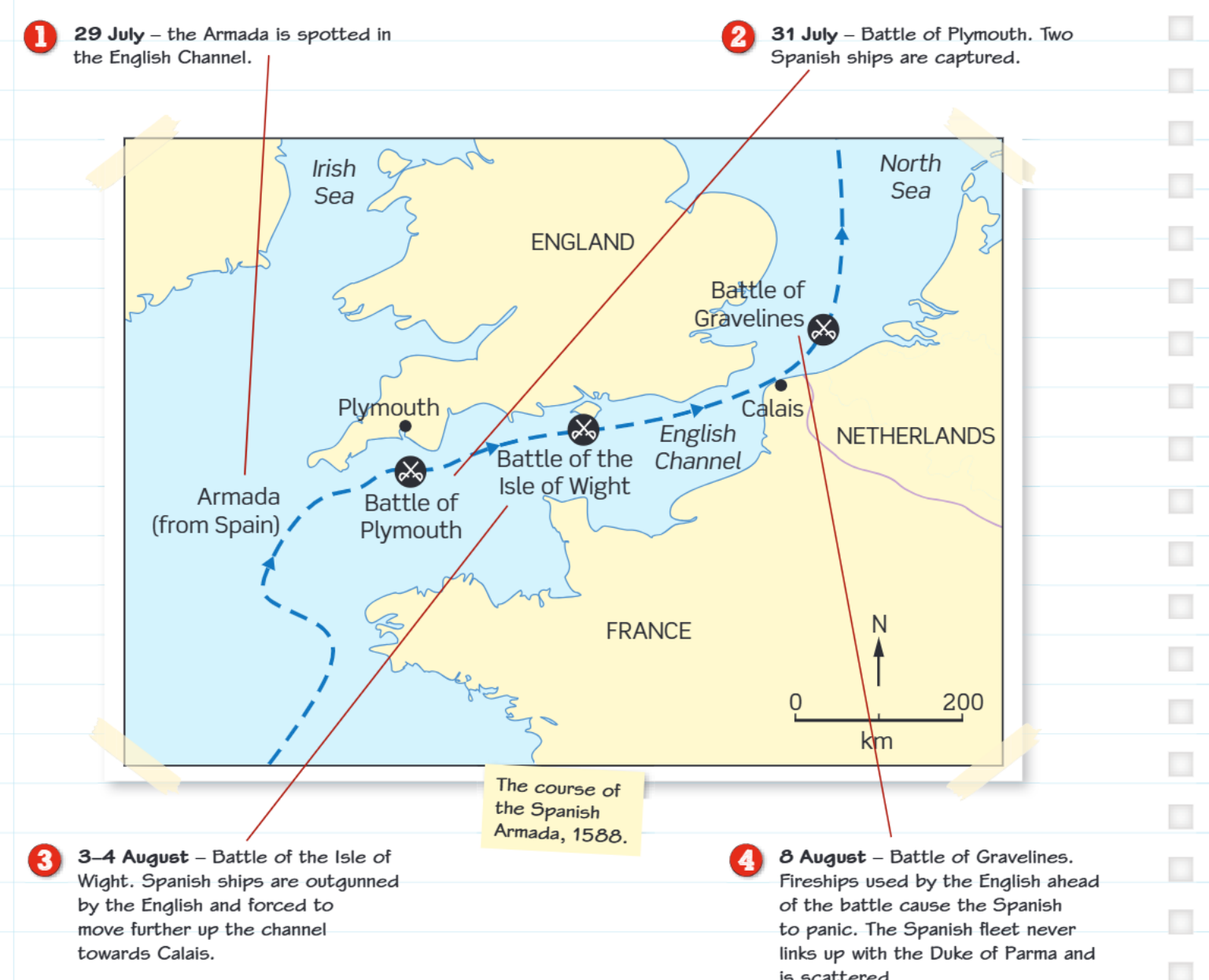
The campaign unfolded over approximately ten days in summer 1588:
- 29 July: Spanish Armada spotted entering the English Channel
- 31 July: Battle of Plymouth - English forces engaged the Spanish fleet, capturing two Spanish ships
- 3-4 August: Battle of the Isle of Wight - English ships outmanoeuvred Spanish vessels, forcing them to continue up the Channel towards Calais
- 8 August: Battle of Gravelines - The decisive engagement where English fireships scattered the Spanish fleet
The decisive battle of Gravelines
The Battle of Gravelines proved to be the turning point of the campaign. The English employed a devastating new tactic: fireships loaded with gunpowder and combustible materials were sent drifting into the Spanish fleet anchored near Calais. This caused panic among the Spanish sailors, forcing them to cut their anchor cables and scatter in disorder.
Example
The Fireship Tactic at Gravelines:
Step 1: English loaded old ships with gunpowder, pitch, and combustible materials Step 2: Ships were set on fire and sent drifting towards the Spanish fleet at night Step 3: Spanish captains, fearing explosion, cut their anchor cables to escape Step 4: Spanish formation broke apart, leaving individual ships vulnerable to attack Step 5: English warships moved in to attack the scattered Spanish vessels
Once the Spanish formation was broken, English warships moved in to attack individual Spanish vessels. The Spanish fleet never managed to regroup properly or link up with the Duke of Parma's invasion force, effectively ending their invasion plans.
Key factors in English success
Several interconnected factors contributed to the English victory:
Superior naval tactics: The English avoided the traditional tactic of boarding enemy ships, instead using their superior firepower and manoeuvrability to attack from a distance.
Innovative use of fireships: The deployment of fireships at Gravelines demonstrated English tactical creativity and caused devastating psychological impact on Spanish morale.
Strategic positioning: By maintaining control of the English Channel, the English prevented the crucial link-up between the Spanish fleet and Parma's army in the Netherlands.
Ship design advantages: English vessels were built for speed and agility, allowing them to dictate the terms of engagement throughout the campaign.
Weather conditions: After Gravelines, adverse weather conditions made it impossible for the Spanish to return through the English Channel, forcing them on the dangerous journey around Scotland and Ireland.
Important
The English victory was not due to superior numbers - the Spanish Armada was actually larger. Instead, it was the combination of tactical innovation, ship design, and strategic thinking that proved decisive.
Timeline of major events
- 1588, July 29: Spanish Armada sighted in English Channel
- 1588, July 31: First major engagement at Plymouth
- 1588, August 3-4: Running battles near Isle of Wight
- 1588, August 8: Decisive Battle of Gravelines with fireships
- 1588, August-September: Spanish retreat around Scotland and Ireland
Summary
Key Points to Remember:
- The English victory was achieved through superior naval tactics rather than larger numbers
- Fireships at Gravelines were the decisive weapon that broke Spanish formations
- Control of the English Channel prevented Spanish invasion plans from succeeding
- English ships were designed for speed and manoeuvrability, giving them tactical advantages
- The campaign lasted only ten days but changed the balance of European power