Spanish invasion plans (Edexcel GCSE History): Revision Notes
📚Revision Notes
Spanish invasion plans

Philip II of Spain had multiple compelling reasons for planning an invasion of England in 1588. This ambitious military campaign represented one of the most serious threats Elizabeth I would face during her reign, combining religious, political, and strategic motivations that made conflict almost inevitable.
Note
The Spanish Armada of 1588 was not just a military campaign - it represented a clash between two different worldviews: Catholic Spain and Protestant England, each seeing the other as an existential threat to their way of life.
Why did Philip decide to attack England?
Philip's decision to launch the Spanish Armada stemmed from four main categories of grievances that had built up over years of tension with Elizabeth's England.
Religious conflict
As a deeply devout Catholic monarch, Philip II viewed Protestant England as a religious threat that needed to be eliminated. The religious dimension of this conflict was personal and ideological for Philip. Elizabeth had been excommunicated by the Pope in 1570, which in Catholic eyes made her an illegitimate ruler who could be lawfully removed from power.
The Pope had promised absolution - complete forgiveness of sins - to anyone who participated in the Armada campaign. This religious blessing transformed what might have been seen as mere political warfare into a holy crusade in the minds of many Spanish Catholics. Philip genuinely believed he was carrying out God's work by removing a heretical queen and restoring Catholic rule to England.
Politics and diplomacy
Several international agreements had created a web of alliances that threatened Spanish interests. The Treaty of Joinville, signed in 1584, allowed Spain to attack England without risking war with France, removing a major diplomatic obstacle to invasion. Meanwhile, the Treaty of Nonsuch in 1585 saw England officially supporting Dutch rebels who were fighting against Spanish rule in the Netherlands.
Philip calculated that England would make a valuable addition to his empire, giving Spain complete control of Atlantic trade routes. The strategic position of England would also strengthen Spanish naval power and provide a base for further expansion.
Acts of provocation
English actions under Elizabeth had repeatedly challenged Spanish authority and economic interests. Sir Francis Drake's raids in the Americas had cost Spain enormous sums of money and damaged Spanish prestige. These weren't just random pirate attacks - they had Elizabeth's unofficial support and were part of England's broader strategy to weaken Spanish power.
Elizabeth's decision to provide military and financial support to Dutch rebels fighting Spanish rule was seen by Philip as direct interference in his territories. This support helped prolong a costly war that was draining Spanish resources and undermining Philip's authority.
Important
Common Misconception: Many students think Drake's raids were just piracy, but they were actually part of England's deliberate strategy to weaken Spain economically and politically. Elizabeth may not have officially endorsed them, but she certainly benefited from their success.
Changing circumstances
Recent developments had shifted the balance of power in ways that favoured Spanish invasion plans. Spain's acquisition of Portugal in 1580 had given Philip access to Portuguese ports and ships, significantly expanding his naval capabilities. This merger created the largest maritime empire in the world under Spanish control.
The Duke of Parma's military successes in the Netherlands since 1579 had secured Spain's position there and freed up experienced troops for other campaigns. Elizabeth's apparent hesitation to fully support the Dutch rebels was interpreted by Philip as a sign of English weakness that could be exploited.
Philip's invasion strategy
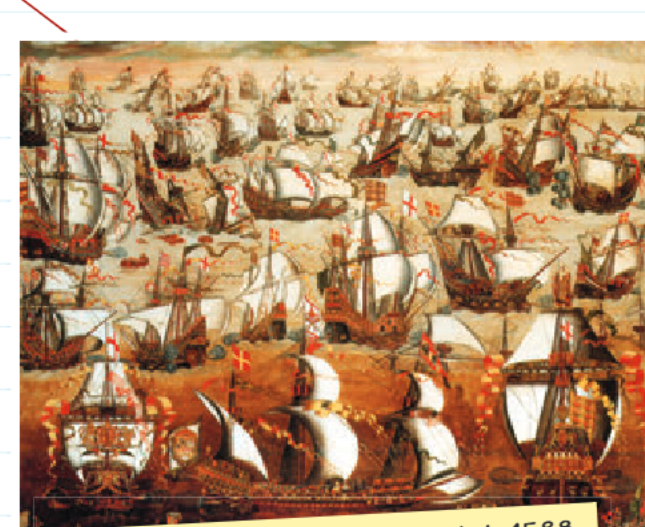
Philip developed an ambitious two-pronged strategy for conquering England. The plan required precise coordination between naval and land forces across hundreds of miles of sea.
The Spanish Armada consisted of 130 ships carrying 2,431 guns and approximately 30,000 troops. This massive fleet was ordered to sail along the English Channel towards the Netherlands, where it would rendezvous with additional Spanish forces under the command of the Duke of Parma.
Example
The Armada's Battle Plan:
Phase 1: The Spanish fleet would sail along the English Channel towards the Netherlands.
Phase 2: Rendezvous with the Duke of Parma's forces - an additional 27,000 seasoned troops waiting in the Netherlands.
Phase 3: Combined force would transport troops across the Channel to Kent.
Phase 4: March on London, capture Elizabeth, and establish a new Catholic government.
The entire plan depended on speed and overwhelming force to prevent English defences from organising an effective response.
Why the Armada represented such a serious threat
The Spanish invasion posed an existential threat to Elizabeth and Protestant England. If the Armada had succeeded, Elizabeth could have lost not only her throne but possibly her life. The consequences would have extended far beyond the royal court.
For English Protestants, including Elizabeth's Privy Councillors, a successful Spanish invasion would have meant the restoration of Catholicism and likely persecution of Protestant believers. Many viewed this conflict as a vital battle to preserve both their religion and their lives. The memory of Mary I's persecution of Protestants was still fresh, and many feared a return to those dark days.
Important
The Stakes Were Life and Death: A successful Spanish invasion would have fundamentally altered the balance of power in Europe for generations to come. Spanish control of England would have given Philip dominance over crucial Atlantic trade routes and strengthened Spain's already formidable empire.
Timeline of key events
- 1570: Pope excommunicates Elizabeth I
- 1579: Duke of Parma begins successful campaigns in Netherlands
- 1580: Spain acquires Portugal, expanding naval power
- 1584: Treaty of Joinville removes French obstacle to Spanish invasion
- 1585: Treaty of Nonsuch commits England to support Dutch rebels
- 1588: Philip II launches the Spanish Armada
Summary
Key Points to Remember:
-
Religious motivation was crucial - Philip saw the invasion as a holy war to restore Catholic rule and remove an excommunicated queen
-
Multiple causes combined - Religious conflict, political treaties, English provocations, and changing international circumstances all contributed to Philip's decision
-
The strategy was ambitious - Coordinating 130 ships with land forces across the Channel required precise timing and execution
-
The threat was existential - Success would have meant the end of Protestant England and Elizabeth's reign
-
International context mattered - Treaties and alliances shaped when and how Philip could launch his invasion