The execution of Mary, Queen of Scots (Edexcel GCSE History): Revision Notes
📚Revision Notes
The execution of Mary, Queen of Scots
Background to the execution
In February 1587, Elizabeth I made one of the most difficult decisions of her reign - she signed the death warrant for Mary, Queen of Scots. This decision came after years of plotting and political tension that threatened Elizabeth's rule and England's security.
Mary had been held prisoner in England since 1568, when she fled Scotland after being forced to abdicate her throne. As Elizabeth's Catholic cousin with a strong claim to the English throne, Mary became the focus of numerous plots to overthrow Elizabeth's Protestant government.
Note
The situation was incredibly complex for Elizabeth - Mary was both family and a fellow queen, yet also represented the greatest threat to Elizabeth's reign and England's Protestant settlement. This created a diplomatic and personal dilemma that Elizabeth tried to avoid resolving for nearly 20 years.
Why was Mary, Queen of Scots executed?
Catholic plots against Elizabeth
Mary's execution resulted from her involvement in several major Catholic conspiracies against Elizabeth's rule. These plots posed serious threats to both Elizabeth's life and England's Protestant settlement.
The key conspiracies that led to Mary's downfall included:
- The Revolt of the Northern Earls - an early Catholic uprising that established Mary as a figurehead for Catholic resistance
- The Ridolfi Plot - a plan to assassinate Elizabeth and place Mary on the throne with Spanish support
- The Throckmorton Plot - another Catholic conspiracy involving French backing
- The Babington Plot - the final conspiracy that directly implicated Mary in plans to murder Elizabeth
Important
The Babington Plot was particularly crucial because it provided the first concrete evidence of Mary's direct involvement in planning Elizabeth's assassination. Previous plots had centred around Mary, but this was the first time intercepted letters proved her active participation in treasonous activities.
Evidence from Walsingham's spy network
Sir Francis Walsingham, Elizabeth's spymaster, had built an extensive intelligence network that uncovered crucial evidence of Mary's involvement in these plots. His spies intercepted letters and communications that proved Mary was actively plotting against Elizabeth's life. This evidence led to Mary's trial and conviction under the Act for Preservation of the Queen's Safety - new legislation specifically designed to deal with threats to Elizabeth's life.
Example
How Walsingham's Spy Network Worked: The Babington Plot
Step 1: Walsingham's agents intercepted coded letters between Mary and Anthony Babington Step 2: The codes were broken by Walsingham's cryptographers Step 3: The decoded letters revealed Mary's approval of plans to assassinate Elizabeth Step 4: This evidence was used as proof of treason in Mary's trial
This sophisticated intelligence operation provided the concrete evidence Elizabeth's government needed to justify Mary's execution.
The Spanish threat
By 1587, the threat from Catholic Spain had reached dangerous levels. King Philip II of Spain had been involved in previous plots against Elizabeth, particularly the Ridolfi Plot. Rumours of a Spanish invasion were widespread, and Philip's support for Mary heightened the threat she represented. With Mary alive, any Spanish invasion could rally around her as an alternative Catholic monarch, making her continued existence a national security risk.
Mary as a Catholic rallying point
Even while imprisoned, Mary remained a powerful symbol for discontented English Catholics and foreign Catholic powers. The Pope had excommunicated Elizabeth in 1570, declaring her illegitimate and encouraging Catholics to depose her. This made Mary an alternative Catholic monarch who could potentially take the throne with support from abroad, giving international legitimacy to any invasion or uprising.
The significance of Mary's execution
Immediate consequences
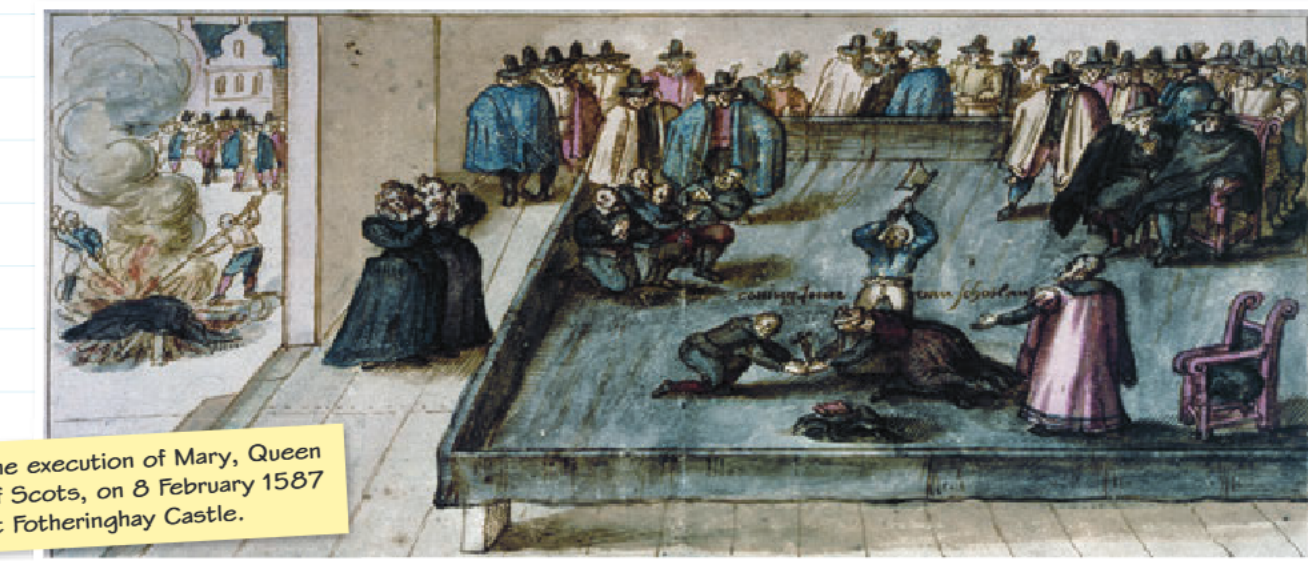
The execution of Mary on 8 February 1587 at Fotheringhay Castle had several important immediate effects. It removed a major threat to Elizabeth's security by eliminating the focal point of Catholic plots. However, it also created new problems - the execution made Elizabeth's own succession even more uncertain and increased the likelihood of civil war after her death.
International impact
Mary's execution had serious international consequences that Elizabeth had tried to avoid. It provided Philip II of Spain with additional justification for his planned invasion of England, as he could now claim to be avenging the death of a fellow Catholic monarch. The execution also set a dangerous precedent - by executing an anointed monarch, Elizabeth risked the same fate if she were ever overthrown.
Note
Elizabeth was acutely aware of the international implications. She famously hesitated for months before signing the death warrant and later claimed that her secretary had sent it without her explicit permission, trying to distance herself from the decision while still achieving the desired outcome.
Setting a precedent
The decision to execute Mary was historically significant because it established that even anointed monarchs could be held accountable for treason. This was a radical step that challenged traditional ideas about the divine right of kings and would have long-term implications for how monarchs could be treated by their subjects.
Timeline
1568 - Mary flees to England and becomes Elizabeth's prisoner 1570 - Pope excommunicates Elizabeth, making Mary an alternative Catholic claimant 1571 - Ridolfi Plot discovered and foiled 1583 - Throckmorton Plot uncovered by Walsingham's spies 1586 - Babington Plot provides direct evidence of Mary's involvement in assassination plans October 1586 - Mary tried and convicted under the Act for Preservation of the Queen's Safety February 1587 - Elizabeth signs Mary's death warrant 8 February 1587 - Mary executed at Fotheringhay Castle
Summary
Key Points to Remember:
- Mary's execution in February 1587 ended nearly 20 years of Catholic plots centred around her claim to the English throne
- The decision was driven by concrete evidence from Walsingham's spies showing Mary's direct involvement in assassination plots against Elizabeth
- The Spanish threat under Philip II made Mary's continued existence a serious national security risk for England
- While the execution removed an immediate threat, it also provided Spain with additional justification for invasion and made Elizabeth more vulnerable
- The execution set an important precedent that even anointed monarchs could be executed for treason, challenging traditional ideas about royal authority