The Ridolfi plot (Edexcel GCSE History): Revision Notes
📚Revision Notes
The Ridolfi plot
Introduction
The Ridolfi plot was one of several Catholic conspiracies against Elizabeth I that emerged after 1570. This dangerous scheme aimed to remove the Protestant queen from power and replace her with Mary, Queen of Scots, threatening the stability of Elizabethan England.
Background to the plot
The plot developed from growing tensions between the government and Catholics in England. After the failure of the Revolt of the Northern Earls and the Papal Bull of 1570, Elizabeth and her Privy Council became increasingly suspicious of Catholics. The Earl of Huntingdon, a committed Protestant, was appointed to lead the Council of the North and implemented strict laws against Catholics in northern England. This harsh treatment angered many Catholics, creating the perfect conditions for someone to plot against Elizabeth with the pope's support.
Note
The combination of the failed Northern Rebellion and the Pope's excommunication of Elizabeth in 1570 created a highly charged atmosphere of religious tension and political suspicion that made Catholic conspiracies almost inevitable.
The progress of the Ridolfi plot
The conspiracy unfolded through six key stages between 1571 and 1572:
Stage 1: The mastermind emerges Roberto Ridolfi, an Italian banker living in England, began working as a spy for the pope. His position gave him access to important English nobles and foreign contacts.
Stage 2: The plan takes shape (1571) Ridolfi developed an ambitious plot to murder Elizabeth, trigger a Spanish invasion, and place Mary, Queen of Scots on the English throne. The plan required Mary to marry the Duke of Norfolk, England's premier nobleman.
Stage 3: International support secured (March 1571) Ridolfi travelled to the Netherlands, which was under Spanish control at the time. There he met with the pope, Philip II of Spain, and the Duke of Alba, who commanded Spanish forces in the Netherlands. Crucially, Ridolfi carried a letter signed by Norfolk declaring himself a Catholic and promising to lead a rebellion with Philip's military support.
Stage 4: Spanish military preparations Philip II instructed the Duke of Alba to prepare 10,000 troops to send across the English Channel in support of the planned revolt, showing how seriously Spain took this opportunity to remove Elizabeth.
Stage 5: The plot unravels (1571) William Cecil, Elizabeth's chief minister, discovered the conspiracy. By the end of 1571, he had gathered enough evidence to prove Norfolk's guilt of high treason for plotting against Elizabeth. Ridolfi, realising the danger, remained abroad and never returned to England.
Stage 6: Parliamentary demands (May 1572) When Parliament reconvened in May 1572, it demanded the execution of both Norfolk and Mary, Queen of Scots. Elizabeth agreed to Norfolk's execution in June 1572, but she was reluctant to punish Mary and refused to remove her from the succession.
Important
International Nature of the Conspiracy
The Ridolfi plot was not just an English domestic conspiracy - it involved the highest levels of international Catholic leadership, including the Pope, Philip II of Spain, and the Duke of Alba. This made it one of the most serious threats Elizabeth faced, as it combined internal treason with the prospect of foreign invasion.
The significance of the Ridolfi plot
The conspiracy had far-reaching consequences for Elizabeth's reign and England's future security. Elizabeth had to proceed cautiously because executing Mary would further anger English Catholics and could unite France and Spain, Europe's two major Catholic powers, against her.
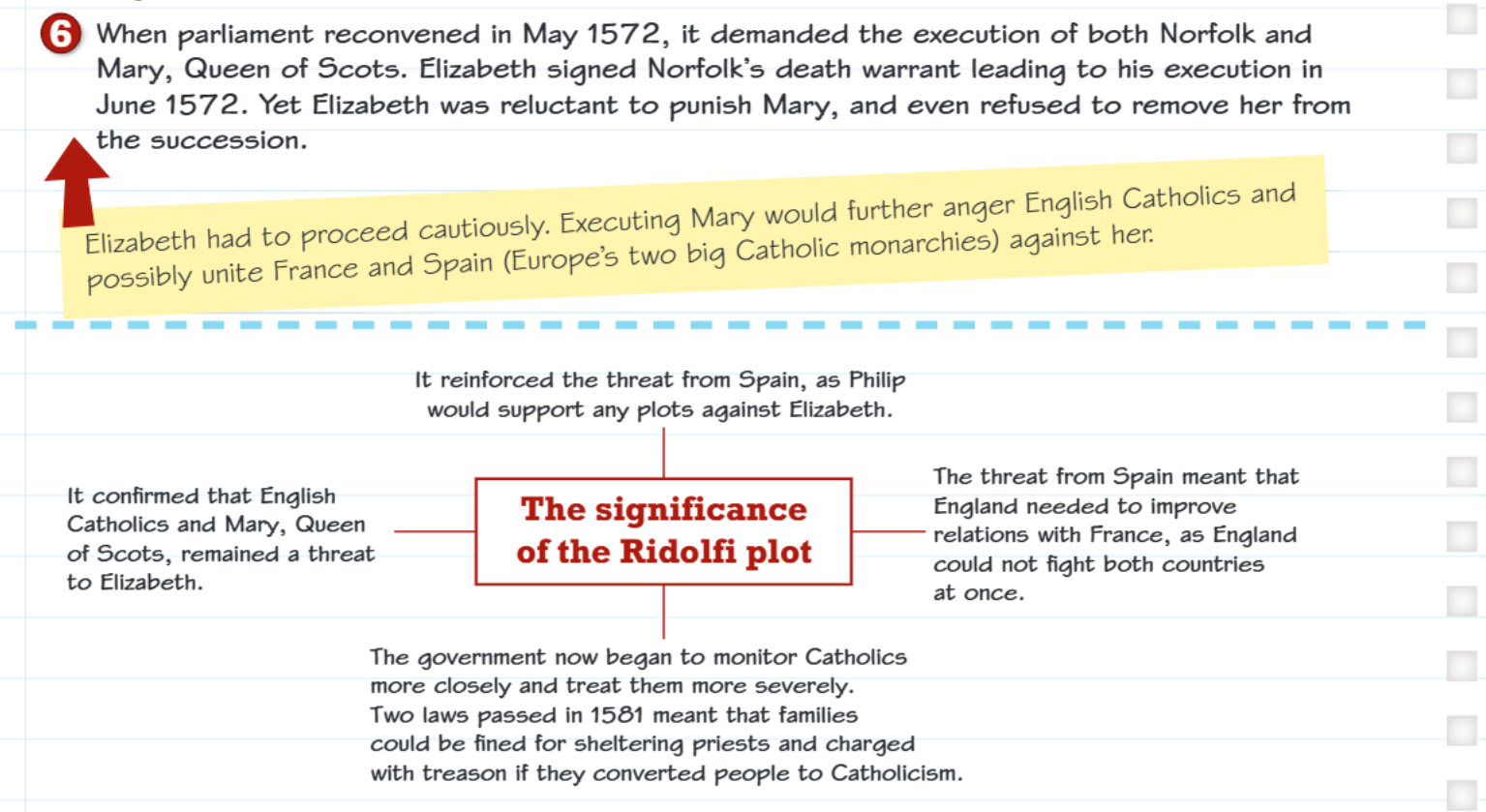
The plot confirmed that English Catholics and Mary, Queen of Scots remained a serious threat to Elizabeth's rule. It also reinforced the danger posed by Spain, as Philip II had shown his willingness to support plots against Elizabeth with military force. This Spanish threat meant England needed to improve its relationship with France, since the country could not fight both major Catholic powers simultaneously.
Note
Elizabeth's strategic thinking is evident in her decision to execute Norfolk but spare Mary. By removing the English conspirator while keeping the foreign claimant alive, she avoided giving Catholic powers a martyr while maintaining some diplomatic flexibility.
In response to these threats, the government began monitoring Catholics much more closely and treating them more severely. Two important laws were passed in 1581 that allowed families to be fined for sheltering priests and made it treason for people to convert to Catholicism. These measures showed how the Ridolfi plot had increased government paranoia about Catholic loyalty.
Timeline of the Ridolfi plot
- 1570: Papal Bull issued; Revolt of Northern Earls fails; Earl of Huntingdon implements anti-Catholic laws
- 1571: Ridolfi develops murder plot; travels to Netherlands in March; Spanish military preparations begin; William Cecil uncovers the conspiracy
- June 1572: Duke of Norfolk executed
- 1581: Anti-Catholic laws passed allowing fines for sheltering priests
Summary
Key Points to Remember:
- The Ridolfi plot was a Catholic conspiracy in 1571 that aimed to murder Elizabeth I and put Mary, Queen of Scots on the throne
- Roberto Ridolfi was an Italian banker who worked as a papal spy and organised the plot with international Catholic support
- The plot involved the Duke of Norfolk declaring himself Catholic and Philip II of Spain preparing 10,000 troops for invasion
- William Cecil discovered the plot, leading to Norfolk's execution in 1572, though Elizabeth spared Mary's life
- The conspiracy increased government suspicion of Catholics and led to stricter anti-Catholic laws being passed in 1581