Changing attitudes (Edexcel GCSE History): Revision Notes
📚Revision Notes
Changing attitudes to poverty in Elizabethan England
Introduction
During Elizabeth I's reign (1558-1588), English society experienced significant shifts in how people viewed and responded to poverty. The government developed new approaches to tackle the growing problem of the poor, showing both continuity with past practices and innovative changes that would shape social policy for centuries to come.
Note
This period marked a crucial transition in English social policy, as the government moved from largely religious and charitable responses to poverty towards more systematic, state-organized approaches that combined both support and control.
Changing attitudes towards the poor
Why attitudes began to shift
Several important factors influenced how Elizabethans thought about poverty during this period. The government and ordinary people became increasingly concerned about the potential for social unrest, as poverty was seen as a threat that could lead to disorder and rebellion. This fear motivated authorities to take more active steps in addressing the problem.
The financial burden of dealing with poverty also became a pressing concern. Local communities struggled with the rising costs of supporting the poor, particularly through the poor rates system that required local taxation. This economic pressure forced people to think more carefully about how resources should be allocated and who deserved help.
Note
Economic Context: The practice of enclosure was particularly significant during this period. As landowners converted agricultural land for more profitable sheep farming, entire rural communities were displaced, creating a new class of "masterless men" who had lost their traditional livelihoods through no fault of their own.
Population changes and the practice of enclosure significantly impacted attitudes as well. As agricultural land was converted for sheep farming, many rural workers lost their jobs and became displaced. This created a more visible population of disadvantaged people in Elizabethan England, making poverty a more urgent social issue that demanded attention.
Economic difficulties, including problems with the wool trade, poor harvests, and general economic instability, further complicated the situation. These circumstances pushed both the Crown and Parliament, along with local Justices of the Peace, to develop more structured and thoughtful approaches to addressing poverty.
Elizabethans and poverty - the crucial distinction
A fundamental shift in Elizabethan thinking was the clear distinction made between two different types of poor people. This classification became central to how society responded to poverty and shaped policy decisions throughout the period.
Important
The Fundamental Distinction:
The concept of the "deserving poor" referred to elderly individuals and sick people who genuinely could not help themselves due to physical limitations or circumstances beyond their control. Elizabethan society generally accepted that these people deserved assistance and support from the community.
In contrast, the "undeserving poor" were seen as those who had the ability to work but deliberately chose not to do so. This group faced much harsher treatment and was often viewed with suspicion by many Elizabethans.
The underlying principle was that everyone should be given opportunities to improve their situation, and those who genuinely could not should receive help. The most disadvantaged and impoverished people were sometimes classified as "vagabonds" and "criminals", and those who deceived others or threatened public order faced severe punishments including whipping, imprisonment, enslavement, or even execution in extreme cases.
Government policies and responses
The Elizabethan approach to poverty involved a complex mixture of supportive measures for those deemed deserving and punitive actions against those considered undeserving. This dual approach is clearly illustrated in the various policies implemented during this period.
Progressive measures - helping the deserving poor
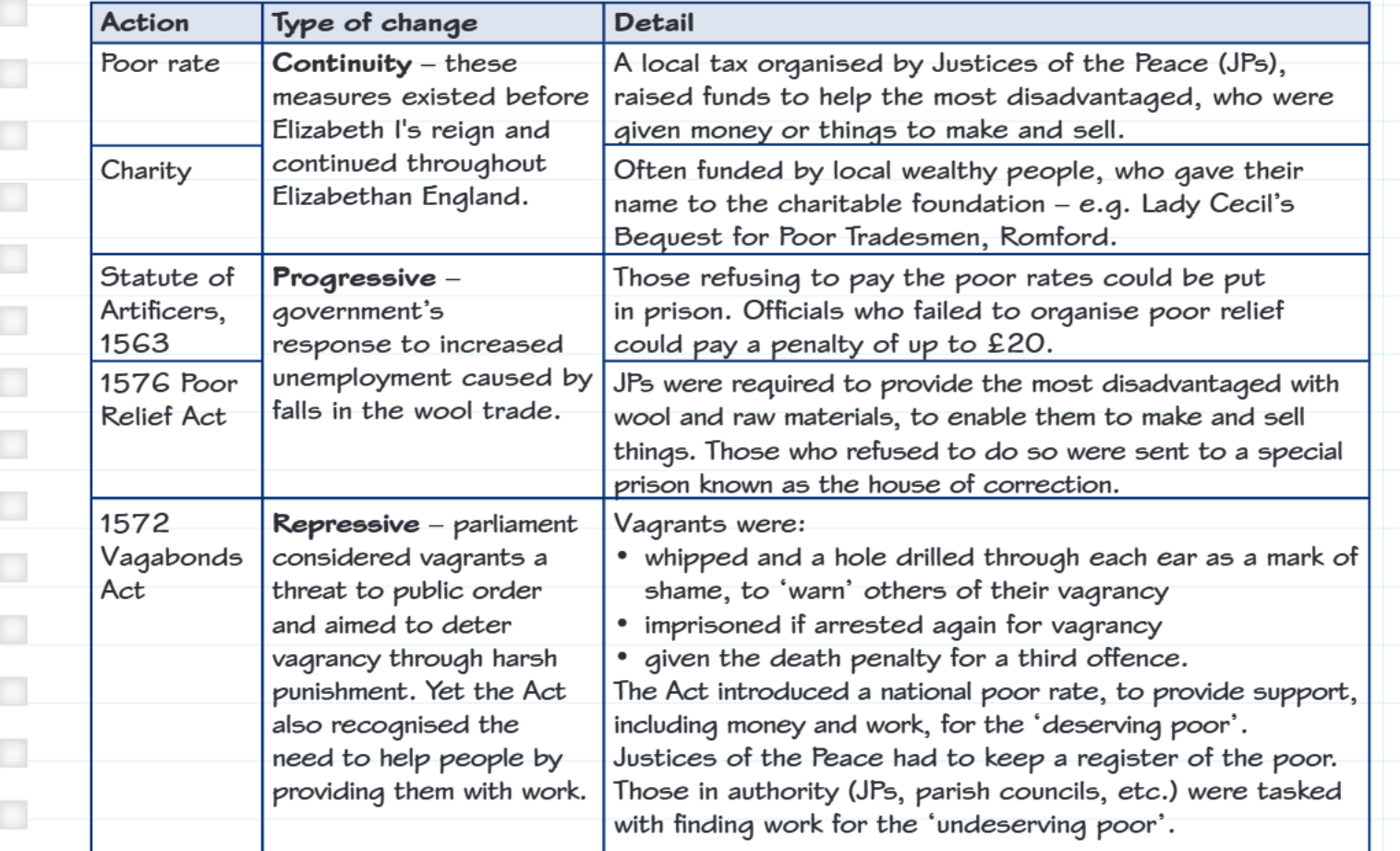
Several policies demonstrated the government's commitment to providing constructive assistance. The poor rate system, which had existed in some form before Elizabeth's reign, continued as a cornerstone of poor relief. Local taxes organised by Justices of the Peace raised funds to help the most disadvantaged members of society, providing them with money or materials to create and sell goods.
Example
Example: Lady Cecil's Bequest for Poor Tradesmen in Romford
This charitable foundation provided targeted support for specific groups in the community, demonstrating how wealthy individuals contributed to poor relief through named foundations. Such institutions became models for organised charitable giving that supplemented government poor rates.
Charitable foundations played an important role in this progressive approach. Wealthy individuals often funded charitable institutions, with some giving their names to these foundations.
The 1576 Poor Relief Act represented a significant step forwards in government thinking about unemployment. This legislation required Justices of the Peace to provide the most disadvantaged people with wool and raw materials, enabling them to create products they could sell for income. Those who refused this opportunity were sent to special institutions known as houses of correction, showing how the government balanced support with expectations of personal responsibility.
Repressive measures - controlling the undeserving poor
The 1572 Vagabonds Act demonstrates the harsh approach taken towards those deemed undeserving of help. Parliament viewed vagrants as a serious threat to public order and implemented severe punishments designed to deter vagrancy through fear and shame.
Important
Harsh Punishments for Vagrants:
The punishments outlined in this legislation were deliberately brutal and public. Vagrants could be whipped and have holes drilled through their ears as visible marks of their shame, intended to warn others about the consequences of vagrancy. Repeat offenders faced imprisonment, and those caught for a third time could receive the death penalty, showing how seriously the authorities treated this issue.
However, the Act also recognised that some people genuinely needed assistance and included provisions for helping deserving individuals through work opportunities. A national poor rate was introduced to provide both financial support and employment for the "deserving poor," while local authorities were given responsibility for maintaining registers of poor people and finding work for the "undeserving poor."
Key legislation timeline
- 1563: Statute of Artificers - Progressive government response to rising unemployment caused by problems in the wool trade
- 1572: Vagabonds Act - Repressive measures targeting vagrants with harsh punishments, but also introduced national poor rate
- 1576: Poor Relief Act - Required JPs to provide materials and work opportunities for the disadvantaged
Continuity and change
The Elizabethan approach to poverty showed both elements of continuity and significant change. Some measures, like poor rates and charitable giving, had existed before Elizabeth's reign and continued throughout this period. However, the government also introduced innovative approaches that represented genuine progress in social policy.
The balance between progressive assistance for deserving individuals and repressive control of undeserving groups became a defining characteristic of Elizabethan social policy. This approach influenced English attitudes towards poverty and social welfare for centuries to come, establishing principles that would continue to shape government responses to social problems long after Elizabeth's death.
Summary
Key Points to Remember:
- Elizabethans made a crucial distinction between the "deserving poor" (elderly, sick) and "undeserving poor" (able-bodied people who chose not to work)
- Government responses combined progressive measures (poor rates, work provision, charitable support) with repressive punishments (whipping, ear drilling, imprisonment, death penalty for repeat vagrants)
- Key legislation included the 1563 Statute of Artificers, 1572 Vagabonds Act, and 1576 Poor Relief Act, each addressing different aspects of the poverty problem
- Justices of the Peace played a central role in organising local taxation and poor relief throughout Elizabeth's reign
- The Elizabethan approach balanced continuity with existing practices and innovative changes that would influence English social policy for centuries